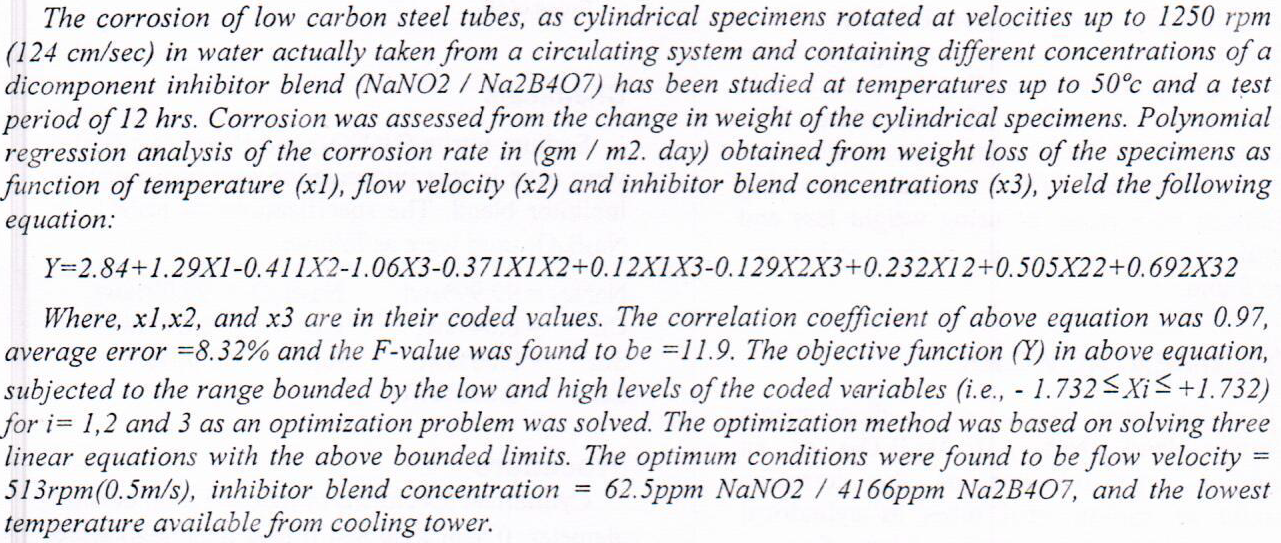
The Influence of Temperature and Flow Velocity on the Corrosion Inhibition of Low Carbon Tubes in Recirculating Water System by a Dicomponent Inhibitor Blend

Background: Decontamination of gutta percha cones was important factor for success of root canal treatment. The aim of the present in vitro study was to identify and to compare the antimicrobial effect of following disinfection solutions: 0.2% chlorhexidine gluconate, Iodine, tetracycline hydrochloride solution, EDTA & formocresol mixed with zinc oxide eugenol, on E faecalis, E coli and Candida albicans using sensitivity test Materials and Methods: Three types of microorganisms were isolated from infected root canals (E faecalis, E coli and Candida albicans) and cultured on Mueller Hinton agar petri-dishes. Disinfection of gutta percha cones done by immersion in six disinfection solutions (six groups), the groups are: distill water (used a
... Show MoreIn the present study, an attempt has been to develop a new water quality index (WQI) method that depends on the Iraqi specifications for drinking water (IQS 417, 2009) to assess the validity of the Euphrates River for drinking by classifying the quality of the river water at different stations along its entire reach inside the Iraqi lands. The proposed classifications by this method are: Excellent, Good, Acceptable, Poor, and Very poor. Eight water quality parameters have been selected to represent the quality of the river water these are: Ion Hydrogen Concentration (pH), Calcium (Ca), Magnesium (Mg), Sodium (Na), Chloride (Cl), Sulphate (SO_4), Nitrate (NO_3), and Total Dissolved Solids (TDS). The variation of the water quality parameters
... Show MoreIn the present study, an attempt has been to develop a new water quality index (WQI) method that depends on the Iraqi specifications for drinking water (IQS 417, 2009) to assess the validity of the Euphrates River for drinking by classifying the quality of the river water at different stations along its entire reach inside the Iraqi lands. The proposed classifications by this method are: Excellent, Good, Acceptable, Poor, and Very poor. Eight water quality parameters have been selected to represent the quality of the river water these are: Ion Hydrogen Concentration (pH), Calcium (Ca), Magnesium (Mg), Sodium (Na), Chloride (Cl), Sulphate (SO_4), Nitrate (NO_3), and Total Dissolved Solids (TDS). The variation of the water quality p
... Show More (24)

Phosphorus is usually the limiting nutrient for eutrophication in inland receiving waters; therefore, phosphorus concentrations must be controlled. In the present study, a series of jar test was conducted to evaluate the optimum pH, dosage and performance parameters for coagulants alum and calcium chloride. Phosphorus removal by alum was found to be highly pH dependent with an optimum pH of 5.7-6. At this pH an alum dosage of 80 mg/l removed 83 % of the total phosphorus. Better removal was achieved when the solution was buffered at pH = 6. Phosphorus removal was not affected by varying the slow mixing period; this is due to the fact that the reaction is relatively fast.
The dosage of calcium chloride and pH of solution play an importa
Background: Tap waters play an important role in fulfilling the people needs for drinking and domestic purposes. Contaminate the tap water with different pollutants has become an issue of great concern for 90% of people who are depended on the tap water as the main source of drinking. Pollutants can make their way easily into the delivering pipes which suffer from the leaking resulting in decreasing the quality of water. Objective: Therefore, assess the water quality for drinking purpose by calculating the water quality index is an important tool to ascertain whether the water is suitable for human consumption or not. Methods: In the present work, the water quality of the Al-Salam, western region of Baghdad city, Iraq was investigated for 7
... Show More (8)
 (30)
(22)

In an attempt to disposal from nuclear waste which threats our health and environments. Therefore we have to find appropriate method to immobilize nuclear waste. So, in this research the nuclear waste (Strontium hydroxide) was immobilized by Carbon nanotubes (CNTs). The Nd-YAG laser with wave length 1064 nm, energy 750 mJ and 100 pulses used to prepare CNTs. After that adding Sr(HO)2 powder to the CNTs colloidal in calculated rate to get homogenous mixing of CNTs-Sr(OH)2. The Sr(HO)2 absorbs carbon dioxide from the air to form strontium carbonate so, the new solution is CNTs-SrCO3. To dry solution putting three drops from the new solution on the glass slides. To investigate the radi
... Show More
(3)
Background: The quality of drinking water is directly related to community health. Therefore, improving the quality of drinking reflects positively on the health situation in general. The studies that deal with the quality of drinking water in the city of Baghdad in terms of chemical or microbial content are very scanty. Objective: The current review highlights the most important studies and research articles that concern the quality of drinking water, both bottled water and tap water, in terms of chemical and biological contamination and chemophysical specifications for drinking water. Abstract: Studies have shown that drinking water in the city of Baghdad, especially tap water, contains certain levels of heavy metals,
... Show More
(6)
(2)
A characteristic study of a passively Q-switched diode pumped solid state laser system is presented in this work. For laser a comparison study for the theoretically calculated results with a simulation results using a software which calculates the Q-switched solid state laser parameters was such as energy, peak power and pulse width were performed. There was a good agreement between our theoretical calculations and the simulation values.
(17)
(2)