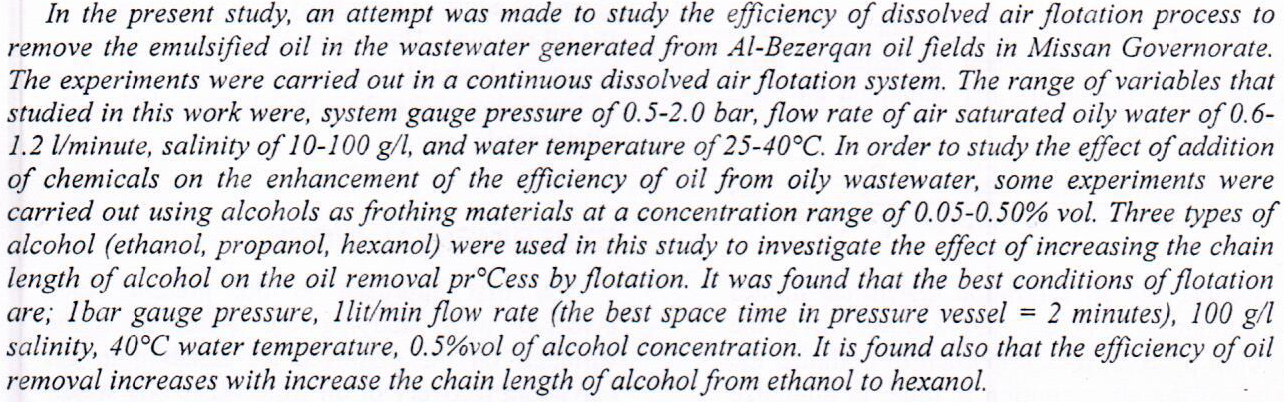
Oil Removal from Wastewater of Al-Bezerqan Crude Oil Fields by Air Flotation

 (2)
(2)
 (2)
(2)



Activated carbon derived from Ficus Binjamina agro-waste synthesized by pyro carbonic acid microwave method and treated with silicon oxide (SiO2) was used to enhance the adsorption capability of the malachite green (MG) dye. Three factors of concentration of dye, time of mixing, and the amount of activated carbon with four levels were used to investigate their effect on the MG removal efficiency. The results show that 0.4 g/L dosage, 80 mg/L dye concentration, and 40 min adsorption duration were found as an optimum conditions for 99.13% removal efficiency. The results also reveal that Freundlich isotherm and the pseudo-second-order kinetic models were the best models to describe the equilibrium adsorption data.
(7)
(3)
This study presents the results of atmospheric particulates sampling using high volume air sampler for selected places at Al Tuwaitha nuclear site. The collected samples were analyzed for gross alpha /beta radioactivity using Ludlum model 3030 and measurement particles activity in Al Tuwaitha nuclear site and the surrounding areas for the period from 28/12/2016 to 13/4/2017.The measurement of activity concentrations ranged from (0.42±0.03 to 4.18±0.13) Bq/m3 for alpha particles and from(0.93±0.06 to 9.21±0.26) Bq/m3for beta particles. The activity concentration of nuclides inversely proportional with air temperature and wind speed while humidity is directly proportional with it. Highest value of activity concentration has been found at(
... Show More
(7)
The study's objective is to produce Nano Graphene Oxide (GO) before using it for batch adsorption to remove heavy metals (Cadmium Cd+2, Nickel Ni+2, and Vanadium V+5) ions from industrial wastewater. The temperature effect (20-50) °C and initial concentration effect (100-800) mg L-1 on the adsorption process were studied. A simulation aqueous solution of the ions was used to identify the adsorption isotherms, and after the experimental data was collected, the sorption process was studied kinetically and thermodynamically. The Langmuir, Freundlich, and Temkin isotherm models were used to fit the data. The results showed that Cd, Ni, and V ions on the GO adsorbing surface matched the Langmuir model with correlation coefficients (R2)
... Show More
(6)
The study's objective is to produce Nano Graphene Oxide (GO) before using it for batch adsorption to remove heavy metals (Cadmium Cd+2, Nickel Ni+2, and Vanadium V+5) ions from industrial wastewater. The temperature effect (20-50) °C and initial concentration effect (100-800) mg L-1 on the adsorption process were studied. A simulation aqueous solution of the ions was used to identify the adsorption isotherms, and after the experimental data was collected, the sorption process was studied kinetically and thermodynamically. The Langmuir, Freundlich, and Temkin isotherm models were used to fit the data. The results showed that Cd, Ni, and V ions on the GO adsorbing surface matched the Langmuir mo
... Show More
(6)
This paper was aimed to study the efficiency of forward osmosis (FO) process as a new application for the treatment of wastewater from textile effluent and the factors affecting the performance of forward osmosis process.
The draw solutions used were magnesium chloride (MgCl2), and aluminum sulphate (Al2 ( SO4)3 .18 H2O), and the feed solutions used were reactive red, and disperse blue dyes.
Experimental work were includes operating the forward osmosis process using thin film composite (TFC) membrane as flat sheet for different draw solutions and feed solutions. The operating parameters studied were : draw solutions concentration (10 – 90 g/l), feed solutions concentration (5 – 30 mg/l), draw solutions flow rate (10 – 50 l/hr
(2)
This research addresses the employment of public relations for foreign oil corporate social responsibility programs operating in Iraq. It is a study of the programmes of six petroleum companies operating in Basra Governorate, which were selected for research as the highest production of Iraqi oil, as well as its enjoyment of strategic oil stores in Iraq.It contains the largest oil fields operatedby major international companies. This study aims at a number of objectives, notably the following:1)Recognize the most prominent corporate social responsibility projects and initiatives the companies have introduced to the local public.2)Investigate the extent to which the Iraqi publ
... Show More
There are still areas around the world suffer from severe shortage of freshwater supplies. Desalination technologies are not widely used due to their high energy usage, cost, and environmental damaging effects. In this study, a mathematical model of single-bed adsorption desalination system using silica gel-water as working pair is developed and validated via earlier experiments. A very good match between the model predictions and the experimental results is recorded. The objective is to reveal the factors affecting the productivity of fresh water and cooling effect in the solar adsorption system. The proposed model is setup for solving within the commercially-available software (Engineering Equation Solver). It is implemented to so
... Show More
(8)
(6)
The removal of COD from wastewater generated by petroleum refinery has been investigated by adopting electrocoagulation (EC) combined with adsorption using activated carbon (AC) derived from avocado seeds. The process variables influencing COD removal were studied: current density (2–10 mA/cm2), pH (4–9), and AC dosage (0.2–1 g/L). Response surface methodology (RSM) based on Box–Behnken design (BBD) was used to construct a mathematical model of the EC/AC process. Results showed that current density has the major effect on the COD removal with a percent of contribution 32.78% followed by pH while AC dosage has not a remarkable effect due to the good characteristics of AC derived from avocado seeds. Increasing current density gives be
... Show More
(4)
(5)