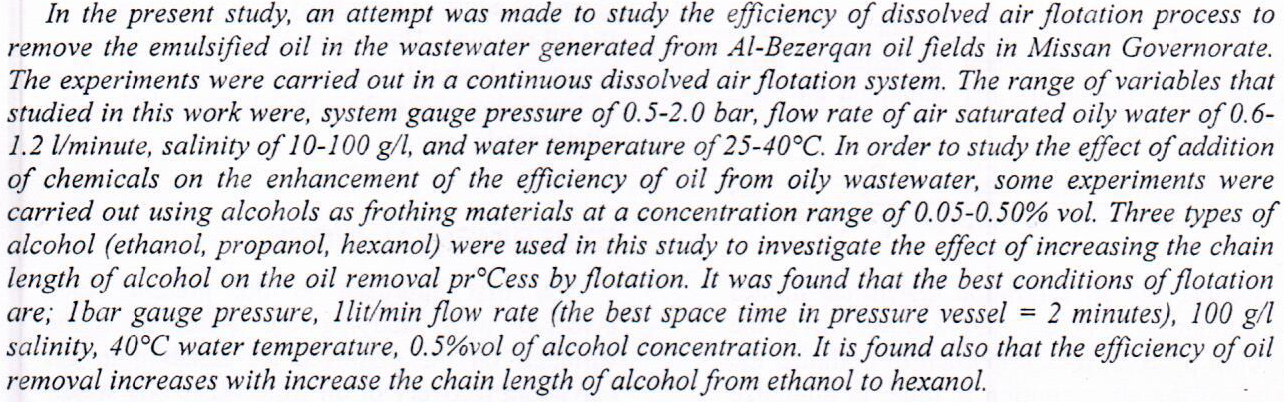
Oil Removal from Wastewater of Al-Bezerqan Crude Oil Fields by Air Flotation

 (2)
(2)
 (2)
(2)


This study aimed to evaluate the reservoir petrophysical properties (porosity, water saturation, and permeability) for optimal flow unit assessment within the Sadi Formation. Utilizing open hole logging data from five wells, the Sadi formation was divided into two rock units. The upper unit (A) is 45-50 meters thick, mainly consisting of limestone, mainly consisting of shaly limestone at the lower part. The lower unit (B) has a thickness of approximately 75-80 meters and is primarily composed of limestone, further subdivided into three subunits (B1, B2, B3). The average water resistivity is 0.04 ohm-m, and the average mud filtrate resistivity is 0.06 ohm-m. The Pickett plot was utilized to determine Archie parameters (tortuosit
... Show More
(1)
The applications of herbal medicine have recently acquired growing interest in range of the prophylaxis and treatment of diseases. Olibanum has been used since ancient eras and several reports studied the pharmacological characteristics of boswellic acid, particularly their effect on the inflammatory response, analgesic properties, and anti-arthritic activity mostly in cell lines, but new approaches include animal models to assess these natural derivatives effects taking into consideration of being safer than synthetic preparations. The impact of olibanum oil on several parameters was studied in rats during this study. These included white blood cell (WBC) count, lactate dehydrogenase (LDH), and C reactive protein (CRP), as well a
... Show More
(2)
An innovative two-step noncatalytic esterifcation technique was proposed to synthesize alkyl esters from free fatty acids simulated in waste cooking oil, as a pretreatment process for biodiesel production, without adding any catalyst under normal conditions of pressure and temperature. The efect of methanol:oil molar ratio, reaction time, mixing rate, and reaction temperature were investigated. The results confrmed that the conversion of the reaction was increased when increasing the methanol molar ratio and decreased in prolonged reaction temperature. High conversion (94.545%) was successfully achieved at optimized conditions of 115:1, 65:1 methanol:oil molar ratio in the frst step and second step, respectively, other conditions i
... Show More
(8)
In this study NiO - CoO bimetallic catalysts are prepared with two Ni/Co ratios (70:30 and 80: 20) using the precipitation method of nitrate salts. The effects of Ni /Co ratio and preparation methods on the catalyst are analyzed by using different characterization techniques, i.e. atomic absorption (AA) , XRD, surface area and pore volume measurements according to the BET method . The results indicate that the best catalyst is the one containing the percentage of Ni :Co ( 70 : 30 ). Experiments indicate that the optimal conditions to prepare catalyst are stirring for three hours at a temperature of 60oC of the preparation , pH= (8-9) , calcination temperature at 400oC for two hours
... Show More
The marketing logistic chain, as an integrated system aimed to balance the achievement of its main opposite objectives which represented in the access to the best service presented to the customer with lowest possible logistic costs especially the transportation costs, where encourages the researcher to choose the second objective as a field of this study in order to reduce the transportation costs in the final link of marketing logistic chain which related to delivering of fuel oil to the customer that falls within organizational responsibilities of the company under consideration (Oil Marketing Company) and also known in a brief name by (SOMO) through two methods, the first is by functioning quantative techniques by using trans
... Show More
Oilwell cementing operations are crucial for drilling and completion, preserving the well's productive life. However, weak and permeable formations pose a high risk of cement slurry loss, leading to failure. Lightweight cement, like foamed cement, is used to avoid these difficulties. This study is focused on creating a range of foamed slurry densities and examining the effect of gas concentration on their rheological properties. The foaming agent and foam stabilizer are tested, and the optimal concentration is determined to be 2% and 0.12%, respectively, by the weight of the cement.
Furthermore, the construction of samples of foam cement with different densities (0.8, 1.0, 1.2, 1.4, and 1.6) g/cc is performed to f
... Show More
(1)
(1)
Turbidity is a visual property of water that expresses the amount of suspended substances in the water. Its presence in quantities more significant than the permissible limit makes the water undrinkable and reduces the effectiveness of disinfectants in treating pathogens. On this basis, turbidity is used as a basic indicator for measuring water quality. This study aims to evaluate the removal efficiency of AL- Muthanna WTP. Water turbidity was used as a basic parameter in the evaluation, using performance improvement evaluation and data from previous years (2016 to 2020). The average raw water turbidity was 26.7 NTU, with a minimum of 14 NTU, with a maximum of 48 NTU. Water turbidity value for 95% of settling daily reading data was
... Show More
(6)
Turbidity is a visual property of water that expresses the amount of suspended substances in the water. Its presence in quantities more significant than the permissible limit makes the water undrinkable and reduces the effectiveness of disinfectants in treating pathogens. On this basis, turbidity is used as a basic indicator for measuring water quality. This study aims to evaluate the removal efficiency of AL- Muthanna WTP. Water turbidity was used as a basic parameter in the evaluation, using performance improvement evaluation and data from previous years (2016 to 2020). The average raw water turbidity was 26.7 NTU, with a minimum of 14 NTU, with a maximum of 48 NTU. Water turbidity value for 95% of settling daily readi
... Show More
(9)
(6)