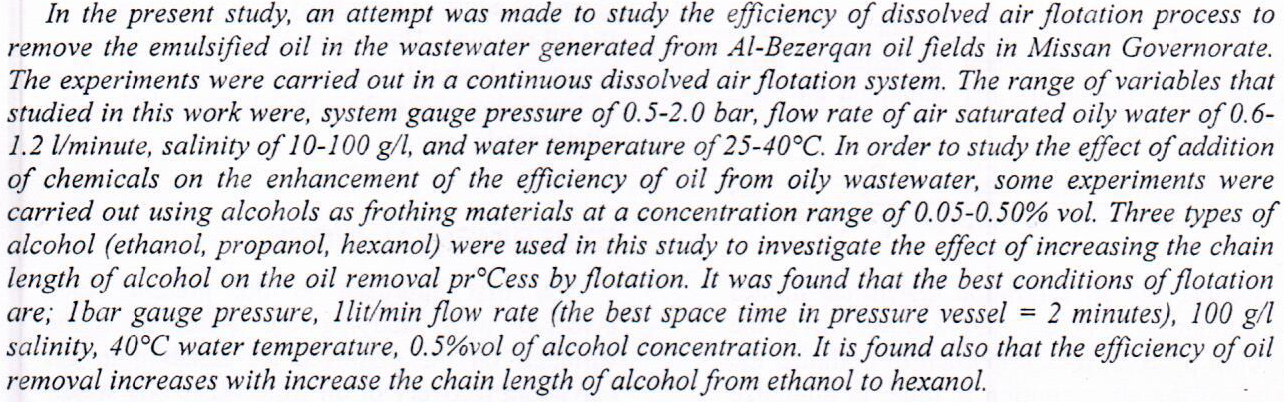
Oil Removal from Wastewater of Al-Bezerqan Crude Oil Fields by Air Flotation

Ultimate oil recovery and displacement efficiency at the pore-scale are controlled by the rock wettability thus there is a growing interest in the wetting behaviour of reservoir rocks as production from fractured oil-wet or mixed-wet limestone formations have remained a key challenge. Conventional waterflooding methods are inefficient in such formation due to poor spontaneous imbibition of water into the oil-wet rock capillaries. However, altering the wettability to water-wet could yield recovery of significant amounts of additional oil thus this study investigates the influence of nanoparticles on wettability alteration. The efficiency of various formulated zirconium-oxide (ZrO2) based nanofluids at different nanoparticle concentrations (0
... Show More (50)
(50)
 (37)
(37)


Oil sector is one of the most important sectors affecting the ecological balance, as activity contributes to the oil companies to influence their working environment, both during the oil exploration and extraction process or during transfer from one place to another process. We will try through this research put an environmental audit program proposal takes into account all the financial aspects, commitment and performance, according to the laws and regulations and agreements as well as relevant international standards, was based on research on the premise that the development of an environmental proposal auditing program that includes environmental controls on oil industry phases which helps reduce or minimize environmental pollutants B
... Show MoreBuzurgan oil Field which is located in south of Iraq has been producing oil for five decades that caused production to drop in many oil wells. This paper provides a technical and economical comparison between the ESP and gas lift in one oil well (Bu-16) to help enhancing production and maximize revenue. Prosper software was used to build, match and design the artificial lift method for the selected well, also to predict the well behavior at different water cut values and its effect on artificial lift method efficiency. The validity of software model was confirmed by matching, where the error difference value between actual and calculated data was (-1.77%).
The ESP results showed the durability of ESP regarding th
... Show MoreMany carbonate reservoirs in the world show a tilted in originally oil-water contact (OOWC) which requires a special consideration in the selection of the capillary pressure curves and an understanding of reservoir fluids distribution while initializing the reservoir simulation models.
An analytical model for predicting the capillary pressure across the interface that separates two immiscible fluids was derived from reservoir pressure transient analysis. The model reflected the entire interaction between the reservoir-aquifer fluids and rock properties measured under downhole reservoir conditions.
This model retained the natural coupling of oil reservoirs with the aquifer zone and treated them as an explicit-region composite system
The Zubair reservoir in the Abu-Amood field is considered a shaly sand reservoir in the south of Iraq. The geological model is created for identifying the facies, distributing the petrophysical properties and estimating the volume of hydrocarbon in place. When the data processing by Interactive Petrophysics (IP) software is completed and estimated the permeability reservoir by using the hydraulic unit method then, three main steps are applied to build the geological model, begins with creating a structural, facies and property models. five zones the reservoirs were divided (three reservoir units and two cap rocks) depending on the variation of petrophysical properties (porosity and permeability) that results from IP software interpr
... Show More
(7)
(1)
In this work, an experimental study has been done to expect the heat characteristics and performance of the forced-convection from a heated horizontal rectangular fins array to air inside a rectangular cross-section duct. Three several configurations of rectangular fins array have been employed. One configuration without notches and perforations (solid) and two configurations with combination of rectangular-notches and circular-perforations for two various area removal percentages from fins namely 18% notches-9% perforations and 9% notches-18% perforations are utilized. The rectangular fins dimensions and fins number are kept constant. The fins array is heated electrically from the base
... Show More
A plant mixture containing indigenous Australian plants was examined for synergistic antimicrobial activity using selected test microorganisms. This study aims to investigate antibacterial activities, antioxidant potential and the content of phenolic compounds in aqueous, ethanolic and peptide extracts of plant mixture
Well diffusion, minimum inhibitory concentration (MIC) and minimum bactericidal concentration (MBC) assays were used to test antibacterial activity against four pathogenic bacteria namely
(37)
(31)

The adsorption of hexavalent chromium by preparing activated carbon from date seeds with zinc chloride as chemical activator and granular date seeds was studied in a batch system. The characteristics of date seeds and prepared activated carbon (ZAC) were determined and found to have a surface area 500.01 m2/g and 1050.01 m2/g , respectively and iodine number of 485.78 mg/g and 1012.91 mg/g, respectively. The effects of PH value (2-12), initial sorbate concentration(50-450mg/L), adsorbent weight (0.004-0.036g) and contact time (30-150 min) on the adsorption process were studied . For Cr(VI) adsorption on ZAC, at 120 min time contact, pH solution 2 and 0.02 adsorbent weight will ach
... Show MoreThis work focuses on the use of biologically produced activated carbon for improving the physi-co-chemical properties of water samples obtained from the Tigris River. An eco-friendly and low-cost activated carbon was prepared from the Alhagi plant using potassium hydroxide (KOH) as an impregnation agent. The prepared activated carbon was characterised using Fourier-transform infrared spectroscopy to determine the functional groups that exist on the raw material (Alhagi plant) and Alhagi activated carbon (AAC). Scanning electron microscope–energy-dispersive X-ray spectroscope was also used to investigate the surface shape and the elements that compose the powder. Brunauer–Emmett–Teller surface area analysis was used to evaluate the spe
... Show More
(7)
The removal of Ibuprofen antibiotics (IBU) by photo-degradation UV/H2O2/Fe+2 system was investigated in a batch reactor under different initial concentrations of H2O2 (100-500) mg/L, Fe+2 (10-40) mg/L, pH (3-9) and initial concentrations of IBU (10-80) mg/L, and their relationship with the degradation efficiency were studied. The result demonstrated that the maximum elimination of IBU was 85.54% achieved at 300 mg/L of H2O2, 30 mg/L of Fe+2, pH=3, and irradiation time of 150 min, for 10 mg/L of IBU. The results have shown that the oxidation reagent H2O2 plays a very important role in IBU degradation.
(9)