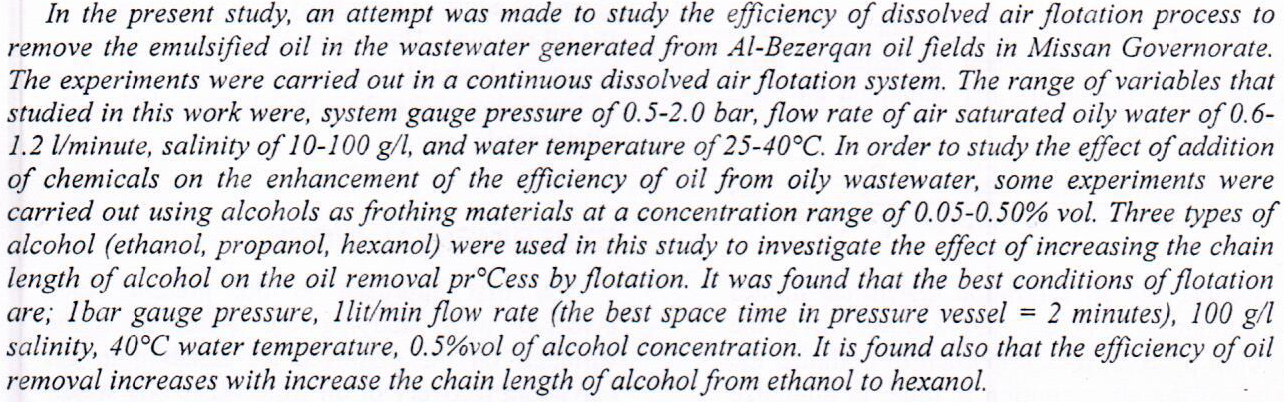
Oil Removal from Wastewater of Al-Bezerqan Crude Oil Fields by Air Flotation

 (7)
(7)
 (3)
(3)



Imposed on foreign oil companies from important sources in the financing of the general budget in most countries of the world income tax is considered as well as be used to achieve political, economic and social goals, and has developed the concept of the tax until it became play an important role in influencing the economic conditions of a country, and the aim of this research is to statement imposed on foreign oil companies operating in Iraq in the financing of the state budget income tax contribution, as well as clarify the contracts type contracts with these companies, which is in favor of Iraq, together with the Income Tax Law No. (19) for the year / 2010, and instructed No. (5) for the year / 2011, which organized the tax process s
... Show More
The research amid to find out the extent of Iraqi oil companies commitment to implement internal control procedures in accordance with the updated COSO framework. As the research problem was represented in the fact that many of the internal control procedures applied in the Iraqi oil companies are incompatible with most modern international frameworks for internal control, including the integrated COSO framework, issued by the Committee of Sponsoring Organizations of the Tradeway Committee. The research followed the quantitative approach to handling and analysing data by designing a checklist to represent the research tool for collecting data. The study population was represented in the Iraqi oil companies, while the study sample
... Show More
Abstract
Oil is considered a commodity and is still an important and prominent role in drawing and shaping the Iraqi economic scene. The revenues generated from the export of oil are considered the main source of the general budget in cash flows.
Since the revenues consist of quantity and price and the latter is an external factor which is difficult to predict, The effect of any commodity on its price, which is proven in the theory of micro-economic, but it is observed through the research that the response is slow, which means not to take advantage of the rise in prices, by increasing the quantity exported, the result of several facto
... Show More
Phosphorus is usually the limiting nutrient for eutrophication in inland receiving waters; therefore, phosphorus concentrations must be controlled. In the present study, a series of jar test was conducted to evaluate the optimum pH, dosage and performance parameters for coagulants alum and calcium chloride. Phosphorus removal by alum was found to be highly pH dependent with an optimum pH of 5.7-6. At this pH an alum dosage of 80 mg/l removed 83 % of the total phosphorus. Better removal was achieved when the solution was buffered at pH = 6. Phosphorus removal was not affected by varying the slow mixing period; this is due to the fact that the reaction is relatively fast.
The dosage of calcium chloride and pH of solution play an importa
(36)
(25)
Reservoir study has been developed in order to get a full interesting of the Nahr Umr formation in Ratawi oil field. Oil in place has been calculated for Nahr Umr which was 2981.37 MM BBL. Several runs have been performed to get matching between measured and calculated of oil production data and well test pressure. In order to get the optimum performance of Nahr Umr many strategies have been proposed in this study where vertical and horizontal wells were involved in addition to different production rates. The reservoir was first assumed to be developed with vertical wells only using production rate of (80000–125000) STB/day. The reservoir is also proposed to produce using horizontal wells besides vertical wells with production rat
... Show More
To verify the influence of magnetic flux on the characteristics of SAE 10W-30 gasoline engine oil when the engine oil is exposed to different magnetic fluxes 0, 6, 9, and 13 Volt. The following oil characteristics were measured: viscosity at 40 and 100 °C, and total acid number (TAN) mg KOH/g. The research was carried out in a completely randomized design with three replications for each treatment under the 5% probability level to compare the means of the treatments. The results of the experiment showed that there were significant differences in the studied properties when the engine oil was exposed to the above magnetic fluxes and, inversely, especially the magnetic flux of 13 Volt, which led to a decrease in the viscosity of the oils at
... Show MorePetrophysical characterization is the most important stage in reservoir management. The main purpose of this study is to evaluate reservoir properties and lithological identification of Nahr Umar Formation in Nasiriya oil field. The available well logs are (sonic, density, neutron, gamma-ray, SP, and resistivity logs). The petrophysical parameters such as the volume of clay, porosity, permeability, water saturation, were computed and interpreted using IP4.4 software. The lithology prediction of Nahr Umar formation was carried out by sonic -density cross plot technique. Nahr Umar Formation was divided into five units based on well logs interpretation and petrophysical Analysis: Nu-1 to Nu-5. The formation lithology is mainly
... Show More