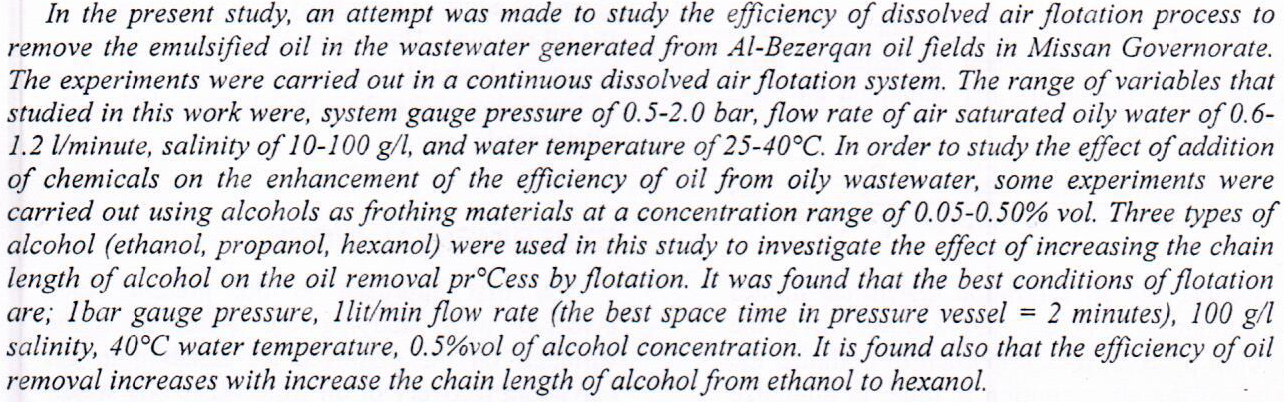
Oil Removal from Wastewater of Al-Bezerqan Crude Oil Fields by Air Flotation

The Sequencing Batch Reactor system (SBR) is a major component of the municipal wastewater biological treatment system and water reclamation that provides high-quality water that could be reused in restricted plants that which require large quantities of water despite the lack of water. The research aims to investigate the performance of a pilot plant SBR unit under real operation conditions that was installed and operated in Al-Rustamiya Wastewater Treatment Plant (WWTP), Baghdad, Iraq. Results showed that the BOD5/COD ratio of the raw wastewater was within the average value at 0.66 emphasizing the organic nature of the influent flow and hence the amenability to biological treatment. The results also ensured that the treatment pro
... Show MoreA simple, accurate, precise, rapid, economical and a high sensitive spectrophotometric method has been developed for the determination of tadalafil in pharmaceutical preparations and industrial wastewater samples, which shows a maximum absorbance at 204 nm in 1:1 ethanol-water. Beer's law was obeyed in the range of 1-7?g/ mL ,with molar absorptivity and Sandell ? s sensitivity of 0.783x10⁵l/mol.cm and 4.97 ng/cm2respectively, relative standard deviation of the method was less than 1.7%, and accuracy (average recovery %) was 100 ± 0. 13. The limits of detection and quantitation are 0.18 and 0.54 µg .ml-1, respectively. The method was successfully applied to the determination of tadalafil in some pharmaceutical formulations
... Show More (2)
(2)

Treatment of a high strength acidic industrial wastewater was attempted by activated carbon
adsorption to evaluate the feasibility of yielding effluents of reusable qualities. The experimental
methods which were employed in this investigation included batch and column studies. The
former was used to evaluate the rate and equilibrium of carbon adsorption, while the latter was
used to determine treatment efficiencies and performance characteristics. Fixed bed and expanded
bed adsorbers were constructed in the column studies. In this study, the adsorption behavior of acetic acid onto activated carbon was examined as a function of the concentration of the adsorbate, contact time and adsorbent dosage. The adsorption data was mo
In the present study, advanced oxidation treatment, the TiO2 /UV/H2O2 process was applied to decolorisation of the reactive yellow dyes in aqueous solution. The UV radiation was carried out with a 6 W low-pressure mercury lamp. The rate of color removal was studied by measuring the absorbency at a characteristic wavelength. The effects of H2O2 dosage, dye initial concentration and pH on decolorisation kinetics in the batch photoreactor were investigated. The highest decolorisation rates were observed (98.8) at pH range between 3 and 7. The optimal levels of H2O2 needed for the process were examined. It appears that high levels of H2O2 could reduce decolori
... Show More
(23)
Infrastructure, especially wastewater projects, plays an important role in the life of residential communities. Due to the increasing population growth, there is also a significant increase in residential and commercial facilities. This research aims to develop two models for predicting the cost and time of wastewater projects according to independent variables affecting them. These variables have been determined through a questionnaire distributed to 20 projects under construction in Al-Kut City/ Wasit Governorate/Iraq. The researcher used artificial neural network technology to develop the models. The results showed that the coefficient of correlation R between actual and predicted values were 99.4% and 99 %, MAPE was
... Show More
(4)
KE Sharquie, AA Noaimi, HA Al-Mudaris, Journal of Cosmetics, Dermatological Sciences and Applications, 2012 - Cited by 6
Acinetobacter baumannii ability to form biofilm makes it to be opportunistic pathogen causing of nosocomial infections and to be good survivor in adverse environmental conditions including medical devices and hospital environments. Six isolates of A. baumannii were isolated from drinking water and tested to investigate biofilm formation capacity on three different type of abiotic surface, also several factors were examined such as hydrophobicity, PH and temperature. All A. baumannii isolates displayed a positive biofilm on congored aga test CRA (pigmented colonies with black color) and Christensen's test (adhesive layer of stained material to the inside surface of the tube).The obtained data of microbial adhesion to hydrocarbons assay (MATH
... Show MoreBackground: Suppression of quorum sensing (QS) that regulates many virulence factors, including antimicrobial resistance, in bacteria may subject the pathogenic microbes to the harmful consequences of the antibiotics, increasing their susceptibility to such drugs. Aim: The current study aimed to make an aqueous crude extract from the soil Proteus mirabilis isolate with the use of the gas chromatography-mass spectrometry (GC-MS) technique for its analysis, and then, study the impact of the extract on clinical isolates of Pseudomonas aeruginosa. Methods: Preparation of crude extracts from P. mirabilis (both organic and aqueous), which were then analyzed by GC-MS to detect the bioactive ingredients. Furthermore, the extract’s capability to i
... Show More

The present study aims to remove nickel ions from solution of the simulated wastewater using (Laminaria saccharina) algae as a biosorbent material. Effects of experimental parameters such as temperature at (20 - 40) C⁰, pH at (3 - 7) at time (10 - 120) min on the removal efficiency were studied.
Box-Wilson method was adopted to obtain a relationship between the above three experimental parameters and removal percentage of the nickel ions. The experimental data were fitted to second order polynomial model, and the optimum conditions for the removal process of nickel ions were obtained.
The highest removal percentage of nickel ions obtained was 98.8 %, at best operating conditions (Temperature 35 C⁰, pH 5 and Time 10 min).
In this paper waste natural material (date seed) and polymer particles(UF) were used for investigation of removal dye of the potassium permanganate. Also study effect some variables such as pH, dye concentration and adsorbent concentration on dye removal. 15 experimental runs were done using the itemized conditions designed established on the Box-Wilson design employed to optimize dye removal. The optimum conditions for the dye removal were found: (pH) 12, (dye con.) 2.38 ppm, (adsorbant con.) 0.0816 gm for date seed with 95.22% removal and for UF (pH) 12, (dye con.) 18 ppm, (adsorbant con.) 0.2235 gm with 91.43%. The value of R-square was 85.47% for Date seed and (88.77%) for UF.
... Show More