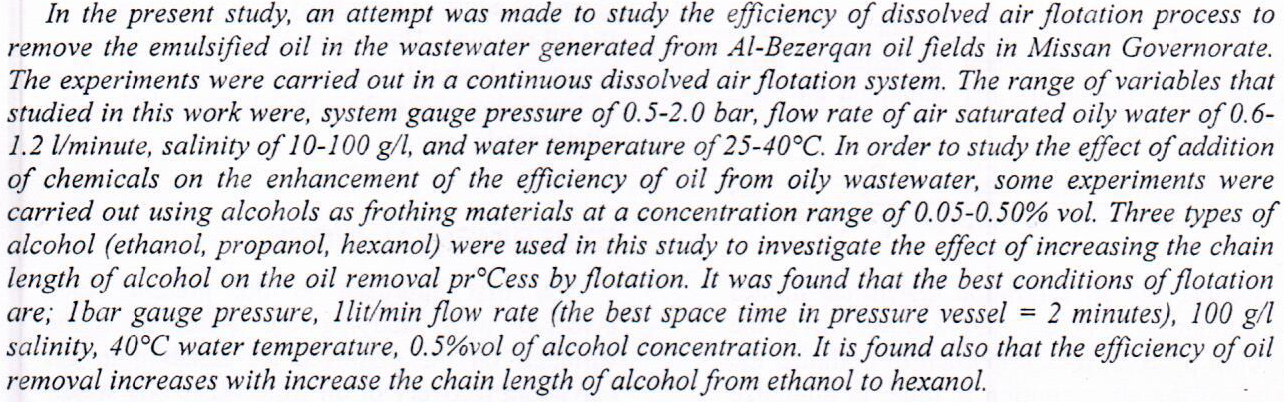
Oil Removal from Wastewater of Al-Bezerqan Crude Oil Fields by Air Flotation

The current study investigated the stability and the extraction efficiency of emulsion liquid membrane (ELM) for Abamectin pesticide removal from aqueous solution. The stability was investigated in terms of droplet emulsion size distribution and emulsion breakage percent. The proposed ELM included a mixture of corn oil and kerosene (1:1) as a diluent, Span 80 (sorbitan monooleate) as a surfactant and hydrochloric acid (HCl) as a stripping agent without utilizing a carrier agent. Parameters such as homogenizer speed, surfactant concentration, emulsification time and internal to organic volume ratio (I/O) were evaluated. Results show that the lower droplet size of 0.9 µm and higher stable emulsion in terms of breakage percent of 1.12 % we
... Show More (5)
(5)

The main idea of this research is that the researcher believes that media research remains useless unless its goals and results are achieved by using the correct scientific tools. The researcher chooses 100 research papers of about 35% of the published ones, 10 of them are excluded because they are outside media. We use a simple and randomized sample including the three departments of media: journalism, television and radio journalism and public relations. The researcher adopts statistical methods such as Fay coefficient, correlation coefficient, Pearson correlation coefficient and straight line equation.
The researcher uses an analytical form followed by analysis of content, them the scale. The results are found in 58 researches, w
(1)

A particulate polymer composite material was prepared by reinforcing with the Aluminum Oxide (Al2O3) or Aluminum (Al) metallic particles with a particle size of (30) µm to an unsaturated Polyester Resin with a weight fraction of (5%, 10%, 15%, 20%).
Tensile test results showed the maximum value of elastic modulus reached (2400MPa.) in the case of reinforcing with (Al) particles with weight fraction (20%) and (1500 MPa.) in the case of reinforcing with (Al2O3) particles of the same weight fraction.
When the impact and the flexural strength tests were done, the results showed that flexural strength (F.S), maximum shear stress (τmax), impact strength
... Show MoreIn the present work, a study is carried out to remove chromium (III) from aqueous solution by: activated charcoal, attapulgite and date palm leaflet powder (pinnae). The effect of various parameters such as contact time, and temperature has been studied. The isotherm equilibrium data were well fitted by Freundlich and Langmuir isotherm models. The adsorption capacity of chromium (III) that was observed by activated charcoal, attapulgite and date palm leaflet powder (pinnae) increased with the rise of temperature when the concentrations of Cr (III) were 600, 700 and 100mg/L respectively. The greatest adsorption capacity ofactivated charcoal, attapulgite and date palm leaflet powder (pinnae) at 10°C was 7.51, 5.39 and 0.77mg.gˉ¹ respective
... Show More (2)
(2)
(2)
(2)
In this study, manganese dioxide (MnO₂) nanoparticles (NPs) were synthesized via the hydrothermal method and utilized for the adsorption of Janus green dye (JG) from aqueous solutions. The effects of MnO₂ NPs on kinetics and diffusion were also analyzed. The synthesized NPs were characterized by scanning electron microscopy (SEM), X-ray diffraction (XRD), energy-dispersive X-ray analysis (EDX), and Fourier-transform infrared spectroscopy (FT-IR), with XRD confirming the nanoparticle size of 6.23 nm. The adsorption kinetics were investigated using three models: pseudo-first-order (PFO), pseudo-second-order (PSO), and the intraparticle diffusion model. The PSO model provided the best fit (R² = 0.999), indicating that the adsorpti
... Show More
(7)
(1)
 (193)
(129)
(193)
(129)
