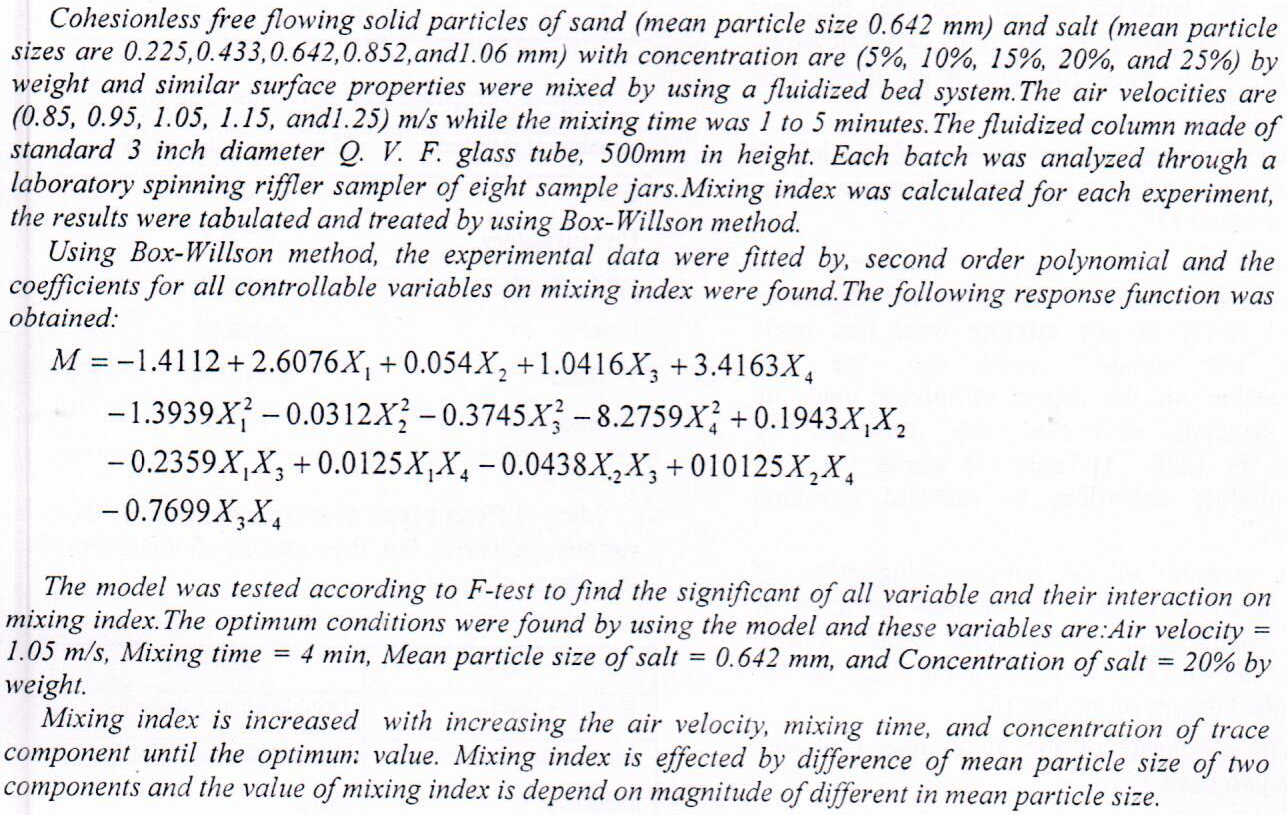
Performance of Mixing Granules Solid Materials by Fluidization

Blends of polyvinyl pyrrolidone (PVP) and polyvinyl alcohol (PVA) in equal weight ratios (50 wt.% PVP + 50 wt.% PVA) were doped with 15% of various lithium salts (Li2CO3, LiNO3, Li2SO4H2O, and LiCl) and prepared using the solution-casting method, with dimethylformamide (DMF) as the solvent. The impact of these salts on the blends was analyzed and the results showed that the energy gap was decreased by adding lithium salts Li2CO3, LiNO3 and Li2SO4.H₂O. The minimum energy gap value was 3.5 eV obtained from PVP/PVA:15% Li2CO3. The optical constants were determined in the range of 300-1100 nm. The results showed that all the optical constants for doped blends were grown with the addition of lithium salts. The FTIR study confirms the c
... Show MoreNumerical study is adapted to combine between piezoelectric fan as a turbulent air flow generator and perforated finned heat sinks. A single piezoelectric fan with different tip amplitudes placed eccentrically at the duct entrance. The problem of solid and perforated finned heat sinks is solved and analyzed numerically by using Ansys 17.2 fluent, and solving three dimensional energy and Navier–Stokes equations that set with RNG based k−ε scalable wall function turbulent model. Finite volume algorithm is used to solve both phases of solid and fluid. Calculations are done for three values of piezoelectric fan amplitudes 25 mm, 30 mm, and 40 mm, respectively. Results of this numerical study are compared with previous b
... Show More (1)
(1)

A single step extraction-cleanup procedure using porous membrane-protected micro-solid phase extraction (μ-SPE) in conjunction with liquid chromatography–tandem mass spectrometry for the extraction and determination of aflatoxins (AFs) B1, B2, G1 and G2 from food was successfully developed. After the extraction, AFs were desorbed from the μ-SPE device by ultrasonication using acetonitrile. The optimum extraction conditions were: sorbent material, C8; sorbent mass, 20 mg; extraction time, 90 min; stirring speed, 1000 rpm; sample volume, 10 mL; desorption solvent, acetonitrile; solvent volume, 350 μL and ultrasonication period, 25 min without salt addition. Under the optimum conditions, enrichment factor of 11, 9, 9 and 10 for AFG2, AFG1
... Show More (65)
(64)
(65)
(64)


AAA AL-NUAIMY, MH ABDLL-ABASS, Iraqi Journal of Agricultural Sciences, 2007
Background: This study was performed to compare the marginal fit changes and facture resistance of metal ceramic crowns constructed from Ceramill Sintron metal coping veneered with three different porcelain veneering materials (Vita Master Koromikos VMK, Willi Geller Creation CC and GC initial MC), also to evaluate the influence of thermocycling on load at fracture. Materials and Methods: Master brass die was scanned ,then metal coping was designed and milled from Ceramill Sintron blank to get 60 metal copings, then divided randomly into three groups(20 sample), then veneered with porcelain: VITA, Creation or GC. The marginal gaps were measured before and after porcelain veneering then marginal fit changes was calculated. Fracture resist
... Show More
Background: Esthetic correction represents one of the clinical conditions that required the use of laminate veneers in premolars region. Aim of the study: The purpose of this study was to evaluate the fracture strength of the laminate veneers in maxillary first premolars, fabricated from either composite (direct and indirect techniques) or ceramic CAD/CAM blocks. Materials and Methods: Fifty sound human maxillary premolar teeth were used in this in vitro study. Teeth were divided randomly into one control group and four experimental groups of ten teeth each; Group A: Restored with direct composite veneer (Filtek Z250 XT), Group B: Restored with indirect composite veneers (Filtek Z250 XT), Group C: Restored with lithium disilicate ceramic CA
... Show MoreThis work involves three parts , first part is manufacturing different types of laminated below knee prosthetic socket materials with different classical laminated materials used in Baghdad center for prosthetic and orthotic (4perlon layers+2carbon fiber layer+4 perlon layers) , two suggested laminated materials(3perlon layers+2carbon fiber layer+3 perlon layers) and (3perlon layers+1carbon fiber layer+3 perlon layers) ) in order to choose perfect laminated socket . The second part tests (Impact test) the laminated materials specimens used in socket manufacturing in order to get the impact properties for each socket materials groups using an experimental rig designed especially for this purpose. The interface pressure between
... Show More
(1)
This work aims to investigate the tensile and compression strengths of heat- cured acrylic resin denture base material by adding styrene-butadiene (S- B) to polymethyl methacrylate (PMMA). The most well- known issue in prosthodontic practice is fracture of a denture base. All samples were a blend of (90%, 80%) PMMA and (10%, 20%) S- B powder melted in Oxolane (Tetra hydro furan). These samples were chopped down into specimens of dimensions 100x10x2.5mm to carry out the requirements of tensile tests. The compression strength test specimens were shaped into a cylinder with dimensions of 12.7mm in diameter and 20mm in length. The experimental results show a significant increase in both tensile and compression strengths when compared to cont
... Show More
(8)
(2)
There are many diseases that affect the arteries, especially those related to their elasticity and stiffness, and they can be guessed by estimating and calculating the modulus of elasticity. Hence, the accurate calculation of the elastic modulus leads to an accurate assessment of these diseases, especially in their early stages, which can contribute to the treatment of these diseases early. Most of the calculations used the one-dimensional (1D) modulus of elasticity. From a mechanical point of view, the stresses to which the artery is subjected are not one-dimensional, but three-dimensional. Therefore, estimating at least a two-dimensional (2D) modulus of elasticity will necessarily be more accurate. To the knowledge of researchers, there i
... Show MoreMagnetic Abrasive Finishing (MAF) is an advanced finishing method, which improves the quality of surfaces and performance of the products. The finishing technology for flat surfaces by MAF method is very economical in manufacturing fields an electromagnetic inductor was designed and manufactured for flat surface finishing formed in vertical milling machine. Magnetic abrasive powder was also produced under controlled condition. There are various parameters, such as the coil current, working gap, the volume of powder portion and feed rate, that are known to have a large impact on surface quality. This paper describes how Taguchi design of experiments is applied to find out important parameters influencing the surface quality generated during
... Show More