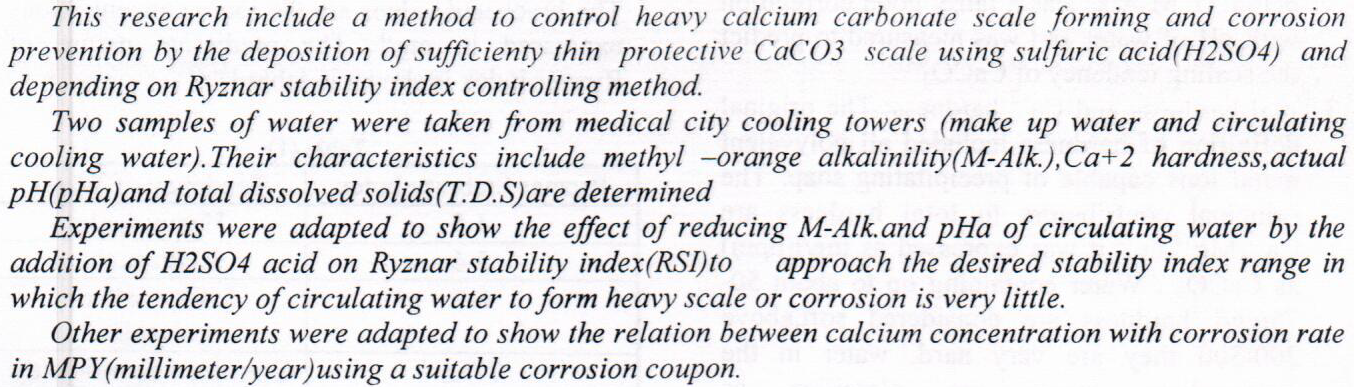
Control of Calcium Scale and Corrosion of Medical City Cooling Water System using Sulfuric Acid

Abstract
In order to enhance the efficiency of flat plate solar water collectors without changing in its original shape and with low additional cost, twisted strips are inserted inside its riser pipes. Three flat plate collectors are used for test. Family of twisted strips are inserted inside each collector risers with different twisted ratios (TR=3,4,5). The collectors are connected in parallel mode (Z-Configuration) and are exposed to the same conditions (solar radiation and ambient temperature) .The experimental results show that, the highest heat transfer rate occurs at twisted ratio (3) .Consequently, for the same twisted ratio the daily efficiencies for the solar collector at d
... Show MoreThe water supply network inside the building is of high importance due to direct contact with the user that must be optimally designed to meet the water needs of users. This work aims to review previous research and scientific theories that deal with the design of water networks inside buildings, from calculating the amount of consumption and the optimal distribution of the network, as well as ways to rationalize the use of water by the consumer. The process of pumping domestic water starts from water treatment plants to be fed to the public distribution networks, then reaching a distribution network inside the building till it is provided to the user. The design of the water supply network inside the building is
... Show More
The paper presents a highly accurate power flow solution, reducing the possibility of ending at local minima, by using Real-Coded Genetic Algorithm (RCGA) with system reduction and restoration. The proposed method (RCGA) is modified to reduce the total computing time by reducing the system in size to that of the generator buses, which, for any realistic system, will be smaller in number, and the load buses are eliminated. Then solving the power flow problem for the generator buses only by real-coded GA to calculate the voltage phase angles, whereas the voltage magnitudes are specified resulted in reduced computation time for the solution. Then the system is restored by calculating the voltages of the load buses in terms
... Show MoreBackground: Bone augmentation techniques are commonly employed in medical fields. This biomaterial system must be readily available, easily applicable by minimally-invasive technique and able to release an osteoinductive growth factor. Such a system will be able to engineer new bone formation locally at the site of injection. Hyaluronic acid has osteogenic potential that can be exploited not only for repairing bone defects but also for providing transplantable bone for the reconstruction of a variety of bone defects. The aims of this study were to evaluate the effects of Hyaluronic acid gel on bone healing by immunohistochemical estimation of transforming growth factor -beta 3 in experimental and control groups. Materials and methods: Thirt
... Show MoreThe manganese doped zinc sulfide nanoparticles were synthesized by simple aqueous chemical reaction of manganese chloride, zinc acetate and thioacitamide in aqueous solution. Thioglycolic acid is used as capping agent for controlling the nanoparticle size. The main advantage of the ZnS:Mn nanoparticles of diameter ~ 2.73 nm is that the sample is prepared by using non-toxic precursors in a cost effective and eco-friendly way. The structural, morphological and chemical composition of the nanoparticles have been investigated by X-ray diffraction (XRD), Scanning Electron Microscopy (SEM) with energy dispersion spectroscopy (EDS) and Fourier transform infrared (FTIR) spectroscopy. The nanosize of the prepared nanoparticles was elucidated by Scan
... Show MoreThis study describe the effect of temperature on the optical
properties of nickel(ii) phthalocyanine tetrasulfonic acid tetrasodium
salt (NiPcTs) organic thin films which are prepared by spin coating
on indium tin oxide (ITO-glass). The optical absorption spectra of
these thin films are measured. Present studies reveal that the optical
band gap energies of NiPcTs thin films are dependent on the
annealing temperatures. The optical band gap decreases with increase
in annealing temperature, then increased when the temperature rising
to 473K. To enhance the results of Uv-Vis measurements and get
more accurate values of optical energy gaps; the Photoluminescence
spectra of as-deposited and annealed NiPcTs thin fi
 (1)
(1)
 (6)
(14)
(6)
(14)

This article presents the simultaneous adsorption of bimetal Cu2+ and Zn2+ from an aqueous solution using activated carbon synthesized from a plum seed precursor by sulfuric acid and microwave activation: plum seeds chemically activated by 45% (w/w) sulfuric acid with 2:1 ratio for 4 h, then carbonized for 2 h at 700 °C and the product obtained activated in a microwave oven for 20 min at 700 W for final of activation. Plum seeds and activated carbon produced were characterized in terms of their physical and chemical composition using Brunauer–Emmett–Teller measurements, field emission scanning electr
... Show More
(2)
(1)

Pharmaceuticals have been widely remaining contaminants in wastewater, and diclofenac is the most common pharmaceutical pollutant. Therefore, the removal of diclofenac from aqueous solutions using activated carbon produced by pyrocarbonic acid and microwaves was investigated in this research. Apricot seed powder and pyrophosphoric acid (45 wt%) were selected as raw material and activator respectively, and microwave irradiation technique was used to prepare the activated carbon. The raw material was impregnated in pyrophosphoric acid at 80◦C with an impregnation ratio of 1: 3 (apricot seeds to phosphoric acid), the impregnation time was 4 h, whereas the power of the microwave was 700 watts with a radiation time of 20 min. A series o
... Show More
(16)
This study was carried out to determine the effects of some environmental variables on biodiversity index value of benthic invertebrates' community in samples that collected monthly from two adjacent sites nearby the confluence of Tigris and Diyala rivers within Baghdad city that’s from November 2007 - October 2008. Results showed differences in chemical and physical characteristics for each river. Where the annual averages of these characteristics in Rivers Tigris and Diyala respectively for: water temperature (20, 19) Cº, pH (8, 8), Dissolved oxygen DO(8,4 ) mg/l , EC(1152,2979)µc/cm , Turbidity (28,74) NTU, Total Hardness of CaCO3 (485,823)mg/l, and finally NO3 (4,6)mg/l. Concerning the biological groups, included types of Insect
... Show More