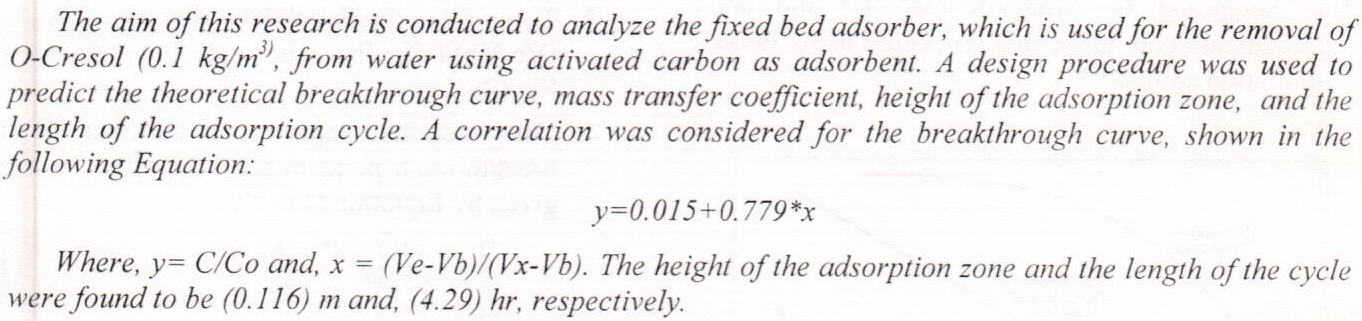
The Analysis of a Fixed Bed Absorber Used for the Removal of Pollutants from Water

The process of coordination and joint cooperation between SAIs and internal auditors in the public sector is considered one of the very important matters in performing efficient audits and are of high quality, especially if this coordination and cooperation is implemented in accordance with international standards, as it leads to avoiding duplication in auditing work. And the distribution of work in a distribution that achieves the objectives of auditing in general and is of general benefit to the economic unit.
The research problem lies in the weakness of the relationship between internal auditing and external auditing as a result of not applying INTOSAI Standard (9150) coordination and joint cooperation
... Show MoreIn this research, production of ethanol from waste potatoes fermentation was studied using Saccharmyses cerevisiae. Potato Flour was prepared from potato tubers after cooking and drying at 85°C. Homogenous slurry of potato flour was prepared in water at solid liquid ratio 1:10. Liquefaction of potato flour slurry with α-amylase at 80°C for 40 min followed by saccharification with glucoamylase at 65°C for 2 hr .Fermentation of hydrolysate with Saccharomyces cerevisiae at 35°C for two days resulted in production of 33 g/l ethanol.
The parameters studied were; temperature, time of fermentation and pH. It was found that Saccharification process is affected by enzyme Amylo 300 conc
... Show More


The extraction process of chlorophyll from dehydrated and pulverized alfalfa plant were studied by percolation method. Two solvent systems were used for the extraction namely; Ethanol-water and Hexane-Toluene systems . The effect of circulation rate, solvent concentration, and solvent volume to solid weight ratio were studied. In both ethanol water, and Hexane-Toluene systems it appears that solvent concentration is the most effective variable.
The objective of this study is to determine the concentration of copper and lead (mg/L) in drinking water by using absorption spectrophotometic and Atomic Absorption spectrophotometric method from different area in Baghdad and with different intervals , The results show that the concentration of copper and Lead ( mgL) in tap water which remains motionless in plumbing system for following periods one hours, 3 hours, 6 hours, 12 hours, 24 hours, 7 days and 14 days are (1 , 2.2 , 4 , 5.3 , 7.5 , 10 and 16 mgL copper ) & ( 0.3, 0.5 , 0.8 , 1 , 2.5 , 3 , 3.8 mg /L lead ) respectively .from these results its clear that high levels of copper & Lead occur if tap water comes in contact with copper - lead plumbing and copper lead -containing fix
... Show More
Thin films of Magnetite have been deposited on Galvanized Steel (G-S) alloy using RF-reactive magnetron sputtering technique and protection efficiency of the corrosion of G-S. A Three-Electrodes Cell was used in saline water (3.5 % NaCl) solution at different temperatures (298, 308, 318 & 328K) using potentiostatic techniques with. Electrochemical Impedance Spectroscopy (EIS) and fitting impedance data via Frequency Response Analysis (FRA) were applied to G-S alloy with Fe3O4 and tested in 3.5 % NaCl solution at 298K.Results taken from Nyquist and Bode plots were analyzed using software provided with the instrument. The results obtained show that the rate of corrosion of G.S alloy increased with increasing the temperatures from 298 t
... Show More
This study was carried out to study effect of magnetic water ( M0 and M) and different concentrations of coconut extract in Fragaria x ananassa (Duch) C.V Festival. The results showed significant differences in the plants treated with magnetic water ( 0.12 Tesla) and different concentrations of coconut extract C1 (0%), C2 (2.5%), C3 (5%), C4 (7.5%) and C5 (10%) in vegetative parameters as in leaf area and chlorophyll in treatment M0C3 was (53.72 Dcm2, 50.00), respectively, highest leaf number and plant dry weight in MC4 (12.77,14.22 gm), respectively. Results recorded significant differences in fruit parameters such as weight in MC1 (18.97 gm). The maximum fruit number was in MC3 (110), the greatest fruit size was in MC4 (15.78 cm3) and the
... Show More
Groundwater quality deterioration due to anthropogenic natural activities and its immense utilization in various sectors is considered a great concern. The aim of this study is to determine the groundwater quality parameters at various sources in and around Dhaka city and compare them with Bangladesh drinking water standards. In this study, six groundwater quality parameters (pH, DO, COD, TS, TDS, and arsenic) and ten groundwater samples are analyzed to determine the water quality. The collected samples have maximum and minimum pH values of 6.9 and 6.4, respectively. Maximum and minimum DO values are 0.3 and 0.1 mg/L, respectively. The arsenic concentration is 0 mg/L for all collected groundwater samples. The maximum and minimum COD
... Show More (16)
(16)
 (13)
(13)