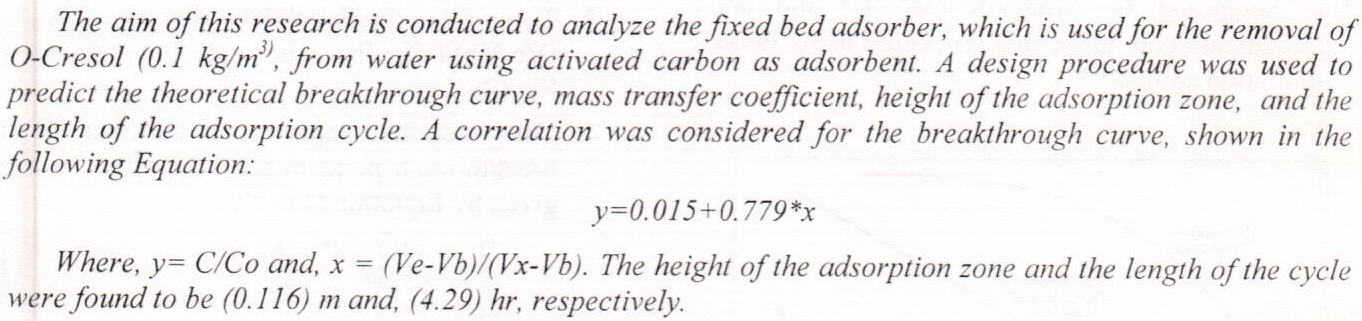
The Analysis of a Fixed Bed Absorber Used for the Removal of Pollutants from Water

Joint diseases, such as osteoarthritis, induce pain and loss of mobility to millions of people around the world. Current clinical methods for the diagnosis of osteoarthritis include X-ray, magnetic resonance imaging, and arthroscopy. These methods may be insensitive to the earliest signs of osteoarthritis. This study investigates a new procedure that was developed and validated numerically for use in the evaluation of cartilage quality. This finite element model of the human articular cartilage could be helpful in providing insight into mechanisms of injury, effects of treatment, and the role of mechanical factors in degenerative
conditions, this three-dimensional finite element model is a useful tool for understanding of the stress d

 (3)
(3)

Due to wind wave actions, ships impacts, high-speed vehicles and others resources of loading, structures such as high buildings rise bridge and electric transmission towers undergo significant coupled moment loads. In this study, the effect of increasing the value of coupled moment and increasing the rigidity of raft footing on the horizontal deflection by using 3-D finite element using ABAQUS program. The results showed that the increasing the coupled moment value leads to an increase in lateral deflection and increase in the rotational angle (α◦). The rotational angle increases from (0.014, 0.15 to 0.19) at coupled moment (120 kN.m), (0.29, 0.31 and 0.49) at coupled moment (240 kN.m) and (0.57, 0.63 and 1.03) at cou
... Show More (1)
(1)
A novel concept of air heater using a heating element made from Aluminum metal porous disc surrounded by a DC resistive electrical heater inserted in the mid-plane of a copper tube of (52.8 mm) diameter and (480 mm) length is presented herein. Study of the developed heater is conducted; using different porous disc thicknesses of (20, 40, 60 mm), heater wall temperatures (106 °C and 119 °C), and flow rates rare varied from (100–300 L/min). Al-metal foam disc has been made using the metal powder technology. Different resistive electrical heaters according to the type of porous disc used have been manufactured. A 2-D computational model is developed, using continuity, momentum, and energy equations for turbulent forced flow in plain tube,
... Show More
(13)
(10)
(64)
(65)

Experimental measurements of viscosity and thermal conductivity of single layer of graphene . based DI-water nanofluid are performed as a function of concentrations (0.1-1wt%) and temperatures between (5 to 35ºC). The result reveals that the thermal conductivity of GNPs nanofluids was increased with increasing the nanoparticle weight fraction concentration and temperature, while the maximum enhancement was about 22% for concentration of 1 wt.% at
35ºC. These experimental results were compared with some theoretical models and a good agreement between Nan’s model and the experimental results was observed. The viscosity of the graphene nanofluid displays Newtonian and Non-Newtonian behaviors with respect to nanoparticles concen
The concerns about water contaminants affect most developing countries bypassing rivers over them. The issue is challenging to introduce water quality within the allowed limits for drinking, industrial and agricultural purposes. In the present study, physical-chemical parameters measurements of water samples taken from eleven stations were collected during six months in 2020 through flow path along the whole length of Tigris River inside AL Kut city (center of Wassit government) were investigated for six parameters are total hardness TH, hydrogen ion pH, biological oxygen demand BOD5, total dissolved solids TDS, nitrate NO3, and sulfate SO4. The water quality analysis results were compared with the maximum allowable limit concentrat
... Show More
(7)
(3)
Background: Polymeric composites have been widely used as dental restorative materials. A fundamental knowledge and understanding of the behavior of these materials in the oral cavity is essential to improve their properties and performance. The goal of this study was to measure water sorption of four composite resins containing different filler and resin matrix contents. Materials and method: Resin composite specimens giomer (Beautifil II) Filtek™ P90, Filtek™ Z350 XT, and Tetric N Ceram were prepared in a cylindrical mould of 3mm thickness and 6mm diameter (n=10) and light cured . All specimens placed in silica-gel desiccators at 37˚C for seven days, a constant weight was obtained. All samples were immersed in deionized distill
... Show More