The Analysis of a Fixed Bed Absorber Used for the Removal of Pollutants from Water
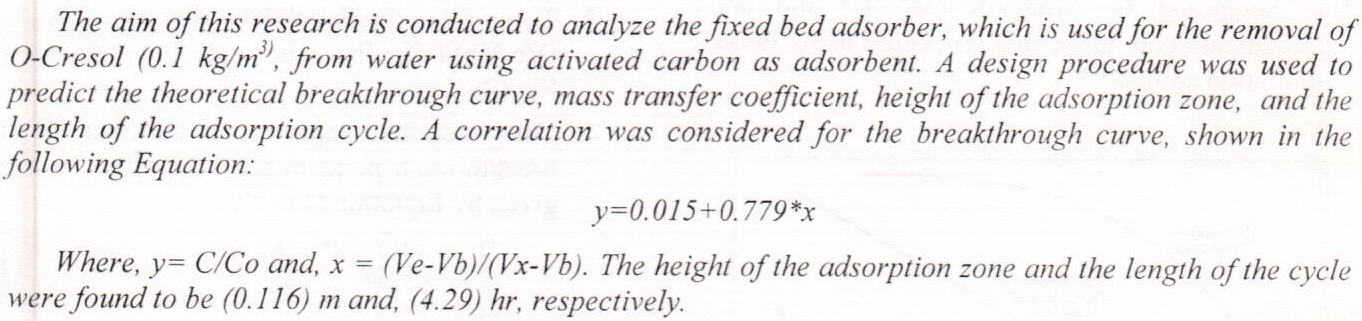

 (4)
(4)
 (4)
(4)


The removal of heavy metal ions from wastewater by ion exchange resins ( zeolite and purolite C105), was investigated. The adsorption process, which is pH dependent, shows maximum removal of metal ions at pH 6 and 7 for zeolite and purolite C105 for initial metal ion
concentrations of 50-250 mg/l, with resin dose of 0.25-3 g. The maximum ion exchange capacity was found to be 9.74, 9.23 and 9.71 mg/g for Cu2+, Pb2+, and Ni2+ on zeolite respectively, while on purolite C105 the maximum ion exchange capacity was found to be 9.64 ,8.73 and 9.39 for Cu2+, Pb2+, and Ni2+ respectively. The maximum removal was 97-98% for Cu2+ and Ni2+ and 92- 93% for Pb2+ on zeolite, while it was 93-94% for Cu2+, 96-97% for Ni2+, and 87-88% for Pb2+ on puroli
(12)
(13)
This research was carried out to study the effect of plants on the wetted area for two soil types in Iraq and predict an equation to determine the wetted radius and depth for two different soil types cultivated with different types of plants, the wetting patterns for the soils were predicted at every thirty minute for a total irrigation time equal to 3 hr. Five defferent discharges of emitter and five initial volumetric soil moisture contents were used ranged between field capacity and wilting point were utilized to simulate the wetting patterns. The simulation of the water flow from a single point emitter was completed by utilized HYDRUS-2D/3D software, version 2.05. Two methods were used in developing equations to predict the domains o
... Show More
(2)
Catalytic wet air oxidation of aqueous phenol solution was studied in a pilot plant trickle bed reactor using copperoxide catalyst supported on alumina and silica. Catalysts were prepared by impregnating method. Effect of feed solutionpH (5.9, 7.3, and 9.2), gas flow rate (20%, 50%, 80%, and 100%), WHSV (1, 2, and 3 h-1), temperature (120°C, 140°C,and 160°C), oxygen partial pressure (6, 9, 12 bar), and initial phenol concentration (1, 2, and 4 g/l).Generally, theperformance of the catalysts was better when the pH of feed solution was increased. The catalysts deactivation is relatedto the dissolution of the metal oxides from the catalyst surface due to the acidic conditions. Phenol oxidation reactionwas strongly affected by WHSV,
... Show More
(2)
Catalytic wet air oxidation of aqueous phenol solution was studied in a pilot plant trickle bed reactor using copper
oxide catalyst supported on alumina and silica. Catalysts were prepared by impregnating method. Effect of feed solution
pH (5.9, 7.3, and 9.2), gas flow rate (20%, 50%, 80%, and 100%), WHSV (1, 2, and 3 h-1), temperature (120°C, 140°C,
and 160°C), oxygen partial pressure (6, 9, 12 bar), and initial phenol concentration (1, 2, and 4 g/l).Generally, the
performance of the catalysts was better when the pH of feed solution was increased. The catalysts deactivation is related
to the dissolution of the metal oxides from the catalyst surface due to the acidic conditions. Phenol oxidation reaction
was strongly
Tigris River is the lifeline that supplies a great part of Iraq with water from north to south. Throughout its entire length, the river is battered by various types of pollutants such as wastewater effluents from municipal, industrial, agricultural activities, and others. Hence, the water quality assessment of the Tigris River is crucial in ensuring that appropriate and adequate measures are taken to save the river from as much pollution as possible. In this study, six water treatment plants (WTPs) situated on the two-banks of the Tigris within Baghdad City were Al Karkh; Sharq Dijla; Al Wathba; Al Karama; Al Doura, and Al Wahda from northern Baghdad to its south, that selected to determine the removal efficiency of turbidity and
... Show More