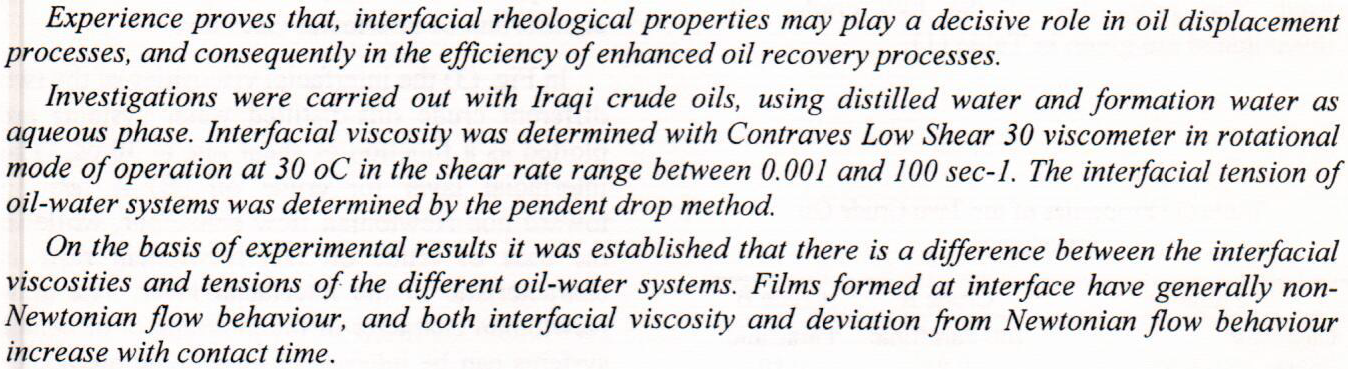
Interfacial Rheological Properties of Iraqi Crude Oils Water System

A mathematical model has been formulated to predict the influence of high outdoor air temperature on the performance of small scale air - conditioning system using R22 and alternative refrigerants R290, R407C, R410A. All refrigerants were investigated in the cooling mode operation. The mathematical model results have been validated with experimental data extracted from split type air conditioner of 2 TR capacity. This entailed the construction of an experimental test rig which consists of four main parts. They are, the refrigeration system, psychrometric test facility, measuring instrumentation, and auxiliary systems. The conditioned air was maintained at 25 0C dry bulb and 19 0C wet bulb for all tests. The outdoor ambient air temperatur
... Show More (3)
(3)

This paper proposes a new structure for a Fractional Order Sliding Mode Controller (FOSMC) to control a Twin Rotor Aerodynamic System (TRAS). The new structure is composed by defining two 3-dimensional sliding mode surfaces for the TRAS model and introducing fractional order derivative integral in the state variables as well as in the control action. The parameters of the controller are determined so as to minimize the Integral of Time multiplied by Absolute Error (ITAE) performance index. Through comparison, this controller outperforms its integer counterpart in many specifications, such as reducing the delay time, rise time, percentage overshoot, settling time, time to reach the sliding surface, and amplitude of chattering in control inpu
... Show MoreDC planar sputtering system is characterized by varying discharge potential of (250-2000 volt) and Argon gas pressures of (3.5×10⁻² – 1.5) mbar. The breakdown voltage for silver electrode was studied with a uniform electric field at different discharge distances, as well as plasma parameters. The breakdown voltage is a product of the Argon gas pressure inside the chamber and gab distance between the electrodes, represent as Paschen curve. The Current-voltage characteristics curves indicate that the electrical discharge plasma is working in the abnormal glow region. Plasma parameters were found from the current-voltage characteristics of a single probe positioned at the inter-cathode space. Typical values of the electron temperature an
... Show More
The systems cooling hybrid solar uses solar collector to convert solar energy into the source of heat for roasting Refrigerant outside of the compressor and this process helps in the transformation of Refrigerant from the gas to a liquid state in two-thirds the top of the condenser instead of two-thirds the bottom of the condenser as in Conventional cooling systems and this in turn reduces the energy necessary to lead the process of cooling. The system cooling hybrid use with a capacity of 1 ton and Refrigerant type R22 and the value of current drawn by the system limits (3.9-4.2A), the same value of electric current calculated by the system are Conventional within this atmosphere of Iraq, and after taking different readings
... Show More
Static Synchronous Series Compensator (SSSC) is a well known device for effectively regulating the active power flow in a power system. In this paper, the SSSC linearized power flow equations are incorporated into Newton-Raphson algorithm in a MATLAB written program to investigate the control of active poweer flow and the transient stability of a five bus and a thirty bus IEEE test systems, during abnormal conduction (three phase fault near buses). A comparison of the results obtained for the base case without SSSC and with it to investigate the effectiveness of the device on both of the active power flow and the transient stability.
 (171)
(171)
(171)
(171)


This effort is related to describe and assess the performance of the Iraqi cement sample planned for oil well-cementing jobs in Iraq. In this paper, major cementing properties which are thickening time, compressive strength, and free water in addition to the rheological properties and filtration of cement slurry underneath definite circumstances are experimentally tested. The consequences point to that the Iraqi cement after special additives encounter the requests of the API standards and can consequently is used in cementing jobs for oil wells. At this research, there is a comparative investigation established on experimental work on the effectiveness of some additives that considered as waste materials which are silica fume, baux
... Show More
This effort is related to describe and assess the performance of the Iraqi cement sample planned for oil well-cementing jobs in Iraq. In this paper, major cementing properties which are thickening time, compressive strength, and free water in addition to the rheological properties and filtration of cement slurry underneath definite circumstances are experimentally tested. The consequences point to that the Iraqi cement after special additives encounter the requests of the API standards and can consequently is used in cementing jobs for oil wells. At this research, there is a comparative investigation established on experimental work on the effectiveness of some additives that considered as waste materials which are silica fume, bauxite,
... Show More
Filled the place thought philosophers and ancient is the identity that you know The value of belonging to a World Geography existential - the spiritual , and Which is characterized by the structure humanity from one another and the Rest of the organisms they interact with him alone by environmental Conditions - surrounding has to achieve time through continuous movement Localized or comprehensive . The place is exemplified by making special Natural Great Creator, I believe making structure humanity combined - Individual interactive because of its influential role in all daily consumer Productions and creative arts, specifically drama's TV , because the place in Aesthetic discourse - TV drama directly affect the creating and building the
... Show MoreThis paper addresses the use of adaptive sliding mode control for the servo actuator system with friction. The adaptive sliding mode control has several advantages over traditional sliding mode control method. Firstly, the magnitude of control effort is reduced to the minimal admissible level defined by the conditions for the sliding mode to exist. Secondly, the upper bounds of uncertainties are not required to be known in advance. Therefore, adaptive sliding mode control method can be effectively implemented. The numerical simulation via MATLAB 2014a for servo actuator system with friction is investigated to confirm the effectiveness of the proposed robust adaptive sliding mode control scheme. The results clarify, after
... Show More