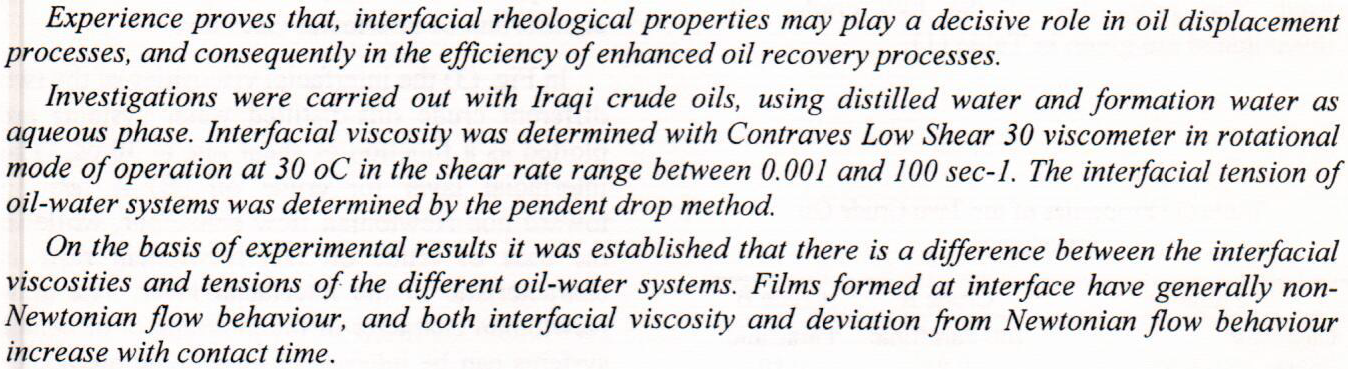
Interfacial Rheological Properties of Iraqi Crude Oils Water System

This research studies the effect of adding five different percentages of polymer (2, 4, 6, 8, and 10% of cement weight) on cement mortar's fresh and hardened properties, which was cured at laboratory temperature for 7, 14, and 28 days. Workability increases with increasing polymer. The workability value was lowest (25.6 and 29.4) % in mixtures containing 2% and 4% of (SBR). Increasing polymer ratios significantly decreased mechanical properties (compressive and flexural strength). Therefore, the best results were at 2% SBR and 4% SBR at 28 days of age. An inverse relationship was recorded between the increase in SBR ratios and polymer-modified cement mortar's compressive and flexural strength values. In general, the high
... Show More

Polyaniline (PANI) has been prepared by the oxidation method in order to fabricate it with various concentrations of copper nanoparticles (CuNPs) which produced using the reduction method. Various techniques have characterized pure PANI and PANI doped CuNPs composites, such as fourier transform infrared spectroscopy (FT-IR), X-ray diffraction spectroscopy (XRD), field emission scanning electron microscopy (FE-SEM) and energy dispersive X-ray spectroscopy (EDS), which were provided important information about the structure and morphology of the fabricated polymer nanocomposites. The properties of dielectric permittivity (έ), dielectric loss (ἔ) and electrical conductivity (σ_AC) properties were studied at room temperature versus a range
... Show More (2)
(2)
 (1)
(1)

AH Haider R, N Adil A, AW Makram M, AK Abdulkaleq S, 2010
Three species of nematodes are recorded from alimentary tracts of some Iraqi bats for the first tithe, while reporting Thelandros alatus constitutes first record of this species from mammals. Information on infection rate, distribution and halts are provided along with some relevant remarks.
HR Al-Hamami, AA Noaimi, MM Al-Waiz, AS Al-Kabraty, Iraqi Postgraduate Medical Journal, 2010 - Cited by 4
The study was conducted to detect the effect of addition of 0.03, 0.06 and0.10% potassium sorbate and 0.10, 0.15, 0.20 and 0.30% sodium propionate upon the sensory properties of laboratory made biscuit. The statistical analysis of the results revealed no significant differences (P<0.05) between the propionate treatment (A,B,C,D) and between the sorbate treatment (E,F,G) and the control (H) in most sensory properties of biscuit prior to storage. Upon six month storage of biscuit made with addition of different levels of sodium propionate 20-40C (room temperature) no significant differences (P<0.05) were shown on softness, flakiness and color in comparison with the control . No significant differences (P<0.05) were also
... Show More
Background Alloys with the addition of zirconium and niobium eliminate the adverse effects of aluminum and vanadium on the nervous system, the possibility of metallosis and the initiation of diseases (including cancers or Alzheimer›s disease). In addition, they have better corrosion resistance, and a Young›s modulus value similar to longitudinal bone tissue. Therefore, only choosing appropriate materials does not guarantee proper functioning of the implants, the surfaces of the implants also have to be suitable to meet the requirements. The laser surface hardening process modifies the surface properties by imparting microstructural changes, whereas surface remelting induces changes in the surface topography, roughness, wettability and w
... Show More
The structural properties of ternary chalcopyrite AgAlSe2 compound alloys and thin films that prepared by the thermal evaporation method at room temperature on glass substrate with a deposition rate (5±0.1) nm s-1 for different values of thickness (250,500 and 750±20) nm, have been studied, using X-ray diffraction technology. As well as, the optical properties of the prepared films have been investigated. The structural investigated shows that the alloy has polycrystalline structure of tetragonal type with preferential orientation (112), while the films have amorphous structure. Optical measurement shows that AgAlSe2 films have high absorption in the range of wavelength (350-700 nm). The optical energy gap for allowed direct transition we
... Show More
