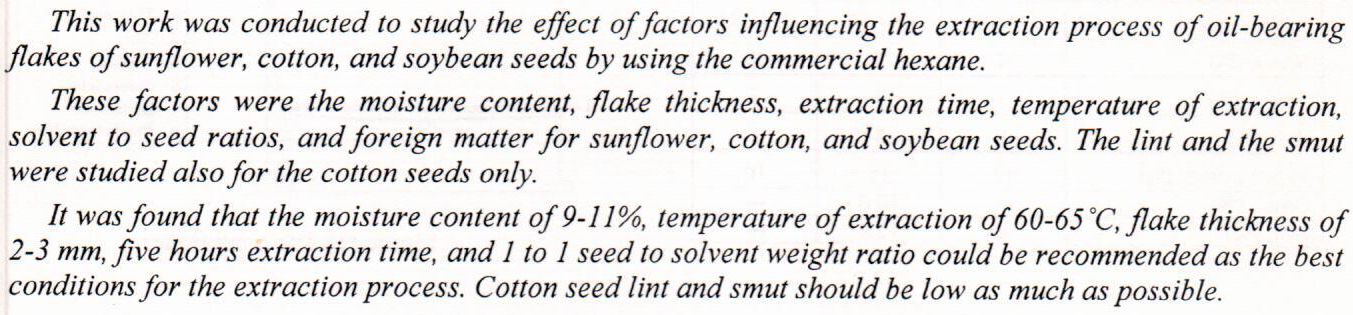
Factors Affecting the Extraction Process

An effective two-body density operator for point nucleon system
folded with the tenser force correlations( TC's), is produced and used
to derive an explicit form for ground state two-body charge density
distributions (2BCDD's) applicable for 25Mg, 27Al and 29Si nuclei. It is
found that the inclusion of the two-body TC's has the feature of
increasing the central part of the 2BCDD's significantly and reducing
the tail part of them slightly, i.e. it tends to increase the probability of
transferring the protons from the surface of the nucleus towards its
centeral region and consequently makes the nucleus to be more rigid
than the case when there is no TC's and also leads to decrease the
1/ 2
r 2 of the nucleu

Objective (s): To determine proportion of anemia among sample of Pregnant women. To identify factors
associated with the anemia (Maternal age, maternal education, gestational age, parity, gravidity, birth
interval, smoking, taking iron supplements and dietary habits).
Methodology: A cross-sectional study conducted at Al- washash & Bab-almoadham primary health care
centers. The sample was selected by (non-probability convenient sampling) and sample size was (550).
The study started from 1st March 2011 to 30th of March 2012. The data was collected by direct interview
using special questionnaire to obtained socio-demographic information.
Results: the result shows that mean age of the subjects was 26.5± 7.5 years, 8
 (5)
(5)

Heart disease is a significant and impactful health condition that ranks as the leading cause of death in many countries. In order to aid physicians in diagnosing cardiovascular diseases, clinical datasets are available for reference. However, with the rise of big data and medical datasets, it has become increasingly challenging for medical practitioners to accurately predict heart disease due to the abundance of unrelated and redundant features that hinder computational complexity and accuracy. As such, this study aims to identify the most discriminative features within high-dimensional datasets while minimizing complexity and improving accuracy through an Extra Tree feature selection based technique. The work study assesses the efficac
... Show More
(7)
 (4)
(4)
Inelastic magnetic electron scattering M1 at Ex =10.23 MeV form factors in Ca-48 have been investigated. The fp shell model space with four orbits and eight neutrons have been considered and FPD6 has been selected between 32 model space effective interactions to generates the model space vectors for the M1 transition with excitation energy Ex =10.23 MeV and for constructing OBDM. Discarded space (core and higher configuration orbits) has been included through the first order perturbation theory to couple the partice-hole pair of excitation in the calculation of the total M1 form factor and regarding the realistic interaction M3Y as a core polarization interaction with six sets of fitting parameters. Finally the theoretical calculations h
... Show MoreThe nucleon momentum distributions (NMD) for the ground state and elastic electron scattering form factors have been calculated in the framework of the coherent fluctuation model and expressed in terms of the weight function (fluctuation function). The weight function has been related to the nucleon density distributions of nuclei and determined from theory and experiment. The nucleon density distributions (NDD) is derived from a simple method based on the use of the single particle wave functions of the harmonic oscillator potential and the occupation numbers of the states. The feature of long-tail behavior at high momentum region of the NMD has been obtained using both the theoretical and experimental weight functions. The observed ele
... Show More
197 vaginal swabs were collected from women of different ages. (60) Isolates of Candida albicans (30.4%) were obtained, and the other species of Candida represent (18.27%). Bacterial infections showed (41.11%), and infection with Trichomonas vaginalis was (2.03%). Ten isolates of C. albicans were chosen randomly for farther study which include two virulence factors tendency of adhesion wich showed a percentage of (52%) to(32%) , and the ability to produce phospholipaze enzyme and it’s activity which showed (50%) of the isolates have the ability to produce the enzyme in different degrees .
Background: Childhood meningitis is a major
cause of morbidity and mortality, Hemophilus
influenza b (Hib) is the most common cause in
many countries, especially below 5 years and
before the development of conjugated Hib vaccine,
it is followed by Streptococcus Pneumonia, and
then N. meningitides, in addition to other
microorganisms.
Objective: To identify the causative organisms
of bacterial meningitis and to identify the factors
predisposing significantly to the incidence of
bacterial meningitis.
Method: This cross sectional , study was done in
Al-Elwia Pediatric Hospital during the period 1st
of January 2007 to 30th of June 2007.Eighty four
patients with presumptive diagnosis of meningitis<
(18)
(13)
(25)
(22)
