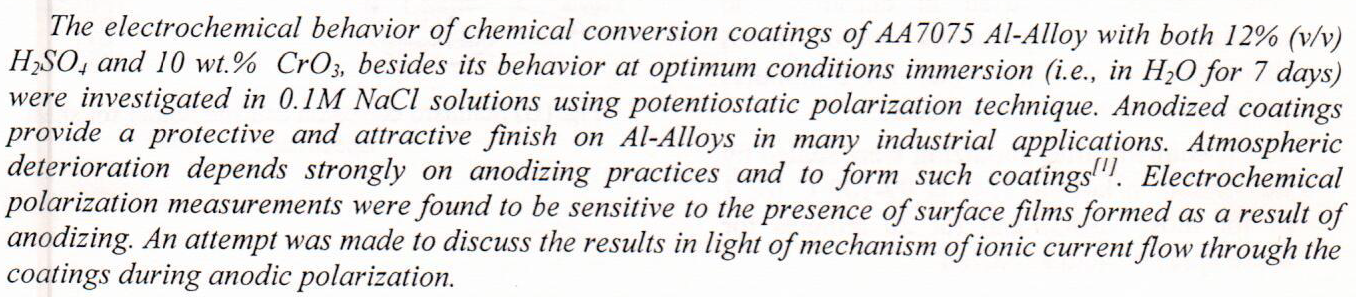
Electrochemical behavior of Anodized AA7075 Aluminum Alloy in 0.1M NaCl Solution as Investigated by Potentiostatic Polarization Ttechnique

This paper presents a study to investigate the behavior of post-tensioned segmental concrete beams that exposed to high-temperature. The experimental program included fabricating and testing twelve simply supported beams that divided into three groups depending on the number of precasting concrete segments. All specimens were prepared with an identical length of 3150 mm and differed in the number of the incorporated segments of the beam (9, 7, or 5 segments). To simulate the genuine fire disasters, nine out of twelve beams were exposed to a high-temperature flame for one hour. Based on the standard fire curve (ASTM – E119), the temperatures of 300◦C (572◦F), 500◦C (932◦F), and 700◦C (1292◦F) were adopted. Consequently,
... Show More (1)
(1)
 (1)
(1)



Conventional concretes are nearly unbendable, and just 0.1 percent of strain potential makes them incredibly brittle and stiff. This absence of bendability is a significant cause of strain failure and has been a guiding force in the production of an elegant substance, bendable concrete, also known as engineered cement composites, abbreviated as ECC. This type of concrete is capable of displaying dramatically increased flexibility. ECC is reinforced with micromechanical polymer fibers. ECC usually uses a 2 percent volume of small, disconnected fibers. Thus, bendable concrete deforms but without breaking any further than conventional concrete. This research aims to involve this type of concrete, bendable concrete, that will give solut
... Show MoreThe main objective of this paper is to study the behavior of Non-Prismatic Reinforced Concrete (NPRC) beams with and without rectangular openings either when exposed to fire or not. The experimental program involves casting and testing 9 NPRC beams divided into 3 main groups. These groups were categorized according to heating temperature (ambient temperature, 400°C, and 700°C), with each group containing 3 NPRC beams (solid beams and beams with 6 and 8 trapezoidal openings). For beams with similar geometry, increasing the burning temperature results in their deterioration as reflected in their increasing mid-span deflection throughout the fire exposure period and their residual deflection after cooling. Meanwhile, the existing ope
... Show More
(23)
(20)
In this study, three strengthening techniques, near-surface mounted NSM-CRFP, NSM-CFRP with externally bonding EB-CFRP, and hybrid CFRP with circularization were studied to increase the seismic performance of existing RC slender columns under lateral loads. Experimentally, 1:3 scale RC models were studied and subjected to both lateral static load and seismic excitation. In the dynamic test, a model was subjected to El Centro 1940 NS earthquake excitation by using a shaking table. According to the test results, the strengthening techniques showed a significant increase in load carrying capacity, of about 86.6%, and 46.6%, for circularization and NSM-CFRP respectively, of the reference unstrengthened columns. On the other hand, column
... Show More
(10)
(4)
(1)
Correlation equations for expressing the boiling temperature as direct function of liquid composition have been tested successfully and applied for predicting azeotropic behavior of multicomponent mixtures and the kind of azeotrope (minimum, maximum and saddle type) using modified correlation of Gibbs-Konovalov theorem. Also, the binary and ternary azeotropic point have been detected experimentally using graphical determination on the basis of experimental binary and ternary vapor-liquid equilibrium data.
In this study, isobaric vapor-liquid equilibrium for two ternary systems: “1-Propanol – Hexane – Benzene” and its binaries “1-Propanol –
... Show More
(6)
(6)
This paper presents a study to investigate the behavior of post-tensioned segmental concrete beams that exposed to high-temperature. The experimental program included fabricating and testing twelve simply supported beams that divided into three groups depending on the number of precasting concrete segments. All specimens were prepared with an identical length of 3150 mm and differed in the number of the incorporated segments of the beam (9, 7, or 5 segments). To simulate the genuine fire disasters, nine out of twelve beams were exposed to a high-temperature flame for one hour. Based on the standard fire curve (ASTM – E119), the temperatures of 300◦C (572◦F), 500◦C (932◦F), and 700◦C (1292◦F) were adopted. Consequently,
... Show More
(1)
Columns subjected to pure axial load rarely exist in practice. Reinforced concrete columns are usually subjected to combination of axial and lateral actions and deformations, caused by spatially‐complex loading patterns as during earthquakes causes lateral deflection that in turn affects the horizontal stiffness. In this study, a numerical model was developed in threedimensional nonlinear finite element and then validated against experimental results reported in the literatures,
to investigate the behavior of conventionally RC columns subjected to axial load and . lateral reversal cyclic loading. To achieve this goal, numerical analysis was conducted by using finite element program ABAQUS/Explicit. The variables co
This research is concerned to investigate the behavior of reinforced concrete (RC) deep beams strengthened with carbon fiber reinforced polymer (CFRP) strips. The experimental part of this research is carried out by testing seven RC deep beams having the same dimensions and steel reinforcement which have been divided into two groups according to the strengthening schemes. Group one was consisted of three deep beams strengthened with vertical U-wrapped CFRP strips. While, Group two was consisted of three deep beams strengthened with inclined CFRP strips oriented by 45o with the longitudinal axis of the beam. The remaining beam is kept unstrengthening as a reference beam. For each group, the variable considered
... Show More