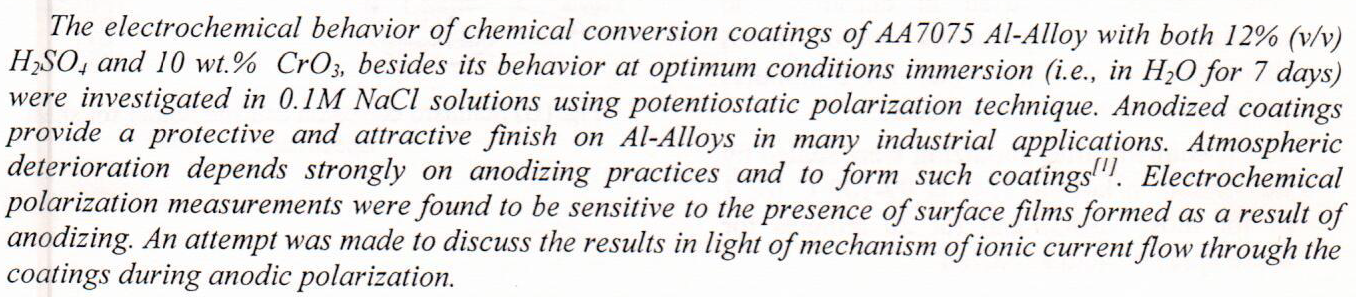
Electrochemical behavior of Anodized AA7075 Aluminum Alloy in 0.1M NaCl Solution as Investigated by Potentiostatic Polarization Ttechnique

Computer models are used in the study of electrocardiography to provide insight into physiological phenomena that are difficult to measure in the lab or in a clinical environment.
The electrocardiogram is an important tool for the clinician in that it changes characteristically in a number of pathological conditions. Many illnesses can be detected by this measurement. By simulating the electrical activity of the heart one obtains a quantitative relationship between the electrocardiogram and different anomalies.
Because of the inhomogeneous fibrous structure of the heart and the irregular geometries of the body, finite element method is used for studying the electrical properties of the heart.
This work describes t
... Show MoreThe main objective of this paper is to study the behavior of Non-Prismatic Reinforced Concrete (NPRC) beams with and without rectangular openings either when exposed to fire or not. The experimental program involves casting and testing 9 NPRC beams divided into 3 main groups. These groups were categorized according to heating temperature (ambient temperature, 400°C, and 700°C), with each group containing 3 NPRC beams (solid beams and beams with 6 and 8 trapezoidal openings). For beams with similar geometry, increasing the burning temperature results in their deterioration as reflected in their increasing mid-span deflection throughout the fire exposure period and their residual deflection after cooling. Meanwhile, the existing ope
... Show More (20)
(20)

Experimental work has been performed on three capillary tubes of different lengths and diameters using R-12 and R-134a. The test also studies the effect of discharge and speed of evaporator fan. The results clearly showed that refrigerant type and discharge significantly influence the temperature drop across the capillary tube. While the speed of evaporator fan has small effect. Experimental results showed that the temperature gradient for the two refrigerants are the same, but after approximatly one meter the temperature gradient of R-134a is steeper than R-12.
The poly(ethylene oxide) polymer (PEO) is doped with fine powder of MnCl2 salt and thin films of thickness (50–150 mm) with salt content (0, 5, 10, 15, and 20 wt%) are obtained. The AC electrical conductivity and dielectric constants are studied as a function of temperature through an impedance technique. It is found that AC conductivity increases and the calculated activation energy decreases with increasing temperature due to enhancement of the ionic conduction in the film bulk. The dielectric constants of the doped membranes increase with temperature. It is found that the peak value of the tanloss is shifted to a higher frequency at higher temperatures. The dielectric behavior is explained on the basis of
... Show More (15)
(13)
(15)
(13)


The aim of this research is to assess the validity of Detailed Micro-Modeling (DMM) as a numerical model for masonry analysis. To achieve this aim, a set of load-displacement curves obtained based on both numerical simulation and experimental results of clay masonry prisms loaded by a vertical load. The finite element method was implemented in DMM for analysis of the experimental clay masonry prism. The finite element software ABAQUS with implicit solver was used to model and analyze the clay masonry prism subjected to a vertical load. The load-displacement relationship of numerical model was found in good agreement with those drawn from experimental results. Evidence shows that load-displacement curvefound from the finite element m
... Show More
(1)
This paper presents a study to investigate the behavior of post-tensioned segmental concrete beams that exposed to high-temperature. The experimental program included fabricating and testing twelve simply supported beams that divided into three groups depending on the number of precasting concrete segments. All specimens were prepared with an identical length of 3150 mm and differed in the number of the incorporated segments of the beam (9, 7, or 5 segments). To simulate the genuine fire disasters, nine out of twelve beams were exposed to a high-temperature flame for one hour. Based on the standard fire curve (ASTM – E119), the temperatures of 300◦C (572◦F), 500◦C (932◦F), and 700◦C (1292◦F) were adopted. Consequently,
... Show More
(1)
(1)
Conventional concretes are nearly unbendable, and just 0.1 percent of strain potential makes them incredibly brittle and stiff. This absence of bendability is a significant cause of strain failure and has been a guiding force in the production of an elegant substance, bendable concrete, also known as engineered cement composites, abbreviated as ECC. This type of concrete is capable of displaying dramatically increased flexibility. ECC is reinforced with micromechanical polymer fibers. ECC usually uses a 2 percent volume of small, disconnected fibers. Thus, bendable concrete deforms but without breaking any further than conventional concrete. This research aims to involve this type of concrete, bendable concrete, that will give solut
... Show MoreThe main objective of this paper is to study the behavior of Non-Prismatic Reinforced Concrete (NPRC) beams with and without rectangular openings either when exposed to fire or not. The experimental program involves casting and testing 9 NPRC beams divided into 3 main groups. These groups were categorized according to heating temperature (ambient temperature, 400°C, and 700°C), with each group containing 3 NPRC beams (solid beams and beams with 6 and 8 trapezoidal openings). For beams with similar geometry, increasing the burning temperature results in their deterioration as reflected in their increasing mid-span deflection throughout the fire exposure period and their residual deflection after cooling. Meanwhile, the existing ope
... Show More
(23)
(20)
In this study, three strengthening techniques, near-surface mounted NSM-CRFP, NSM-CFRP with externally bonding EB-CFRP, and hybrid CFRP with circularization were studied to increase the seismic performance of existing RC slender columns under lateral loads. Experimentally, 1:3 scale RC models were studied and subjected to both lateral static load and seismic excitation. In the dynamic test, a model was subjected to El Centro 1940 NS earthquake excitation by using a shaking table. According to the test results, the strengthening techniques showed a significant increase in load carrying capacity, of about 86.6%, and 46.6%, for circularization and NSM-CFRP respectively, of the reference unstrengthened columns. On the other hand, column
... Show More
(10)