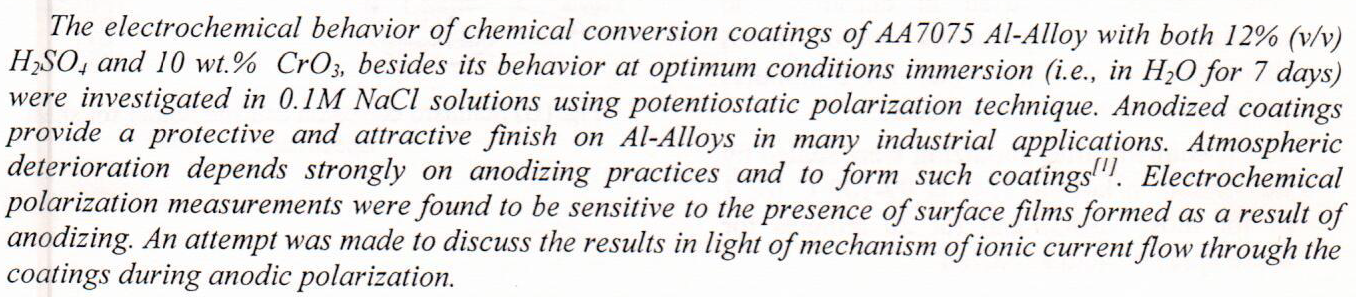
Electrochemical behavior of Anodized AA7075 Aluminum Alloy in 0.1M NaCl Solution as Investigated by Potentiostatic Polarization Ttechnique

The current study performs an explicit nonlinear finite element simulation to predict temperature distribution and consequent stresses during the friction stir welding (FSW) of AA 7075-T651 alloy. The ABAQUS® finite element software was used to model and analyze the process steps that involve plunging, dwelling, and traverse stages. Techniques such as Arbitrary Lagrangian–Eulerian (ALE) formulation, adaptive meshing, and computational feature of mass scaling were utilized to simulate sequence events during the friction stir welding process. The contact between the welding tool and workpiece was modelled through applying Coulomb’s friction model with a nonlinear friction coefficient value. Also, the model considered the effect o
... Show More (49)
(49)
 (31)
(31)


The objective of this work is to study the influence of end milling cutting process parameters, tool material and geometry on multi-response outputs for 4032 Al-alloy. This can be done by proposing an approach that combines Taguchi method with grey relational analysis. Three cutting parameters have been selected (spindle speed, feed rate and cut depth) with three levels for each parameter. Three tools with different materials and geometry have been also used to design the experimental tests and runs based on matrix L9. The end milling process with several output characteristics is solved using a grey relational analysis. The results of analysis of variance (ANOVA) showed that the major influencing parameters on multi-objective response w
... Show More
(4)
(2)
The corrosion behavior of carbon steel at different Temperatures and in water containing different sodium chloride
concentrations under 3 bar pressure has been investigated using weight loss method . The carbon steel specimens were
immersed in water containing (100,400,700,1000PPM) of NaCl solution and under temperature was increased from
(90-120ºC) under pressures of 3 bar. The results of this investigation indicated that corrosion rate increased with NaCl
concentrations and Temperature.
Bioindicators have an important role in assessing the quality of water bodies. Aquatic oligocheates, was used as a bioindicator to assess the sediment quality of Al-Hindyia and AL-Abbasyia river (branches of Euphrates River in Iraq). Two sites in each river have been chosen for this purpose, site S1 was located at Al-Hindyia River and S2 at Al-Abbasyia River. Some kinds of biological indices were used in this study, comprising the percentage of oligochaetes in benthic invertebrates, ranged from 20.3-60.16%. While the percentage of Tubificidae within benthic invertebrates was close 43.3-43.9%.Index of pollution D ranged from 0.13-0.21. The maximum percentage of aquatic oligochaetes to insects larvae of family
... Show More
(2)
 (1)
(1)
(1)
(1)
Coconut milk is considered as a natural drink that enhances the immunity and it is enriched by calcium, iron, magnesium and vitamin (C) and it is also safe drink for kids and bacterial anti-oxdant, and it may be used in the natural juices instead of the whole milk (cow milk) which is added to some juices. This study aimed to determine the nutritrnal value and the sensory evaluation properties of the natural orange juice enriched by canned coconut milk &nb
... Show MoreThe aim of this research is to employ starch as a stabilizing and reducing agent in the production of CdS nanoparticles with less environmental risk, easy scaling, stability, economical feasibility, and suitability for large-scale production. Nanoparticles of CdS have been successfully produced by employing starch as a reducing agent in a simple green synthesis technique and then doped with Sn in certain proportions (1%, 2%, 3%, 4%, and 5%).According to the XRD data, the samples were crystallized in a hexagonal pattern, because the average crystal size of pure CdS is 5.6nm and fluctuates in response to the changes in doping concentration 1, 2, 3, 4, 5 %wt Sn, to become 4.8, 3.9, 11.5, 13.1, 9.3 nm respectively. An increase in crystal
... Show More
(4)
(1)
The aim of this work is to shed light on the importance of medicinal plants, especially those that have extracts that have a direct effect on human health. The study and identification of botany is necessary because human life has become closely linked to the life of plants as food. In addition to using plants as food, primitive man did not stop at this point, but rather developed their use to hunt prey and also used toxic plant materials in wars. With the passage of time, the ancient man was able to link the wild plants that cover the surface of the earth and the diseases that afflict him, so he used these plants or Parts of it are for treatment. A medicinal plant is defined as one or more of its parts that contain one or more chemicals in
... Show Morethin films of se:2.5% as were deposited on a glass substates by thermal coevaporation techniqi=ue under high vacuum at different thikness
In this research tri metal oxides were fabricated by simple chemical spray pyrolysis technique from (Sn(NO3)2.20 H2O, Zn(NO3)2.6 H2O, Cd(NO3)2.4 H2O) salts at concentration 0.1M with mixing weight ratio 50:50 were fabricated on silicon substrate n-type (111). (with & without the presence of grooves by the following diemensions (20μm width, 7.5μm depth) with thickness was about ( 0.1 ±0.05 µm) using water soluble as precursors at a substrate temperature 550 ºC±5, with spray distance (15 cm) and their gas sensing properties toward H2S gas at different concentrations (10,50,100,500 ppmv) in air were investigated at room te
... Show More
(2)