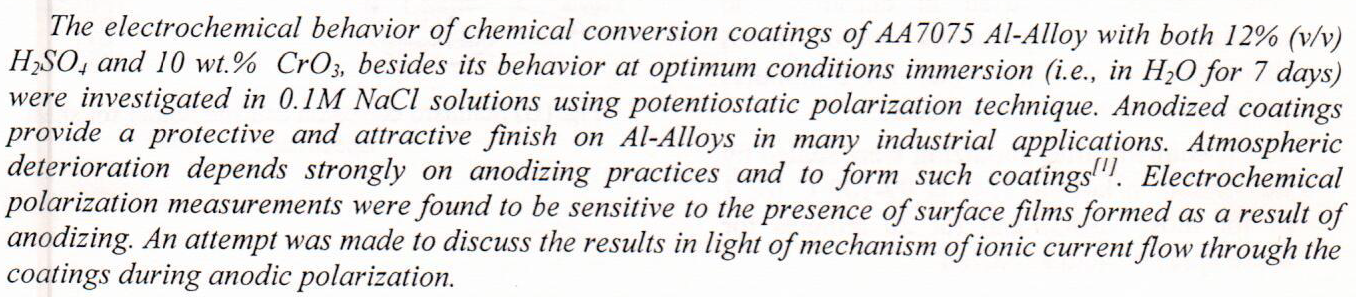
Electrochemical behavior of Anodized AA7075 Aluminum Alloy in 0.1M NaCl Solution as Investigated by Potentiostatic Polarization Ttechnique

In this work; copper oxide films (CuO) were fabricated by PLD. The films were analyzed by UV-VIS absorption spectra and their thickness by using profilometer. Pulsed Nd:YAG laser was used for prepared CuO thin films under O2 gas environment with varying both pulse energy and annealing temperature. The optical properties of as-grown film such as optical transmittance spectrum, refractive index and energy gap has been measured experimentally and the effects of laser pulse energy and annealing temperature on it were studied. An inverse relationship between energy gap and both annealing temperature and pulse energy was observed.
 (5)
(5)

Tin dioxide doped silver oxide thin films with different x content (0, 0.03, 0.05, 0.07) have been prepared by pulse laser deposition technique (PLD) at room temperatures (RT). The effect of doping concentration on the structural and electrical properties of the films were studied. Atomic Force Measurement (AFM) measurements found that the average value of grain size for all films at RT decrease with increasing of AgO content. While an average roughness values increase with increasing x content. The electrical properties of these films were studied with different x content. The D.C conductivity for all films increases with increasing x content. Also, it found that activation energies decrease with increasing of AgO content for all films.
... Show More
Abstract: The aim of this study was to evaluate the effect of bone density value in Hounsfield unit derived from cone beam computed tomography (CBCT), and implant dimensions in relation to implant stability parameters namely the resonance frequency analysis and the insertion torque (IT) value. It included 24 patients who received 42 dental implants (DI). The bone density of the planned implant site was preoperatively measured using cone beam computed tomography. The implant stability was measured using Osstell implant stability quotient (ISQ). The ISQ values were recorded immediately postoperatively and after 16 weeks. The IT value was categorized as 35 N/cm or > 35 N/cm. The mean (standard deviation) primary stability was 79.58 (5.27) ISQ,
... Show More (14)
(18)
(14)
(18)

 (26)
(18)
(5)
(3)
(26)
(18)
(5)
(3)
The logistic regression model is an important statistical model showing the relationship between the binary variable and the explanatory variables. The large number of explanations that are usually used to illustrate the response led to the emergence of the problem of linear multiplicity between the explanatory variables that make estimating the parameters of the model not accurate.
... Show More
Coupling reaction of 2-amino benzoic acid with the 8-hydroxy quinoline gave the azo ligand (H2L): 5-(2-benzoic acid azo )-8-hydroxy quinoline.Treatment of this ligand with some metal ions (CoII, NiII and CuII ) in ethanolic medium with a (1:2) (M:L) ratio yielded a series of neutral complexes with general Formula[M(HL)2],where: M=Co(II), Ni(II) and Cu(II), HL=anion azo ligand (-1).The prepared complexes were characterized using flame atomic absorption,FT-IR and UV-Vis spectroscopic methods as well as magnetic susceptibility and conductivity measurements.
This study was carried out to measure the percentage of heavy metals pollution in the water of the Diyala river and to measure the percentage of contamination of these elements in the leafy vegetables grown on both sides of the Diyala river, which are irrigated by the contaminated river water (celery, radish, lepidium, green onions, beta vulgaris subsp, and malva). Laboratory analysis was achieved to measure the ratio of heavy element contamination (Pb, Fe, Ni, Cd, Zn and Cr) using flame atomic absorption spectrophotometer during the summer months of July and August for the year 2017. The study showed that the elements of zinc, chromium, nickel and cadmium were high concentrations and exceeded. The maximum concentration of these
... Show MoreIn this work, metal oxides nanostructures, mainly, copper oxide (CuO), nickel oxide (NiO), titanium dioxide (TiO2), and multilayer structure were synthesized by dc reactive magnetron sputtering technique. The structural purity and nanoparticle size of the prepared nanostructures were determined. The individual metal oxide samples (CuO, NiO and TiO2) showed high structural purity and minimum particle sizes of 34, 44, 61 nm, respectively. As well, the multilayer structure showed high structural purity as no elements or compounds other than the three oxides were founds in the final sample while the minimum particle size was 18 nm. This reduction in nanoparticle size can be considered as an advantage for the dc reactive magnetron sputtering tec
... Show More