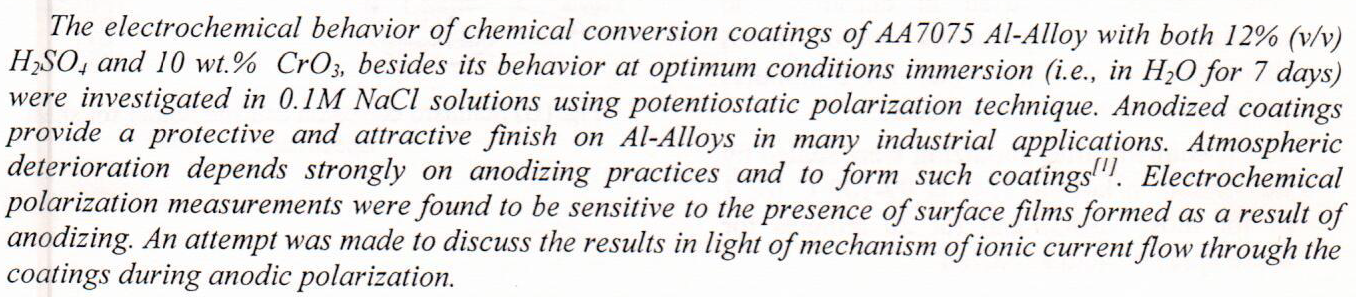
Electrochemical behavior of Anodized AA7075 Aluminum Alloy in 0.1M NaCl Solution as Investigated by Potentiostatic Polarization Ttechnique

The influence and hazard of fire flame are one of the most important parameters that affecting the durability and strength of structural members. This research studied the influence of fire flame on the behavior of reinforced concrete beams affected by repeated load. Nine self- compacted reinforced concrete beams were castellated, all have the same geometric layout (0.15x0.15x1.00) m, reinforcement details and compressive strength (50 Mpa).
To estimate the effect of fire flame disaster, four temperatures were adopted (200, 300, 400 and 500) oC and two method of cooling were used (graduated and sudden). In the first cooling method, graduated, the tested beams were leaved to cool in air while in the seco
... Show MoreThis paper studies the behavior of axially loaded RC columns which are confined with carbon fiber reinforced polymers’ sheet (CFRP) and steel jackets (SJ). The study is based on twelve axially loaded RC columns tested up to failure. It is divided into three schemes based on its strengthening type; each scheme has four columns. The main parameters in this study were the compressive strength of the concrete and steel reinforcement ratio. Furthermore, the results of the experimental test showed a substantial enhancement in the column's load-carrying capacity. When compared to the original columns, the CFRP sheet had a significant effect on improving the ductility of the column by increasing the axial deformation by about 59.2 to 95.7
... Show More (2)
(2)
 (1)
(1)


This research involves the synthesis of some sulphanyl benzimidazole derivatives (Ia-c), which were prepared from reaction of 2-mercaptobenzimidazole substituted benzyl halide, and structures were identified by spectral methods[FTIR, 1H-NMR and 13C-NMR].These compounds were investigated as corrosion inhibitors for carbon steel in 1M H2SO4 solution using weight loss, potentiostatic polarization methods; obtained results showed that the sulphanyl benzimidazole derivatives retard both cathodic and anodic reactions in acidic media, by virtue of adsorption on the carbon steel surface. This adsorption obeyed Langmuir’s adsorption isotherm. The inhibition efficiency of (Ia-c) ranging between (65-92) %. By using different Ib derivative conc
... Show MoreIn this present research, new derivatives were designed from metoclopramide skeleton and after studying the effect of these materials as corrosion inhibitors for the carbon steel 45 in HCl solution. Metoclopramide as the starting compound was diazotized with sodium nitrate and concentrated HCl in below 5 oC to afford diazonium salt that coupled in a basic medium with active compounds like 1-Nitrose-2-naphthol and 2-Nitrose-1-naphthol to afforded azo compounds M1 and M2 respectively. The newly designed compounds identify their structure by distinct spectral techniques involving FTIR and 1H-NMR. Also several of its physical properties were determined. These compounds were studied as corrosion inhibitors in an acidic medium at different t
... Show More
Quadrupole Q moments and effective charges are calculated for 9C, 11C, 17C and 19C exotic nuclei using shell model calculations. Excitations out of major shell space are taken into account through a microscopic theory which are called core-polarization effects. The simple harmonic oscillator potential is used to generate the single particle matrix elements of 9,11,17,19C. The present calculations with core-polarization effects reproduced the experimental and theoretical data very well.
The degradation of Toluidine Blue dye in aqueous solution under UV irradiation is investigated by using photo-Fenton oxidation (UV/H2O2/Fe+). The effect of initial dye concentration, initial ferrous ion concentration, pH, initial hydrogen peroxide dosage, and irradiation time are studied. It is found put that the removal rate increases as the initial concentration of H2O2 and ferrous ion increase to optimum value ,where in we get more than 99% removal efficiency of dye at pH = 4 when the [H2O2] = 500mg / L, [Fe + 2 = 150mg / L]. Complete degradation was achieved in the relatively short time of 75 minutes. Faster decolonization is achieved at low pH, with the optimal value at pH 4 .The concentrations of degradation dye are detected by spectr
... Show More
The nanostructured MnO2 /carbon fiber (CF) composite electrode was prepared using the anodic electrodeposition process. The crystal structure and morphology of MnO2 particles were determined with X-ray diffraction and field-emission scanning electron microscopy. The electrosorptive properties of the prepared electrode were investigated in the removal of cadmium ions from aqueous solution, and the effect of pH, cell voltage, and ionic strength was optimized and modeled using the response surface methodology combined with Box–Behnken design. The results confirm that the optimum conditions to remove Cd(II) ions were: pH of 6.03, a voltage of 2.77 V, and NaCl concentration of 3 g/L. The experimental results showed a good fit for the Freundli
... Show More
(5)
(4)

The dimensions of bubbles were measured in a stirrer tank electrochemical reactor, where the analysis of the bubble size distribution has a substantial impact on the flow dynamics. The high-speed camera and image processing methods were used to obtain a reliable photo. The influence of varied air flow rates (0.3; 0.5; 1 l/min) on BSD was thoroughly investigated. Two types of distributors (cubic and circular) were examined, and the impact of various airflow rates on BSD was investigated in detail. The results showed that the bubbles for the two distributors were between 0.5 and 4.5 mm. For both distributors at each airflow, the Sauter mean diameter for the bubbles was calculated. According to the results, as the flow rate raised, the bubb
... Show More
The driving idea for the present work was to combine the effect of polyvinyl alcohol (PVA) as corrosion inhibitor with the distance between the anodic and cathodic elements of the galvanic cell, beside their area ratio, in scope of synergistic suppression of galvanic corrosion on Cu/Fe model couple, using weight loss method. The performance affecting galvanic corrosion process has been tested for three major factors affect the process:
1. Four PVA inhibitor concentrations were selected to be (0, 1000, 4000 and 7000 ppm) in simulated cooling water.
2. Two cathode: anode area ratios as 1:1 and 2.4:1.
3. Two distances apart cathode – anode as 3 and 7 cm.
Maximum corrosion inhibition achieved was 86% which indicates that increa
Industrial machining workshops generate substantial quantities of aluminum wire offcuts and filings that cannot be re-entered into bulk metal recycling circuits, posing both a resource management challenge and a potential environmental burden. This study demonstrates a closed-loop valorization route in which this low-grade aluminum waste is converted into nanostructured aluminum oxide (Al2O3) nanoparticles (NPs) by two scalable synthesis pathways (i) chemo-thermal calcination of precipitated Al(OH)₃ at 1000 °C and 1200 °C for 1 and 4 h, and (ii) direct chemical precipitation via AlCl3/Na2CO3 reaction, and then deployed as a functional additive in water-based drilling fluids (WBDFs) used by the oil and gas industry. Comprehensive chara
... Show More
(2)
(1)