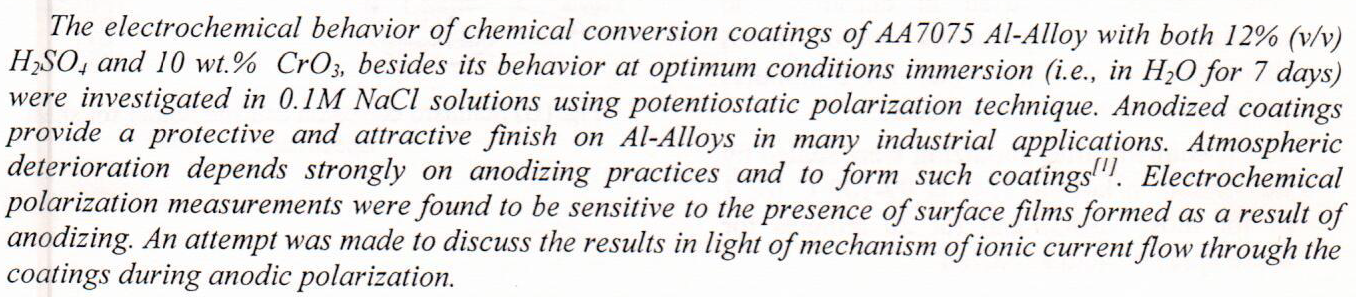
Electrochemical behavior of Anodized AA7075 Aluminum Alloy in 0.1M NaCl Solution as Investigated by Potentiostatic Polarization Ttechnique

Fe, Co and Sb nanopowders were fruitfully prepared by electrical wire explosion method in Double distilled and de-ionized water (DDDW) media. The formation of iron, cobalt and antimony (FeCoSb) alloy nanopowder was monitored by X-ray diffraction. The x-ray diffraction pattern indicates that there are iron, cobalt and antimony peaks. Optical properties of this alloy nanoparticles were characterized by UV-Visible absorption spectra. The absorption peak position is shifted to the lower wavelengths when the current increases. That means the mean size of the nanoparticles controlled by changing the magnitude of the current. The surface morphological analysis is carried out by employing Scanning Electron Microscope (SEM). Particles with varies
... Show More (1)
(1)

Abstract: In the present work, the heat transfer of Nano Aluminum Oxide -NAO- has been studied practically to define the appropriate insulation conditions. This study focuses on finding of the amount of heat transfer through a glass substrate that is coated with nanoalumina doped on PMMA matrix. The optical and thermal properties were systematically investigated. The density of heat flow rate, was calculated in the range values (240-260) W/m2 while the optimum values confine between (250-260) W/m2 at temp. (25-35)Co. The results showed that the thermal insulation of the sample was significantly enhanced at temp. (30-50)Co. The simulated net heat transfer through window decreased linearly with incr
... Show MoreLaser shock peening (LSP) is deemed as a deep-rooted technology for stimulating compressive residual stresses below the surface of metallic elements. As a result, fatigue lifespan is improved, and the substance properties become further resistant to wear and corrosion. The LSP provides more unfailing surface treatment and a potential decrease in microstructural damage. Laser shock peening is a well-organized method measured up to the mechanical shoot peening. This kind of surface handling can be fulfilled via an intense laser pulse focused on a substantial surface in extremely shorter intervals. In this work, Hydrofluoric Acid (HF) and pure water as a coating layer were utilized as a new technique to improve the properti
... Show More
(5)
Viscosities (η) and densities (ρ) of atenolol and propranolol hydrochloride in water and in concentrations (0.05 M) and (0.1 M) aqueous solution of threonine have been used to reform different important thermodynamic parameters like apparent molal volumes fv partial molal volumes at infinite dilution fvo , transfer volume fvo (tr), the slop Sv , Gibbs free energy of activation for viscous flow of solution ΔG*1,2 and the B-coefficient have been calculated using Jones-Dole equation. These thermodynamic parameters have been predicted in terms of solute-solute and solute-solvent interaction.
Elastic magnetic M1 electron scattering form factor has been calculated for the ground state J,T=1/2-,1/2 of 13C. The single-particle model is used with harmonic oscillator wave function. The core-polarization effects are calculated in the first-order perturbation theory including excitations up to 5ħω, using the modified surface delta interaction (MSDI) as a residual interaction. No parameters are introduced in this work. The data are reasonably explained up to q~2.5fm-1 .
In the theoretical part, removal of direct yellow 8 (DY8) from water solution was accomplished using Bentonite Clay as an adsorbent. Under batch adsorption, the adsorption was observed as a function of contact time, adsorbent dosage, pH, and temperature. The equilibrium data were fitted with the Langmuir and Freundlich adsorption models, and the linear regression coefficient R2 was used to determine the best fitting isotherm model. thermodynamic parameters of the ongoing adsorption mechanism, such as Gibb's free energy, enthalpy, and entropy, have also been measured. The batch method was also used for the kinetic calculations, and the day's adsorption assumes first-order rate kinetics. The kinetic studies also show that the intrapar
... Show More (57)
(57)
 (57)
(57)
The influence and hazard of fire flame are one of the most important parameters that affecting the durability and strength of structural members. This research studied the influence of fire flame on the behavior of reinforced concrete beams affected by repeated load. Nine self- compacted reinforced concrete beams were castellated, all have the same geometric layout (0.15x0.15x1.00) m, reinforcement details and compressive strength (50 Mpa). To estimate the effect of fire flame disaster, four temperatures were adopted (200, 300, 400 and 500) oC and two method of cooling were used (graduated and sudden). In the first cooling method, graduated, the tested beams were leaved to cool in air while in the second method, sudden, water splash was use
... Show More