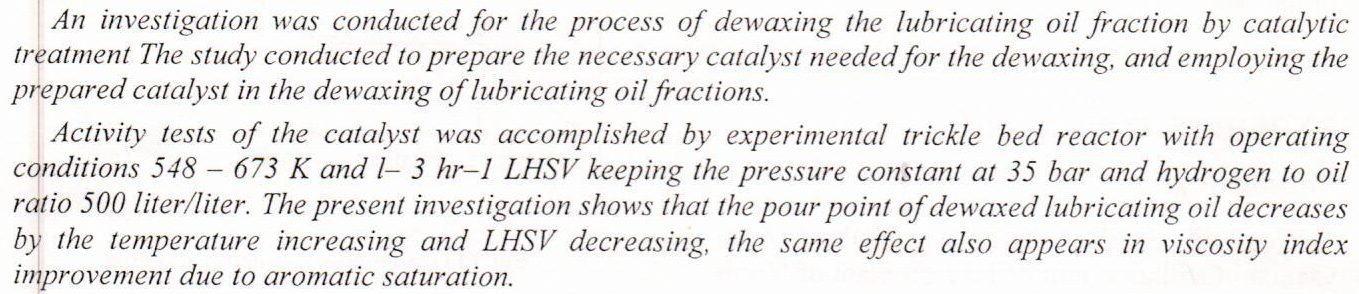
Catalytic Pour Point Reduction and Viscosity Improvement of Lubricating Oil Fractions using Sulfided Nickel-Tungsten Catalysts

Objectives: The study aims to investigate the efficiency of physiotherapy methods to improve the
degree of the clinical recovery of the peripheral facial palsy.
Methodology: This study is carried out at the Rehabilitation Center-Baghdad from November 2009 till
March 2010. This study includes (40) patient, their ages are from (13) to (55) years old; (24) male and
(16) female with unilateral facial palsy of undetermined cause. House-Brackmann facial recovery
scores have been used before and after the physiotherapy treatment.
Results: The results show that the physiotherapy sessions obtained the best effect of the electrical
stimulation, exercises and massage in the treatment of facial palsy. Highly respondents in femal
Oil flow lines are used to transport oil and its derivatives from a well over long distances, and because oil wells produce other potentially corrosive products, such as carbon dioxide and Hydrogen sulfide, it is necessary to take methods to protect the pipeline from corrosion. One of these methods is the use of corrosion inhibitors in this study. Prepare 5-acetyl-2-anilino-4-dimethylaminothiazole and test it as a corrosion inhibitor on a sample of the Rumaila flow line at a constant temperature 25°C in (3.5%) NaCl and (3.5%) KCl solution in the absence and presence of different concentrations of inhibitor (0 mM, 0.01 mM, 0.03 M, 0.05 mM). by using liner polarization (Tafel slope). The inhibiter exhibited the best performance at hi
... Show More (2)
(2)

 (1)
(1)

The herbal remedy individually or in combination with standard medicines has been used in diverse medical treatises for the cure of different diseases. Pumpkin seed oil is one of the recognized edible oil and has substantial medicinal properties due to the presence of unique natural edible substances. Inflammation is an adaptive response that is triggered by noxious stimuli and conditions, which involves interactions amongst many cell types and mediators, and underlies many pathological processes. Unsaturated fatty acids (UFAs) can influence inflammation through a variety of mechanisms, and have been indicated as alternative anti-inflammatory agents to treat several inflammatory skin disorders. Pumpkin seed oil is rich in (UFAs), that its t
... Show More
(14)
Background: Medicinal plants that possess antimicrobial and antioxidant properties have garnered significant attention for their role in maintaining food quality, improving safety, and impeding spoilage. They also can aid in controlling food contamination risks and augmenting the nutritional value of foods. Objective: The study aimed to obtain botanical extracts possessing antimicrobial capabilities and use them to inhibit the growth of molds and yeasts. Additionally, these extracts are aimed at prolonging product shelf life by harnessing their antioxidant attributes. Methods: Several microorganisms, including E. coli and Pseudomonas, were subjected to testing. Ethanolic alcohol, chloroform, and essential oil extracts were prepared;
... Show More
(11)
(3)

This study was conducted in the field of the Poultry Research Station of the animal resources Department / office of Agricultural Research / Ministry of Agriculture from the period 4th April to16th May2021.This study was aimed to investigate the effect of using avocado and chia oil and their mixture in broiler diets on the final productive performance and meat cholesterol concentration and measuring meat oxidation indicators after storing it for 60 days. 300 one-day-old (Ross308) chicks were fed on diets that used avocado oil and chia with percentages of 0, 0.2, 0.4, 0.6%, respectively, and their mixture consisting of 0.0, 0.1, 0.2, 0.3 each of avocado and chia oil (50% avocado + 50% chia oil). The experiment included 10 treatments
... Show More
(2)
An experimental analysis was included to study and investigate the mass transport behavior of cupric ions reduction as the main reaction in the presence of 0.5M H2SO4 by weight difference technique (WDT). The experiments were carried out by electrochemical cell with a rotating cylinder electrode as cathode. The impacts of different operating conditions on mass transfer coefficient were analyzed such as rotation speeds 100-500 rpm, electrolyte temperatures 30-60 , and cupric ions concentration 250-750 ppm. The order of copper reduction reaction was investigated and it shows a first order reaction behavior. The mass transfer coefficient for the described system was correlated with the aid of dimensionless groups as fo
... Show More<p>In this paper, we prove there exists a coupled fixed point for a set- valued contraction mapping defined on X× X , where X is incomplete ordered G-metric. Also, we prove the existence of a unique fixed point for single valued mapping with respect to implicit condition defined on a complete G- metric.</p>
In this study, sulfur was removed from imitation oil using oxidative desulfurization process. Silicoaluminophosphate (SAPO-11) was prepared using the hydrothermal method with a concentration of carbon nanotubes (CNT) of 0% and 7.5% at 190 °C crystallization temperature. The final molar composition of the as-prepared SAPO-11 was Al2O3: 0.93P2O5: 0.414SiO2. 4% MO/SAPO-11 was prepared using impregnation methods. The produced SAPO-11 was described using X-ray diffraction (XRD) and Brunauer-Emmet-Teller (N2 adsorption–desorption isotherms). It was found that the addition of CNT increased the crystallinity of SAPO-11. The results showed that the surface area of SAPO-11 containing 7.5% CNT was 179.54 m2/g, and the pore volume was 0.31
... Show More
(6)