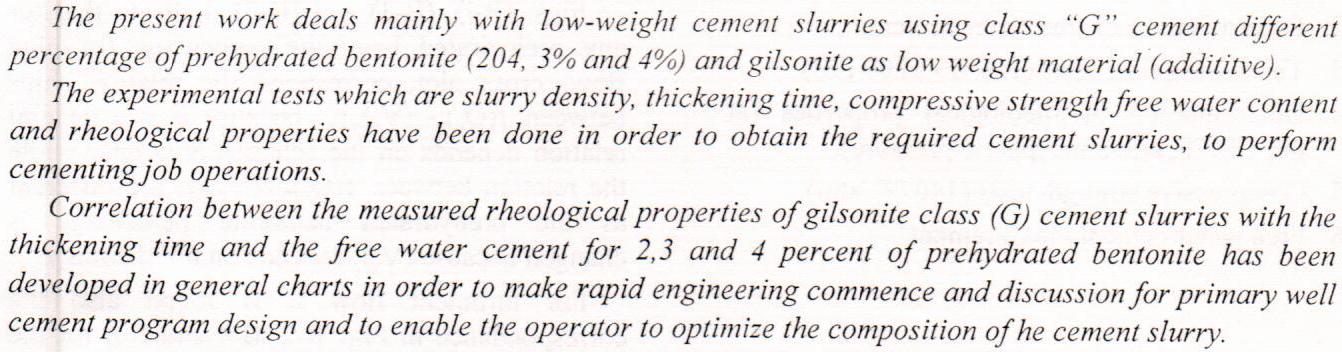
Physical and Rheological Properties of Class "G" Gilsonite Cement Slurries (Experimental Study)

The main objective of this study is to understand the work of the pile caps made of lightweight aerated foam concrete and study the many factors affecting the ability and the capacity of the shear. The study was done by analyzing previous practical and theoretical experiences on the reinforced concrete pile caps. The previous practical results indicated that all specimens failed by shear diagonal compression or tension modes except one specimen that failed flexural-shear mode. Based on test specimens' practical results and behavior, some theoretical methods for estimating the ultimate strength of reinforced concrete pile caps have been recommended, some of which evolved into the design documents available on the subject.
... Show More
Background: Sialosis described as a specific consequence of diabetes. In diabetic sialosis, the increased volume of the glands is due to the infiltration of adipose in the parenchyma. The B-scan ultrasonography is a generally accepted tool for determining parotid gland enlargement. Oral health is, to a greater extent, dependent on quality and quantity of saliva, both of which may be altered in diabetics. This study was established to detect the enlargement of parotid gland in diabetic patient and study the changes in physical properties of saliva and its relation with the salivary gland enlargement. Subjects, Materials and Methods: A cross-sectional study with highly specified criteria with ages ranged (20-65) years, male and female subject
... Show More (3)
(3)
Acidizing is one of the most used stimulation techniques in the petroleum industry. Several reports have been issued on the difficulties encountered during the stimulation operation of the Ahdeb oil field, particularly in the development of the Mishrif reservoir, including the following: (1) high injection pressures make it difficult to inject acid into the reservoir formation, and (2) only a few acid jobs have been effective in Ahdeb oil wells, while the bulk of the others has been unsuccessful. The significant failure rate of oil well stimulation in this deposit necessitates more investigations. Thus, we carried out this experimental study to systematically investigate the influence of acid treatment on the geomechanical properties of Mi4
... Show More
(23)
In this research, a selection of some mineral water was selected on the basis of being the most marketed by the owners of shops in Najaf province, with six types, where daily samples of this water were taken by 50 ml for two months from (1/11/2018 -1/1/2019). The following ions concentrations were measured (Br-, Cl-, F-, NO3-, SO42-, Na+, K+, Ca2+, Mg2+), pH and the electrical conductivity were measured and the results were compared with the allowable rates according to the international organizations. It was noted that they conform to international and Iraqi standards.
In this work, functionally graded materials were synthesized by centrifugal technique at different
volume fractions 0.5, 1, 1.5, and 2% Vf with a rotation speed of 1200 rpm and a constant rotation time, T
= 6 min . The mechanical properties were characterized to study the graded and non-graded nanocomposites
and the pure epoxy material. The mechanical tests showed that graded and non-graded added alumina
(Al2O3) nanoparticles enhanced the effect more than pure epoxy. The maximum difference in impact strength
occurred at (FGM), which was loaded from the rich side of the nano-alumina where the maximum value was
at 1% Vf by 133.33% of the sample epoxy side. The flexural strength and Young modulus of the fu
 (6)
(2)
(6)
(2)

Let P be a right R-module, where R is a ring with identity. In the present research, a class of modules is described similar to H-μ-supplemented and μ-lifting modules. A module P is called principally H-μ-supplemented if there is a summand L of P such that pR is μ-equivalent to L for every p in P. Additionally, we present an extension of supplemented modules. A module P is considered to be principally μ-supplemented if, for every p in P, pR has a μ-supplement in P. A number of characteristics of these modules are shown, and it is demonstrated that both the Pμ-H-supplemented and Pμ-supplemented modules include the class of principally μ-lifting modules.
The aim of this study was spot light to the possibility of confection between hepatitis C&G viruses in Iraqi patients. The groups was studied included two groups as follow: 1- first group: its (Infected group) the patients of this group have Anti-HCV abs in their serum by using Indirect ELISA technique. 2- second group: its (Control group) the persons of this group have no Anti-HCV abs in their serum by using indirect ELISA technique. The result of this study was observed there was two patients from the first group have Anti-HGVabs in their serum with infection percent 2.70%, also the same result was found in the second group wich mean there was two persons have Anti-HGVabs in their serum with infection percent 8.33% .So when we comparin
... Show More
In this work, ZnO nanostructures for powder ZnO were synthesized by Hydrothermal Method. Size and shape of ZnO nanostructureas can be controlled by change ammonia concentration. In the preparation of ZnO nanostructure, zinc nitrate hexahydrate [Zn(NO3)2·6H2O] was used as a precursor. The structure and morphology of ZnO nanostructure have been characterized by scanning electron microscopy (SEM), atomic force microscopy (AFM), X-ray diffraction (XRD). The synthesized ZnO nanostructures have a hexagonal wurtzite structure. Also using Zeta potential and Particle Size Analyzers and size distribution of the ZnO powder
Abstract
Theoretical and experimental methodologies were assessed to test curved beam made of layered composite material. The maximum stress and maximum deflection were computed for each layer and the effect of radius of curvature and curve shape on them. Because of the increase of the use of composite materials in aircraft structures and the renewed interest in these types of problems, the presented theoretical assessment was made using three different approaches: curved beam theory and an approximate 2D strength of material equations and finite element method (FEM) analysis by ANSYS 14.5 program for twelve cases of multi-layered cylindrical shell panel differs in fibe
... Show MoreThe present work aimed to study the efficiency of nanofiltration (NF) and reverse osmosis (RO) membrane for heavy metal removal from wastewater and study the factors affecting the performance of these two membranes: feed concentrations for heavy metal ions, pressure, and flow rate. The experimental results showed, heavy metals concentration in permeate increase with raise in feed concentrations, decline with increase in flow rate. The raise of pressure, heavy metals concentration decreases for RO membrane, but for NF membrane the concentration decrease and then at high pressure increase. The rejection percentage for chromium in NF and RO is 99.7% and 99.9%, for copper is 98.4% and 99.3%, for zinc is 97.9% and 99.5%, for nickel is 97.2% and
... Show More
(3)