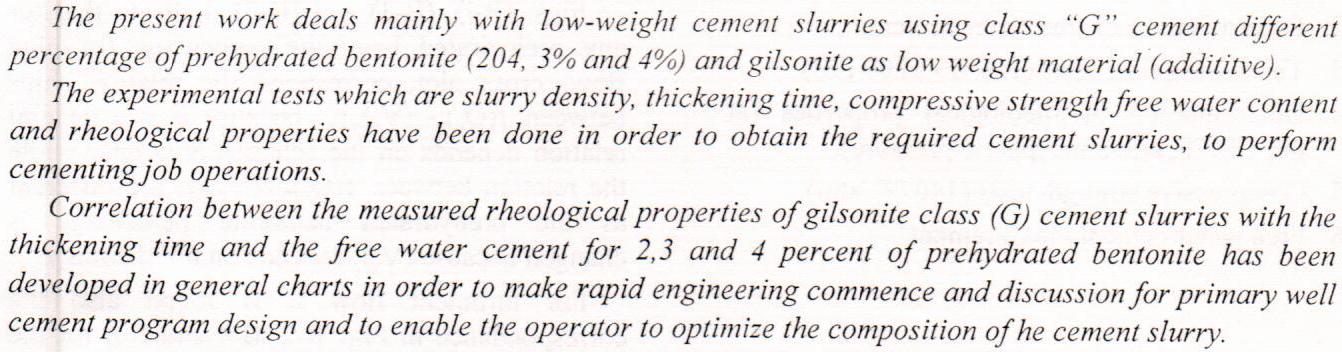
Physical and Rheological Properties of Class "G" Gilsonite Cement Slurries (Experimental Study)

Esterification reaction is most important reaction in biodiesel production. In this study, oleic acid was used as a suggested feedstock to study and simulate production of biodiesel. Batch esterification of oleic acid was carried out at operating conditions; temperature from 40 to 70 °C, ethanol to oleic acid molar ratio from 1/1 to 6/1, H2SO4 as the catalyst 1 and 5% wt of oleic acid, reaction time up to 180 min. The optimum conditions for the esterification reaction were molar ratio of ethanol/oleic acid 6/1, 5%wt H2SO4 relative to oleic acid, 70 °C, 90 min and conversion of oleic 0.92. The activation energy for the suggested model was 26625 J/mole for forward reaction and 42189 J/mole for equilibrium constant. The obtained results s
... Show More (2)
(2)


In this study, iron oxide nanoparticles (α-Fe₂O₃ NPs) were prepared using a readily available chili pepper plant extract from local markets. This study aims to evaluate the magnetic properties of α-Fe₂O₃ prepared in green chemistry from Capsicum plant extract. After several simple preparatory steps, such as washing and cutting, they were treated with an inorganic complex (potassium hexacyanoferrate) (K3[Fe(CN)₆]). In the first analytical step, the in vitro detection of the plant extract solution after reaction with the potassium hexacyanoferrate (III) complex revealed characteristic adsorption bands of the cyanide group, which disappeared upon complexation. The iron oxide NPs were characterized using various methods, including X
... Show More
Films of pure Poly (methyl methacrylate) (PMMA) doped by potassium iodide (KI) salt with percentages (1%) at different thickness prepared by casting method at room temperature. In order to study the effect of increasing thickness on optical properties, transmission and absorption spectra have been record for five different thicknesses(80,140,210,250,320)µm. The study has been extended to include the changes in the band gap energies, refractive index, extinction coefficient and absorption coefficient with thickness.
A new 4-thiazolidinone, substitutedbenzylidene-thiazolidinone and tetrazole were synthesized from thiosemicarbazone and hydrazone. The thiosemicarbazone was prepared by the reaction of thiosemicarbazide with aldehyde derivative from L-ascorbic acid in absolute ethanol using glacial acetic acid as a catalyst. 1, 3-thiazolidin-4-ones were synthesized from the condensation of thiosemicarbazones with chloroacetic acid in presence of anhydrous sodium acetate. A 1, 3- thiazolidine-4-one was reaction with several 4-substitutedaldehydes to produce new derivatives with a double bond at the position-5 of the 4-thiazolidinone ring. While the tetrazole compounds were synthesized by 1, 3-cycloaddition reaction of sodium azide and hydrazone compounds in
... Show MoreA new carbonyl complexes of triazole and oxadiazole were synthesized. These complexes were identified and their structural geometric were suggested by using FT-IR and UV-Vis spectra, conductivity measurements and other chemical and physical properties. The spectra data (FT-IR, UV, Vis.) with the substantial aid of group theoretical calculations gave so many evidences for the proposed geometries and the type of bonding of these compounds
Thispaperpresentsthesynthesisandstudyofsomenewmixed-liagnd complexescontainingtowaminoacids[Alanine(Ala)andphenylalanine(phe)]withsome metals .Theresultsproductswerefoundtobesolidcrystallinecomplexeswhichhave been characterized by using (FT-IR,UV-Vis) spectra , melting point, elemental analysis (C.H.N) , molar conductivity and solubiltyThe proposed structure of the complexes using program , chem office 3D(2000) .The general formula have been given for the prepared complexes :[M(A-H)(phe-H)]M(II): Hg , Mn ,Co , Ni , Cu ) , Zn , Cd(II) .Ala = Alanine acid = C3H7NO2Phe = phenylalanine = C9H11NO2
In this work involved prepared of several new 1-cyclopentene-1,2-dicarboxylimide linked to oxadiazole and benzothiazole moiety were synthesized by two steps: The first step 2-amino-substituted-1,3,4-oxadiazoles and substituted-2-aminobenzothiazole were reaction with 1-cyclopentene-1,2-dicarboxyl anhydride producing N-( 5- substituted-1,3,4-oxadiazole-2-yl)-1-cyclopentene-1,2-dicarboxyl amic acids and N-(Substitutedbenzothiazole-2-yl)-1-cyclopentene-1,2-dicarboxyl amic acids which in turn were dehydrated in the second step via fusion method to afford he desirable N-(5-substituted-1,3,4-oxadiazole-2-yl)-1-cyclopentene-1,2-dicarboxylimides and N-(Substituted benzothiazole-2-yl)1-cyclopentene-1,2-dicarboxylimides respectively. Struct
... Show More