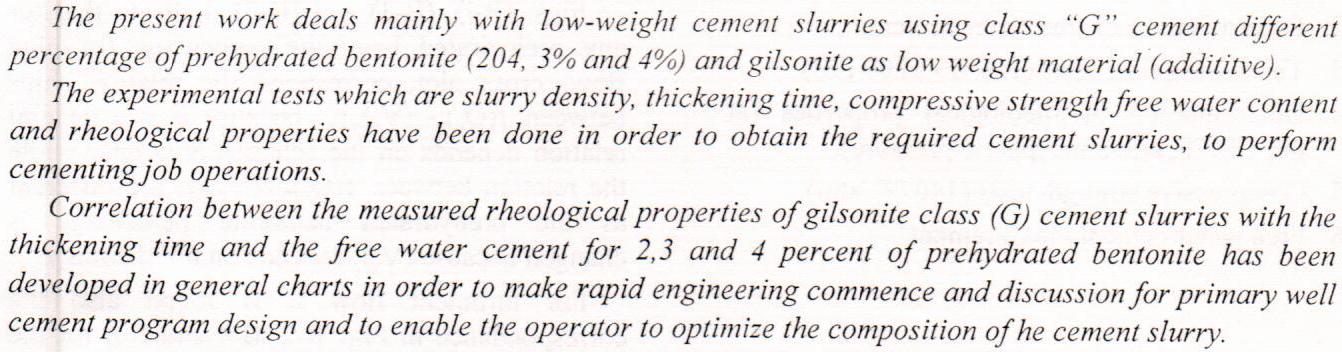
Physical and Rheological Properties of Class "G" Gilsonite Cement Slurries (Experimental Study)

Tafsir, ‘interpretation’ is one of the most important sciences the Muslims need. Because Allah, Almighty, revealed the Qur’an to be a way of life for the Muslims in which the healing of what is in the chest, including their goodness and their peasant. Allah says:
“O people, an admonition has indeed come to you from your Lord and a healing for what is in the hearts; and a guidance and a mercy for the believers.”
In order to achieve the goal for which God revealed the Quran must be understood and managed verses:” This is a Book that We have revealed to you abounding in good, that they may ponder over its verses, and that those who have understanding may be mindful.”
The Prophet (PBUH) and his companions understood t

 (1)
(1)

 (17)
(12)
(17)
(12)
New substituted coumarins derivatives were synthesized by using nitration reaction to produce different nitro coumarin isomers which were separated from these isomers by using different solvent, and the reduction of nitro compounds was done to give corresponding amino coumarins. Temperature and reaction time of reaction were very important factors in determining the most productive nitro isotopes. A low temperature for three hours was sufficient to give a high product of a compound 6-nitro coumarin while increasing the temperature for a period of twenty-four hours that gave a high product of 8-nitro-coumarin. The synthesized compounds were confirmed by FT-IR,1 H-NMR, and13 C-NMR spectroscopy and all final compounds were tested for their ant
... Show More
(32)
the study covered theoretical concering parial molal volume the applicability of jones-dole equation
Scorpions and spiders belong to the class Arachnida in phylum Arthropoda. Scorpions are easily distinguished by median eyes on obvious the center of the carapace and have one pair, and lateral eyes have 2-8 in some species. Scorpions do not have good eyesight so the median eyes have always been simple and they are more sensitive than the lateral pairs. They have anterior median eyes (AME) with narrow field of view and pairs of lateral eyes (LE) with more sensitivity and response to light. Family Buthidae have 2-6 lateral eyes in Compsobuthus Mesobuthus, Hottentotta, while Vaejovidae, Chactidae and Chaerilidae have 2 pairs of lateral eyes. In addition, 3 pairs are found in Orthochirus and Androctonus. Spiders have six eyes in family Pholicid
... Show MoreThree groups of subjects have been divided (25/group): healthy normotensive non-pregnant women (Group A), normal normotensive pregnant women (Group B), and women with preeclampsia (Group C).The levels of serum alanine aminotransferase (ALT), aspartate aminotransferase (AST), total bilirubin , creatinine , blood urea nitrogen, triglyceride , total cholesterol and glucose have been estimated in all subjects. All measured parameters were determined by spectrophotometric analysis. The results showed a significant(P<0.05) increase in serum ALT, AST, blood urea nitrogen, triglyceride and total cholesterol levels in group B as compared to group A. However creatinine, total bilirubin and glucose levels did not show any statistical significant alt
... Show More
An increasing number of emerging contaminants have been detected in surface waters, sediment, soil and ground water in different locations in the world, which is a new environmental challenges need an actual concern for international scientific and legislative communities.
The nonprescription and huge used pharmaceuticals ibuprofen and diclofenac sodium will be focused in this study. New adsorbent developed using cheap inorganic clay material (bentonite) and organic polymer polyureaformaldehyde (PUF), the combination of these two materials gave the surface more roughness with wide active site distribution. Batch adsorption experiment performed to each pharmaceutical individually to determine the optimum separat
... Show MoreCarbides or nitrides thin films present materials with good mechanical properties for industrial applications as they can be coatings at low temperatures serve temperature sensitive surfaces. In this work the effect of the C percentage on the mechanical properties represented by the Young modulus (E) of combinatorial magnetron sputtered TiCx (34%x˂65%) has been studied. The structure of the produced films is TiC independent on the C concentration. The mechanical properties are increased with increasing the C concentration up to 50%, and then decreasing with further C % increasing. These results can be explained by considering the resultant residual stresses.