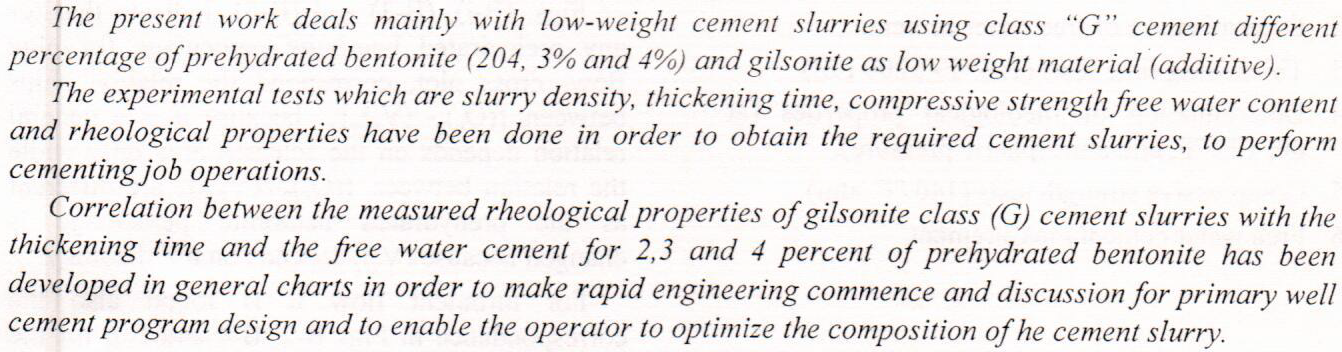
Physical and Rheological Properties of Class "G" Gilsonite Cement Slurries (Experimental Study)

Biodegradable polymers have garnered increasing attention as eco-friendly alternatives to conventional petroleum-derived plastics, which pose a global environmental challenge due to their difficult recycling and slow degradation. This study focuses on the preliminary evaluation of surface functional properties of chitosan films reinforced with TiO₂ or ZnO nanoparticles (NPs). These films were prepared at different loading ratios using the solution-casting method. Structural and morphological properties were characterized using FTIR and FESEM, while functional properties were evaluated by surface wettability, UV–Vis spectroscopy, thermogravimetric analysis and antibacterial activity testing. FTIR results showed significant changes in abs
... Show More (1)
 (1)

 (6)
(3)
 (1)
Al-Si alloys which are widely used in engineering applications due to their outstanding properties can be modified for more enhancements in their properties. Current work investigated the ability of these alloys to be modified by casting them through the addition of nanoparticles. So, Multi-wall carbon nanotubes (CNT) and titanium carbide ceramic particles (TIC) with size of (20 nm) were added with different amounts started from (0.5 up to 3%) weight to cast alloy A356 that was considered to be the base metal matrix, then stirred with different speeds of (270, 800, 1500, 2150) rpm at 520 °C for one minute. The results showed change in microstructure’ shape of the casted alloys from the dendritic to spherical gra
... Show More
(47)
(34)
Global warming and environmental damage have become major problems. The production of Portland cement releases large quantities of gas, which cause pollution to the atmosphere. This problem can be solved via the use of sustainable materials, such as glass powder. This study investigates the effect of partial replacement of cement with sustainable glass powder at various percentages (0, 15, 20, and 25%) by weight of cement on some mechanical properties (compressive strength, flexural strength, absorption, and dry density) of Reactive Powder Concrete (RPC) containing a percentage of Polypropylene fibers (PRPC) of 1% by weight. Furthermore, steam curing was performed for 5 hours at 90oC after hardening the sample directly. The RPC was
... Show More
(17)
(42)
(38)
The present research investigates joints welding of 304L austenitic stainless steel using metal inert gas (MIG) welding method. The research explores the effect of process parameters (arc voltage, wire feed rate, and electrode wire diameter) on the mechanical properties of stainless steel. The above variables are varied respectively with 18.5, 19, 19.5 V, 116, 127, 137 mm/s, and 0.8, 1, 1.2 mm, with E308L as a filler electrode. The design matrix of the experiments was determined using the design of experiment (DOE) program Minitab 17 based on the levels of input elements used. The Taguchi orthogonal matrix methodology (Taguchi) technique was used to develop some empirical analysis for the maximum tensile strength and proper surface
... Show More
(3)
(2)
Expansive soil is one of the most serious problems that face engineers during the execution of any infrastructure projects. Soil stabilization using chemical admixture is one of the most traditional and widespread methods of soil improvement. Nevertheless, soil improvement on site is one of the most economical solutions for many engineering applications. Using construction and demolishing waste in soil stabilization is still under research., The aim of this study is to identify the effect of using concrete demolishing waste (CDW) in soil stabilization. Serious tests were conducted to investigate the changes in the geotechnical properties of the natural soil stabilized with CDW. From the results, it is concluded that the
... Show More
(6)
The research targets study of influence of additives on sand mold’s properties and, consequently, on
that of carbon steel CK45 casts produced by three molds. Three materials were selected for addition
to sand mix at weight percentages. These are sodium carbonates, glycerin and oat flour. Sand molds
of studied properties were produced to get casts from such molds. The required tests were made to
find the best additives with respect to properties of cast. ANSYS software is used to demonstrate
the stresses distribution of each produced materials. It is shown that the mechanical properties of
casts produced is improved highly with sodium carbonates and is less with oat flour and it is seem a
few with glycerin additives
(4)