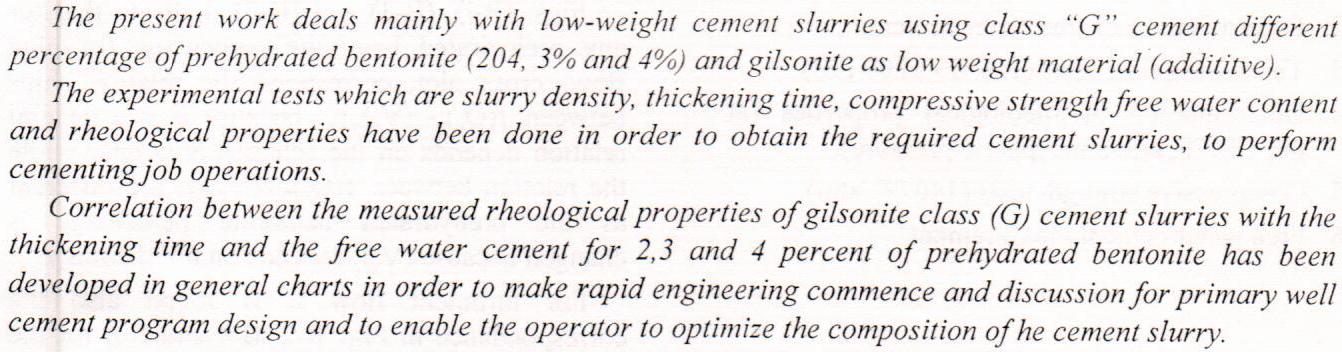
Physical and Rheological Properties of Class "G" Gilsonite Cement Slurries (Experimental Study)

In this work, we introduce the algebraic structure of semigroup with G-algebra is called GS-Algebra as extension of algebras QS-algebra and BP-algebra and then some basic properties are investigated. Several examples are presented. Also, some ideals in this concept are studied such as GS-ideal and closed-ideal. Some properties and characterizations of GS-ideal are presented. The relationships between GS-ideal and closed-ideal are studied. Furthermore, some results of GS-ideal in GS-Algebra under homomorphism are discussed. Finally, the graph (by its annihilator-ideal) as the simple graph with elements of a GS-Algebra is studied and some related properties are given. Several examples are presented and some theorems are proved.


The dynamic thermomechanical properties, sealing ability, and voids formation of an experimental obturation hydroxyapatite-reinforced polyethylene (HA/PE) composite/carrier system were investigated and compared with those of a commercial system [GuttaCore (GC)]. The HA/PE system was specifically designed using a melt-extrusion process. The viscoelastic properties of HA/PE were determined using a dynamic thermomechanical analyser. Human single-rooted teeth were endodontically instrumented and obturated using HA/PE or GC systems, and then sealing ability was assessed using a fluid filtration system. In addition, micro-computed tomography (μCT) was used to quantify apparent voids within the root-canal space. The data were statistically analys
... Show More (7)
(7)

We investigated at the optical properties, structural makeup, and morphology of thin films of cadmium telluride (CdTe) with a thickness of 150 nm produced by thermal evaporation over glass. The X-ray diffraction study showed that the films had a crystalline composition, a cubic structure, and a preference for grain formation along the (111) crystallographic direction. The outcomes of the inquiry were used to determine these traits. With the use of thin films of CdTe that were doped with Ag at a concentration of 0.5%, the crystallization orientations of pure CdTe (23.58, 39.02, and 46.22) and CdTe:Ag were both determined by X-ray diffraction. orientations (23.72, 39.21, 46.40) For samples that were pure and those that were doped with
... Show More (9)
(8)
(9)
(8)
A polycrystalline PbxS1-x alloys with various Pb content ( 0.54 and 0.55) has been prepared successfully. The structure and composition of alloys are determined by X-ray diffraction (XRD), atomic absorption spectroscopy (AAS) and X-ray fluorescence (XRF) respectively. The X-ray diffraction results shows that the structure is polycrystalline with cubic structure, and there are strong peaks at the direction (200) and (111), the grain size varies between 20 and 82 nm. From AAS and XRF result, the concentrations of Pb content for these alloys were determined. The results show high accuracy and very close to the theoretical values. A photoconductive detector as a bulk has been fabricated by taking pieces of prepared alloys and polished chemic
... Show More
(20)
A lotic ecosystem is considered a source of carbon dioxide (CO2) in the atmosphere where it becomes supersaturated with CO2, which contributes to the global carbon cycle. To enhance our comprehension of the roles of CO2 in rivers, an outdoor experiment was designed with controlled carbon source inputs to investigate the roles of the dissolved organic carbon (DOC) and dissolved inorganic carbon (DIC) in the phytoplankton community. Plastic enclosures were installed in the Tigris River within Baghdad for that goal. Samples were collected on the first day, as well as on the 5th and the 12th days from 14 enclosures. The enclosures were treated by artificial glucose (C6H12O6) (10, 20, 30mg/ l) as DOC sources, while sodium bicarbonate (NaHCO3) (1
... Show More
(1)
The aim of this work is to study the effect of mud compositions on it’s rheological behavior under high temperature conditions. Seventeen samples of five types of water base mud in which (fresh water bentonite mud. Lignosulphonate mud, gypsum mud, polymer mud, and salt saturated mud) were tested with different temperatures using the fann viscometer model 50-c. All the tested samples, except the fresh water bentonite mud, have the same trend reduction in both plastic viscosity and yield point with increasing temperature. Six rheological models has been adapted: Bingham plastic, power law, Casson model represent the laboratory data accurately
In this work, a composite material was prepared from Low-density polyethylene (LDPE) with different weight percent of grain and calcinations kaolin at temperature of (850oC) using single screw extruder and a mixing machine operated at a temperature between (190-200oC). Some of mechanical and physical properties such as tensile strength, tensile strength at break, Young modulus, and elongation at break, shore hardness and water absorption were determined at different weight fraction of filler (0, 2, 7, 10 and 15%). It was found that the addition of filler increases the modulus of elasticity, elongation at break, shore hardness and impact strength; on other hand, it decreases the tensile strength and tensile strength
... Show MoreIn this investigation, metal matrix composites (MMCs) were manufactured by using powder technology. Aluminum 6061 is reinforced with two different ceramics particles (SiC and B4C) with different volume fractions as (3, 6, 9 and 12 wt. %). The most important applications of particulate reinforcement of aluminum matrix are: Pistons, Connecting rods etc. The specimens were prepared by using aluminum powder with 150 µm in particle size and SiC, B4C powder with 200 µm in particle size. The chosen powders were mixed by using planetary mixing setup at 250 rpm for 4hr.with zinc stearate as an activator material in steel ball milling. After mixing process the powders were compacted by hydraulic
... Show More