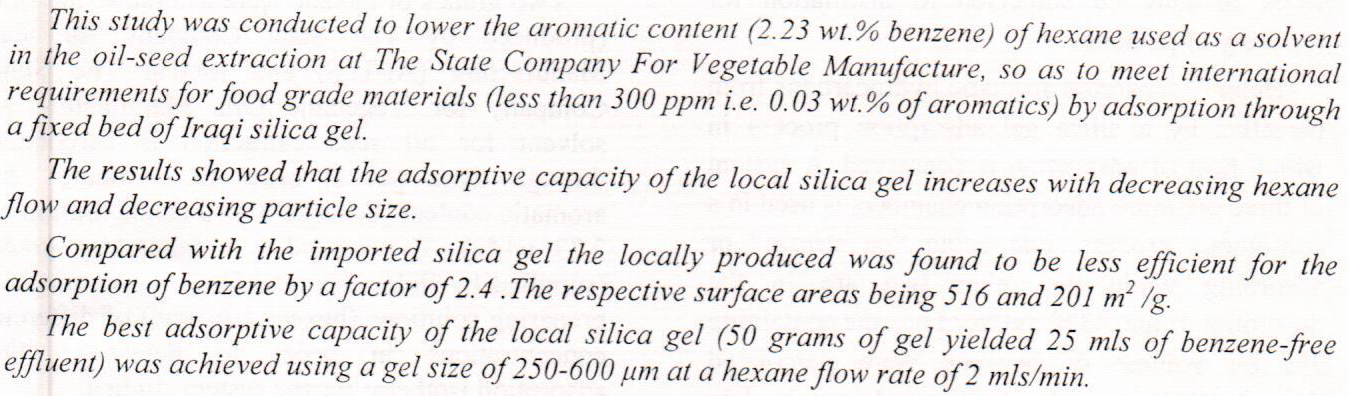
Reduction of Aromatic Content from Hexane by Silica Gel

One of the most difficult tasks in modern medical societies is the process of identifying a cure for many infectious diseases caused by drug-resistant microbes. Therefore, it has become necessary to discover new compounds that work in this regard. The currently prepared Schiff base, derived from thiazole, has a biological activity against bacteria and biofilms and its activity increases when it is associated with copper, zinc and platinum ions and forms metal complexes. This study highlights the synthesis and evaluation of novel biological compounds as inhibitors of bacterial growth and biofilms. A three newly complexes are resulting from the reaction of a new Schiff base ligand (LC) with metal ions (Zn, Cu, Pt). The new ligand (LC)
... Show More
MR Younus, Al-A'DAB, 2011
Imidacloprid is systemic insecticide (1-[(6-chloro-3-pyridinyl) methyl]-N-nitro-2-imidazolidinimine) and the world’s most widely used has significant efficacy against a broad variety of pests and a unique mode of action by using it spreader and irrigation. The persistence of this pesticide in the soil means that it causes environmental damage that must be cleaned up. In this study collected and identified the best bacteria isolate that breakdown imidacloprid from the Plant Protection Director in Baghdad, which has been using neonicotinoid pesticides for years in their own greenhouse for pest control. Using high-performance liquid chromatography HPLC to measuring the residual concentrations of imidacloprid in MSM media at a concentration o
... Show More
The objective of this study is to investigate the application of advanced oxidation processes (AOPs) in the treatment of wastewater contaminated with furfural. The AOPs investigated is the homogeneous photo-Fenton (UV/H2O2/Fe+2) process. The experiments were conducted by using cylindrical stainless steel batch photo-reactor. The influence of different variables: initial concentration of H2O2 (300-1300mg/L), Fe+2(20-70mg/L), pH(2-7) and initial concentration of furfural (50-300 mg/L) and their relationship with the mineralization efficiency were studied.
Complete mineralization for the system UV/H2O2/Fe+2 was achieved at: initi
... Show MoreIn this paper the behavior of the quality of the gradient that implemented on an image as a function of noise error is presented. The cross correlation coefficient (ccc) between the derivative of the original image before and after introducing noise error shows dramatic decline compared with the corresponding images before taking derivatives. Mathematical equations have been constructed to control the relation between (ccc) and the noise parameter.
Gypseous soils represented one of the most complex salty soils that faced the geotechnical engineers. Structures that built on gypsum soil will undergo unexpected distortions that will eventually contribute to catastrophic failure. The purpose of this article is to understand the durability of gypsum soil against wetting drying cycles after improvement with polyurethane polymer especially investigate the effect of the wetting-drying cycle on collapsibility. The soil was brought from Sawa lake in AL-Muthanna Governorate in Iraq, with gypsum content 65.5%, A set of Odometer tests were performed to determine the collapsibility potential (CP) for treated and untreated gypsum soil. The result shows that adding a different per
... Show MoreThe aim of this study is to investigate the ability of malachite green (MG) combined with 650nm diode laser to kill Candida albicans and to spectrally study the MG photodegradation after photodynamic therapy (PDT) spectrally. Cultures of Candida albicans were exposed to 40mW, 650 nm diode laser in the absence of MG. In PDT group, the MG was added to the Candida suspension for 5 min then exposed to diode laser for (5, 10, 15, 20) min at power density of 0.59W/cm2. The absorption spectrum of the photosensitized fungal suspension was obtained. The data were submitted to T-test (p<0.05). A 650nm diode laser in the presence of MG reduced the number of CFU/ml in 98.4%. Laser with 650nm alone and MG alone did not reduce significantly the num
... Show More