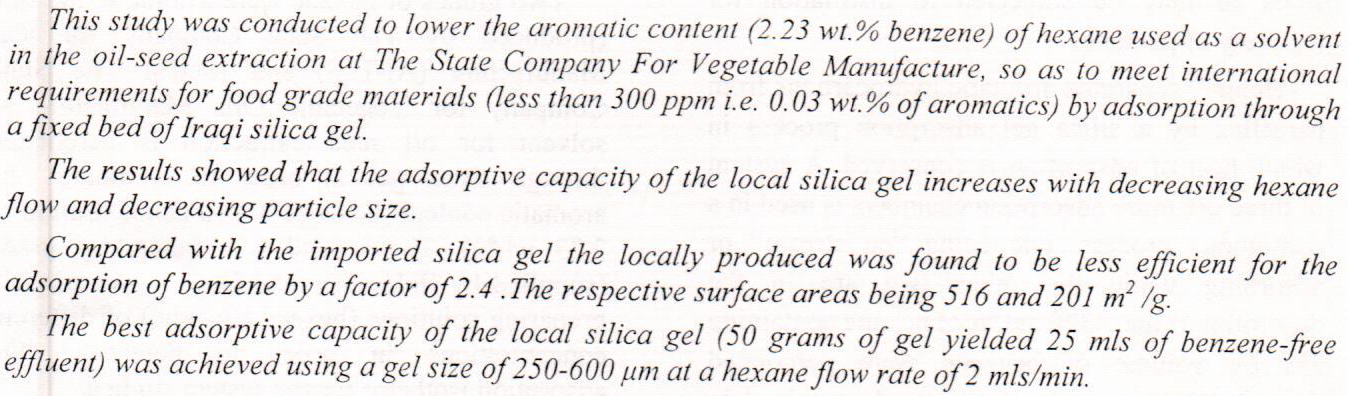
Reduction of Aromatic Content from Hexane by Silica Gel

 (12)
(12)
 (8)
(8)

 (10)
(8)
(10)
(8)

Biogas is one of the most important sources of renewable energy and is considered as an environment friendly energy source. The major goal of this research is to see if rice husk (Rh) waste and pomegranate peels (PP) waste are suitable for anaerobic digestion and what effect NaOH pre-treatment has on biogas generation. Rice husk and pomegranate peels were tested in anaerobic digestion under patch anaerobic conditions as separate wastes as well as blended together in equal proportions. The cumulative biogas output for the blank test (no pretreatment) was 1923 and 2526 ml, respectively using a single rice husk (Rh) and pomegranate peel (PP) substrates. The 50% rice husk digestion and 50% of pomegranate peels for blank test gave the result 224
... Show MoreThe current research aims to analyze the chemistry books for the preparatory stage according to life skills for the academic year (2019-2020) and to know the life skills contained in the chemistry books for the preparatory stage through the following two questions:1-What life skills should be available in the content of chemistry books prescribed for middle school students approved by the Ministry of Education, General Directorate of Curricula in the academic year(2019-2020). 2-What is the percentage of life skills included in the content of chemistry textbooks prescribed for middle school students approved by the Ministry of Education, General Directorate of Curricula in the academic year (2019-2020). To achieve the objectives of the resea
... Show MoreThe purpose of current study is to analyze the computer textbooks content for intermediate stage in Iraq according to the theory of multiple intelligence. By answering the following question “what is the percentage of availability of multiple intelligence in the content of the computer textbooks on intermediate stage (grade I, II) for the academic year (2017-2018)? The researcher followed the descriptive analytical research approach (content analysis), and adopted an explicit idea for registration. The research tool was prepared according the Gardner’s classification of multiple intelligence. It has proven validity and reliability. The study found the percentage of multiple intelligence in the content of computer textbooks for the in
... Show MoreWheat straw was modified with malonic acid in order to get low cost adsorbent have a good ability to remove copper and ferric ions from aqueous solutions, chemical modification temperature was 120°C and the time was 12 h. Parameters that affect the adsorption experiments were studied and found the optimum pH were 6 and 5 for copper and iron respectively and the time interval was 120 min and the adsorbent mass was 0.1 g. The values for adsorption isotherms parameters were determined according to Langmuir [qmax were 54.64 and 61.7 mg/g while b values were 0.234 and 0.22 mg/l] , Freundlich [Kf were 16.07 and 18.89 mg/g and n were 2.77 and 3.16], Temkin [B were 0.063 and 0.074 j/mol and At were 0.143 and 1.658 l/g] and for Dubinin-Radushkev
... Show MoreThe preparation of activated carbon (AC) from date stones by using microwave assisted K2CO3 activation was investigated in this paper. The influence of radiation time, radiation power, and impregnation ratio on the yield and methylene blue (MB) uptake of such carbon were studied. Based on Box-Wilson central composite design, two second order polynomial models were developed to correlate the process variables to the two responses. From the analysis of variance the significant variables on each response were identified. Optimum coditions of 8 min radiation time, 660 W radiation power and 1.5 g/g impregnation ratio gave 460.123 mg/g MB uptake and 19.99 % yield. The characteristics of the AC were examined by pore structure analysis, and scan
... Show MoreThe process of discharging the quantities of dyes resulting from industrial processes with wastewater leads to the occurrence of a serious environmental problem that threatens the environmental health security of humans. Therefore, a number of studies have been addressed that include presenting many physical and chemical treatment methods to get rid or reduce the proportion of pigments such as biological decomposition, ion exchange, and sedimentation. Chemotherapy, reverse osmosis, coagulation, Toxic sludge generation, flocculation. In addition to the above, this review deals with a number of studies that present activated carbon of plant origin, methods of obtaining it, types and advantages of it being cheap and environmentally friendly. A
... Show MoreAdsorption techniques are widely used to remove organics pollutants from waste water particularly, when using low cost adsorbent available in Iraq. Al-Khriet powder which was found in legs of Typha Domingensis is used as bio sorbent for removing phenolic compounds from aqueous solution. The influence of adsorbent dosage and contact time on removal percentage and adsorb ate amount of phenol and 4- nitro phenol onto Al-Khriet were studied. The highest adsorption capacity was for 4-nitrophenol 91.5% than for phenol 82% with 50 mg/L concentration, 0.5 gm. dosage of adsorbent and pH 6 under a batch condition. The experimental data were tested using different isotherm models. The results show that Freundlich model resulted in the best fit also
... Show More