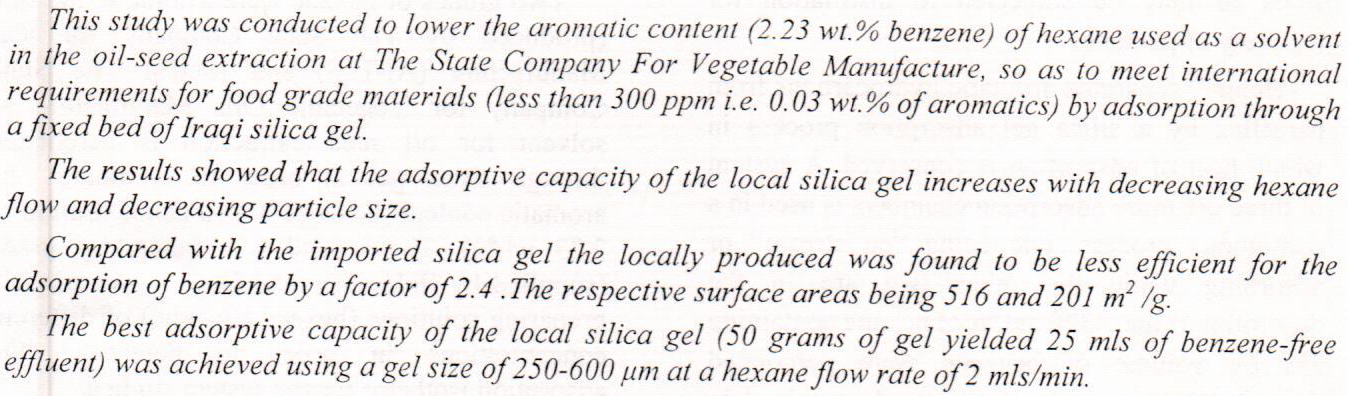
Reduction of Aromatic Content from Hexane by Silica Gel

Anadara granosa is a species of the class bivalve commonly found on the east coast of South Sumatra as a fishery commodity. This species has not been widely studied as a source of new bioactive compounds that have antioxidant abilities. This study aims to analyze the antioxidant ability of A. granosa against DPPH radicals and its phytochemical profile qualitatively. Samples were taken at the fishing port of Sungsang Village, South Sumatra, Indonesia. Furthermore, the samples were extracted using ethanol as a solvent and tested for antioxidants against DPPH radicals, total phenol analysis, and preliminary phytochemical test. Based on the antioxidant test results, the IC50 value of the ethanolic extract of
... Show More (17)
(17)
 (4)
(4)


The sol-gel preparation technique of transparent silica monoliths containing up to 0.5 M of samarium have been described. The sol-gel processing parameters are: acid catalyzed hydrolysis and controlled drying. The prepared monoliths are analyzed by X-ray diffraction, pycnometer measurements, Fourier transformation infrared spectroscopy and optical spectroscopy. The oscillator strengths of the Sm3+ ions in the silica monoliths are calculated. The results show a linear concentration dependence of some Sm3+ transitions in UV/Vis absorption spectra and formation of Sm3+ clusters inside the pores structure of silica monoliths at high Sm3+ concentration
The ceramic composite with different proportions of clay and silica was prepared with a grain size of 70 μm and the weight percentage was selected for four groups (clayx silica100-x) were x q15, 25, 30 and 50. In this manuscript, for each pressured sample, a sintering procedure was carried out for 3 hours under static air and at various sintering temperatures (1000, 1100, 1200, 1400)°C. After sintering, the density, porosity, water absorption, compression strength and thermal conductivity were measured. The best results were obtained using a mixture of 15% clay and 85% silica which were sintering at 1400°C for three hours under air.
the study aimed to identify the impact of the types of cooking utensils in transition metal elements to food and the effect of acid and storage in the concentration of these elements. used five types of cooking utensils including aluminum. tefal, astainls steel, glass. (pyrex), and ceramic prepared in it the food meal. the same meals were repeated add to them acid. the estimate of mineral elements in the meal prepared before storage and after storage in refrigerator temperature degree. the result shows the increase of aluminum concentration in the meals that prepared in aluminum pot reaching 2.913 pmm while reached less concentration in the meal prepared in astainls pot reaching 0.325 pmm. the highest concentration of iron reached 25.2 p
... Show MoreThe viscosity of crude oil has a crucial role in drag reduction during pipeline transportation; hence additives are required to enhancing the flow properties of AL-Ahdab crude oil. In this work, the potato starch biopolymer and CTAB surfactant are utilized to achieve the target. The drag reduction experiments were carried out at different crude oil flow rates (20-35-50 liters/min), pipe diameters (0.5-0.75 -1 inch), and different concentrations of potato starch (500-2000 ppm) and CTAB (100-500 ppm). The results showed that these additives had minimized flow resistance in various operating conditions, the drag reduction percent increased with increasing of additives concentration increase. The maximum drag reduction achieved using CT
... Show More
(10)
(9)
Study the effect of additives polymer polyvinyl alcohol (PVA) after solving in water by concentration 10% since represent a standard of PVA solution with added to cement – silica composite of ratio (1:2) with 5%, 10%, 15%, 20%, and 25% respectively to the standard quantity of water which using as a mortar of building. The results are demonstrate increasing on compression resistance with increase of PVA solution until 20%, and decreasing of thermal conductivity which represent a composite are increasing in thermal insulating. The results were recommended decreasing of water absorption with increase of PVA solution ratio as illustrated in this study.


