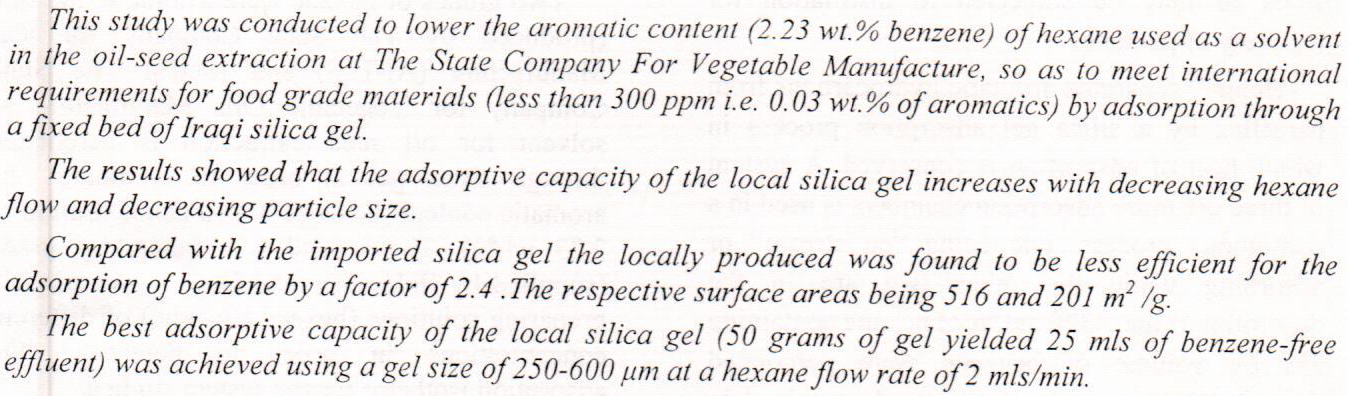
Reduction of Aromatic Content from Hexane by Silica Gel

Energy savings are very common in IoT sensor networks because IoT sensor nodes operate with their own limited battery. The data transmission in the IoT sensor nodes is very costly and consume much of the energy while the energy usage for data processing is considerably lower. There are several energy-saving strategies and principles, mainly dedicated to reducing the transmission of data. Therefore, with minimizing data transfers in IoT sensor networks, can conserve a considerable amount of energy. In this research, a Compression-Based Data Reduction (CBDR) technique was suggested which works in the level of IoT sensor nodes. The CBDR includes two stages of compression, a lossy SAX Quantization stage which reduces the dynamic range of the
... Show More (43)
(43)
 (28)
(28)



Often there is no well drilling without problems. The solution lies in managing and evaluating these problems and developing strategies to manage and scale them. Non-productive time (NPT) is one of the main causes of delayed drilling operations. Many events or possibilities can lead to a halt in drilling operations or a marginal decrease in the advancement of drilling, this is called (NPT). Reducing NPT has an important impact on the total expenditure, time and cost are considered one of the most important success factors in the oil industry. In other words, steps must be taken to investigate and eliminate loss of time, that is, unproductive time in the drilling rig in order to save time and cost and reduce wasted time. The data of
... Show More
(2)
(3)
The purpose of the study was to determine the in-vitro antitumor and antioxidant activity of Aloe vera gel extract by evaluating the cytotoxic effect of extract and Zoladex (goserelin) on breast cancer cell line (MCF-7) and prostate cancer cell line (PC-3), in addition to measure the antioxidant activity to find out this kind of anticancer drug, which is a cheap, safe, less toxic, and more active drug contrasted to chemotherapy drug. The cytotoxic effect evaluated by cytotoxicity assay (MTT assay), while the activity of the Aloe Vera gel as antioxidant was tested using a scavenging test of free radical (2,2-Diphenyl-1-picrylhydrazyl) (DPPH), ferric reducing antioxidant potential (FRAP) and (Oxygen Radical Absorbance Capacity)(ORAC).
... Show More
In this research, a novel thin film Si-GO10 and nanopowders Si-GO30 of silica-graphene oxide (GO) composite were prepared via the sol–gel method and deposited on glass substrates using spray pyrolysis. X-ray diffraction (XRD) results showed a relatively strong peak in the graphite layer that corresponds to the (002) plane. Transmission electron microscope (TEM) images showed that SiO2 nanoparticles were randomly distributed on the surface of GO plates, and the particle size in these nanopowders was below 50 nm. Field emission scanning electron microscopy (FESEM) analysis demonstrated that silica nanoparticles on the surface of GO plates exhibited almost spherical and rod-like nanoparticle shape, which in tur
... Show More
(3)
(1)
Abstract:Two-dimensional crystal has been achieved and controlled with the aid of DC electric field applied between two electrodes at 5 millimeters separating distance between them. Sol-gel method has been used to prepared nanosilica particle which used in this work as well as TiO2 nanopaowder. The assembly of the silica particles is due to the interaction between the electrical force, the particles dipole, and the interaction between the particles themselves. When a DC voltage is applied, the particles accumulated and crystallized on the surface between the electrodes. The Light diffraction demonstrates that the hexagonal crystal is always oriented with one axis along the direction of the field. The particles disassemble when the field is
... Show MoreIn this research, a novel thin film Si-GO10 and nanopowders Si-GO30 of silica-graphene oxide (GO) composite were prepared via the sol–gel method and deposited on glass substrates using spray pyrolysis. X-ray diffraction (XRD) results showed a relatively strong peak in the graphite layer that corresponds to the (002) plane. Transmission electron microscope (TEM) images showed that SiO2 nanoparticles were randomly distributed on the surface of GO plates, and the particle size in these nanopowders was below 50 nm. Field emission scanning electron microscopy (FESEM) analysis demonstrated that silica nanoparticles on the surface of GO plates exhibited almost spherical and rod-like nanoparticle shape, which in turn confirmed the formation of Si
... Show MoreTwo-dimensional crystal has been achieved and controlled
with the aid of DC electric field applied between two electrodes at 5
millimeters separating distance between them. Sol-gel method has
been used to prepared nanosilica particle which used in this work as
well as TiO2 nanopaowder. The assembly of the silica particles is
due to the interaction between the electrical force, the particles
dipole, and the interaction between the particles themselves. When a
DC voltage is applied, the particles accumulated and crystallized on
the surface between the electrodes. The Light diffraction
demonstrates that the hexagonal crystal is always oriented with one
axis along the direction of the field. The particles disass
(151)
(133)
In cognitive radio system, the spectrum sensing has a major challenge in needing a sensing method, which has a high detection capability with reduced complexity. In this paper, a low-cost hybrid spectrum sensing method with an optimized detection performance based on energy and cyclostationary detectors is proposed. The method is designed such that at high signal-to-noise ratio SNR values, energy detector is used alone to perform the detection. At low SNR values, cyclostationary detector with reduced complexity may be employed to support the accurate detection. The complexity reduction is done in two ways: through reducing the number of sensing samples used in the autocorrelation process in the time domain and through using the Slid
... Show More
(9)
(7)