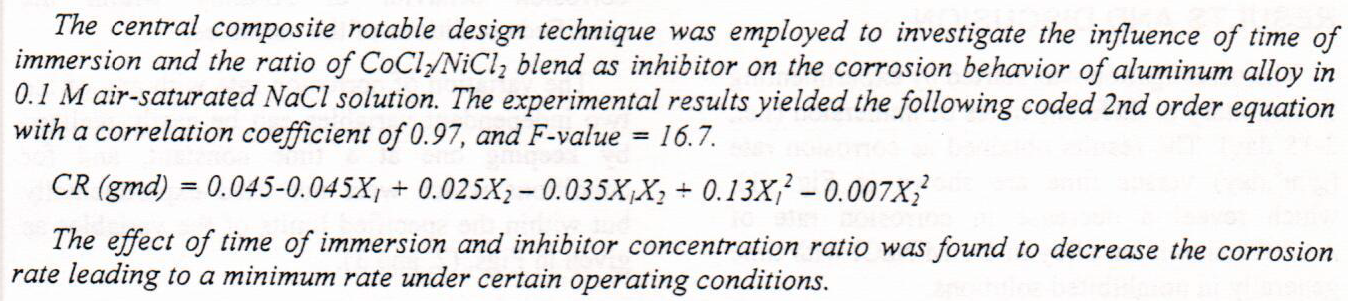
The Optimal Corrosion Inhibition of Aluminum in 0.1M NaCl Solution

The Boltzmann transport equation is solved by using two- terms approximation for pure gases . This method of solution is used to calculate the electron energy distribution function and electric transport parameters were evaluated in the range of E/N varying from . 172152110./510.VcmENVcm
From the results we can conclude that the electron energy distribution function of CF4 gas is nearly Maxwellian at (1,2)Td, and when E/N increase the distribution function is non Maxwellian. Behavior of electrons transport parameters is nearly from the experimental results in references. The drift velocity of electron in carbon tetraflouride is large compared with other gases
The Boltzmann transport equation is solved by using two- terms approximation for pure gases and mixtures. This method of solution is used to calculate the electron energy distribution function and electric transport parameters were evaluated in the range of E/N varying from . 172152110./510.VcmENVcm
The electron energy distribution function of CF4 gas is nearly Maxwellian at (1,2)Td, and when E/N increase the distribution function is non Maxwellian. Also, the mixtures are have different energy values depending on transport energy between electron and molecule through the collisions. Behavior of electrons transport parameters is nearly from the experimental results in references. The drift velocity of electron in carbon tetraflouride i
Modified bentonite has been used as effective sorbent material for the removal of acidic dye (methyl orange) from aqueous solution in batch system. The natural bentonite has been modified using cationic surfactant (cetyltrimethyl ammonium bromide) in order to obtain an efficient sorbent through converting the properties of bentonite from hydrophilic to organophilic. The characteristics of the natural and modified bentonite were examined through several analyses such as Scanning electron microscopy (SEM), Fourier transform infrared spectroscopy (FTIR), and Surface area. The batch study was provided the maximum dye removal efficiency of 88.75 % with a sorption capacity of 555.56 mg/g at specified conditions (150 min, pH= 2, 250 rpm, and 0.
... Show More (4)
(4)

 (3)
(5)
(3)
(5)

The simple and available technique of colorimetry and indirect X-ray fluorescence determination of tetracycline hydrochloride (in the form of colored complex with iron(III) ions) and cyanocobalamine (in the form of the colored thiocyanate complex with cobalt(II) ions) is offered. The analytes were separated from the accompanying components by sorption to polyurethane foam based on ethers. The conditions of sorption separation and measurement of analytical signal of these substances are optimized. The obtained results of tetracycline drugs and injection solution B12 vitamin are in satisfactory agreement with data declared by the manufacturer.
(1)
The current study was to examine the reliability and effectiveness of using most abundant, inexpensive waste in the form of scrap raw zero valent aluminum ZVAI and zero valent iron ZVI for the capture, retard, and removal of one of the most serious and hazardous heavy metals cadmium dissolved in water. Batch tests were conducted to examine contact time (0-250) min, sorbent dose (0.25-1 g ZVAI/100 mL and 2-8 g ZVI/100 mL), initial pH (3-6), pollutant concentration of 50mg/L initially, and speed of agitation (0-250) rpm . Maximum contaminant removal efficiency corresponding to (90 %) for cadmium at 250 min contact time, 1g ZVAI/ 6g ZVI sorbent mass ratio, pH 5.5, pollutant concentration of 50 mg/L initially, and 250 rpm agitation speed wer
... Show More
(12)
The emphasis of Master Production Scheduling (MPS) or tactic planning is on time and spatial disintegration of the cumulative planning targets and forecasts, along with the provision and forecast of the required resources. This procedure eventually becomes considerably difficult and slow as the number of resources, products and periods considered increases. A number of studies have been carried out to understand these impediments and formulate algorithms to optimise the production planning problem, or more specifically the master production scheduling (MPS) problem. These algorithms include an Evolutionary Algorithm called Genetic Algorithm, a Swarm Intelligence methodology called Gravitational Search Algorithm (GSA), Bat Algorithm (BAT), T
... Show More
(16)
(13)
An efficient modification and a novel technique combining the homotopy concept with Adomian decomposition method (ADM) to obtain an accurate analytical solution for Riccati matrix delay differential equation (RMDDE) is introduced in this paper . Both methods are very efficient and effective. The whole integral part of ADM is used instead of the integral part of homotopy technique. The major feature in current technique gives us a large convergence region of iterative approximate solutions .The results acquired by this technique give better approximations for a larger region as well as previously. Finally, the results conducted via suggesting an efficient and easy technique, and may be addressed to other non-linear problems.
(5)
