Volumetric Mass Transfer Capacity Coefficient in the RTL Extractor
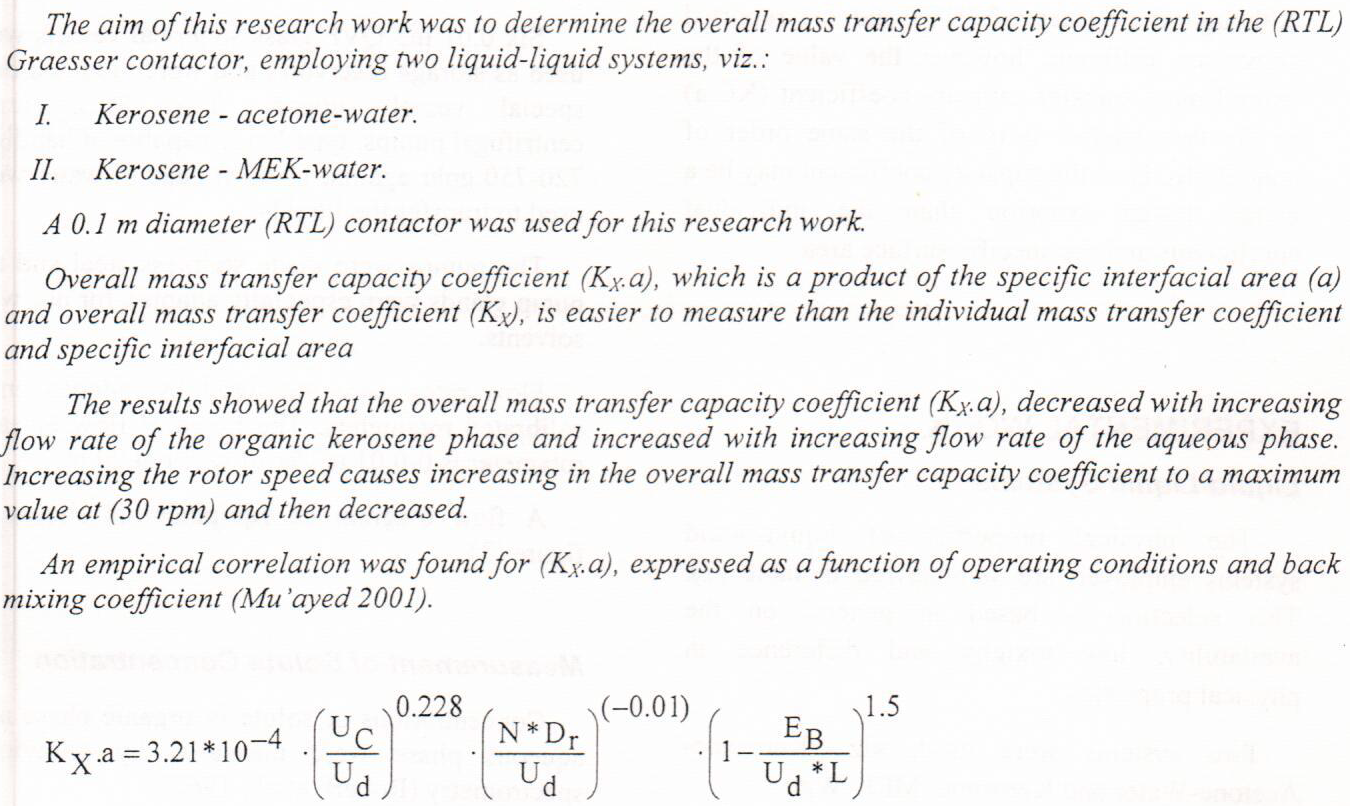

 (6)
(6)
 (2)
(2)



In real conditions of structures, foundations like retaining walls, industrial machines and platforms in offshore areas are commonly subjected to eccentrically inclined loads. This type of loading significantly affects the overall stability of shallow foundations due to exposing the foundation into two components of loads (horizontal and vertical) and consequently reduces the bearing capacity.
Based on a numerical analysis performed using finite element software (Plaxis 3D Foundation), the behavior of model strip foundation rested on dry sand under the effect of eccentric inclined loads with different embedment ratios (D/B) ranging from (0-1) has been explored. The results display that, the bearing capacity of st
... Show MoreBackground: Information concerning the maximum bite force in human population is important to clinical orthodontics. Additionally, the influence of bite force on the vertical stability of any treatment result is important. The new position of the dentition should be compatible with the dynamics of the muscular and occlusal forces in all planes. This study was conducted to 1) to measure and compare maximum bite force, body height and weight among normal occlusion and malocclusion groups (cl I,cl II,cl III) in both gender 2) to evaluate the correlation between bite force and craniofacial morphology, body height and weight. Materials and Methods: The sample consists of 100 Iraqi adult subjects aged 18-25 years. It was classified in to four gr
... Show MoreObesity is a risk factor associated with age-related disorders that accelerate aging, and it increases the risk of metabolic diseases. Therefore, this study was conducted to investigate the association of leukocyte telomere length (LTL) with the presence of higher body weight in middle-aged females and males. The study subjects comprised 160 (80 control and 80 higher body mass index BMI groups) with ranging ages of 30-50 years included and stratified for BMI. The physio-biochemical analysis was measured using enzymatic determination. Mean telomere length was determined by using the southern blotting technique. The association analysis revealed a significant variance (P < 0.01) in biochemical parameters between higher BMI grou
... Show More
(5)
(3)
This study deals with free convection heat transfer for the outer surface of two
cylinders of the shape of (Triangular & Rectangular fined cylinders with 8-fins),
putted into two different spaces; small one with dimension of (Length=1.2m,
height=1m, width=0.9m) and large one with dimension of (Length=3.6m, height =3m,
width=2.7m). The experimental work was conducted with air as a heat transport
medium. These cylinders were fixed at different slope angles (0o, 30o, 60o and 90o)
.The heat fluxes were (279, 1012, 1958, 3005, 4419) W/m2, where heat transferred by
convection and radiation. In large space, the results show that the heat transfer from
the triangular finned cylinder is maximum at a slope angle equals
Multi-walled carbon nanotubes (MWCNTs) were functionalized by hexylamine (HA) in a promising, cost-effective, rapid and microwave-assisted approach. In order to decrease defects and remove acid-treatment stage, functionalization of MWCNTs with HA was carried out in the presence of diazonium reaction. Surface functionality groups and morphology of chemically-functionalized MWCNTS were characterized by FTIR, Raman spectroscopy, thermogravimetric analysis (DTG), and transmission electron microscopy (TEM). To reach a promising dispersibility in oil media, MWCNTs were functionalized with HA. While the cylindrical structures of MWCNTs were remained reasonably intact, characterization results consistently confirmed the sidewall-functionalization o
... Show More
(74)
(74)
(14)
(11)
An annular two-phase, steady and unsteady, flow model in which a conductingfluid flow under the action of magnetic field is concavely. Two models arepresented, in the model one; the magnetic field is perpendicular to the long side ofthe channel, while in the model two is perpendicular to the short side. Also, westudy, to some extent the single-phase liquid flow.It is found that the motion and heat transfer equations are controlled by differentdimensionless parameters namely, Reynolds, Hartmann, Prandtl, and Poiseuilleparameters. The Laplace transform technique is used to solve each of the motion andheat transfer equations. The effects of each of dimensionless parameters upon thevelocity and heat transfer is analyzed.A comprehensive study fo
... Show MoreThis paper reports experimental and computational fluid dynamics (CFD) modelling studies to investigate the effect of the swirl intensity on the heat transfer characteristics of conventional and swirl impingement air jets at a constant nozzle-to-plate distance ( L = 2 D). The experiments were performed using classical twisted tape inserts in a nozzle jet with three twist ratios ( y = 2.93, 3.91, and 4.89) and Reynolds numbers that varied from 4000 to 16000. The results indicate that the radial uniformity of Nusselt number (Nu) of swirl impingement air jets (SIJ) depended on the values of the swirl intensity and the air Reynolds number. The results also revealed that the SIJ that was fitted with an insert of y = 4.89, which correspo
... Show More
(16)
(10)
The effect of linear thermal stratification in stable stationary ambient fluid on free convective flow of a viscous incompressible fluid along a plane wall is numerically investigated in the present work. The governing equations of continuity, momentum and energy are solved numerically using finite difference method with Alternating Direct implicit Scheme. The velocity, temperature distributions
and the Nusselt number are discussed numerically for various values of physical parameters and presented through graphs. ANSYS program also used to solve the problem. The results show that the effect of stratification parameter is marginalized with the increase in Prandtl number, and the increase in Grashof number does not practically vary the
(1)