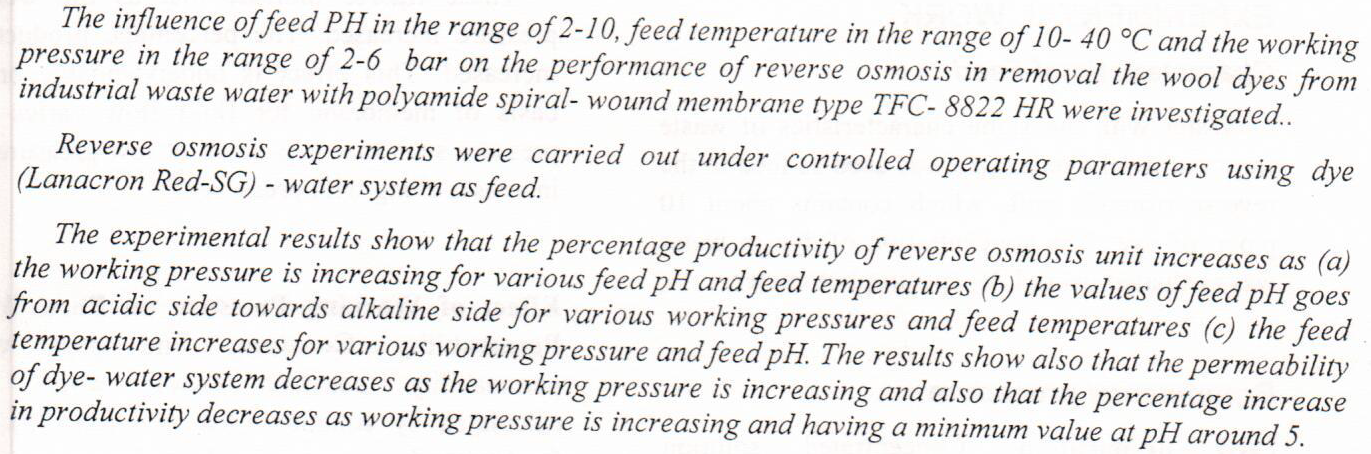
Removal of Wool Dyes from Industrial Wastewater by Reverse Osmosis Process

The main objectives of this research is to extract essential oil from: orange ( citrus sinensis), lemon( citrus limon) and mandarin( citrus reticulata) peels by two methods: steam distillation (SD) and microwave assisted steam distillation (MASD), study the effect of extraction conditions (weight of the sample, extraction time, and microwave power, citrus peel type) on oil yield and compare the results of the two methods, the resulting essential oil was analyzed by Gas Chromatography (GC).
Essential oils are highly concentrated substances used for their flavor and therapeutic or odoriferous properties, in a wide selection of products such as foods, medicines and cosmetics. Extracti
... Show MoreIn this work, the extraction of glycyrrhizin from Licorice using bulk liquid membrane technique was developed and optimized. The effect of various parameters such as pH of stripping and donor solutions, temperature, stirring speed and kinetic parameters were investigated. Moreover, to study the impact of the polarity of membrane solvent, two types of extraction solvents were used as a membrane solvent: n-Hexane was used as a non-polar solvent and 1-Hexanol was as a polar solvent. The optimum extraction condition was found (95.53%) using 1-Hexanol, rotating speed was 400 rpm, and pH of the acceptor and donor solutions were 8 and 5.5, respectively. The reaction kinetics constants ( and ) for the transport of glycyrrhizin from the donor pha
... Show More (18)
(18)
 (13)
(13)



Fabrication of porous clay refractory insulating specimens from Iraqi kaolin with different percentage of Expanded Polystyrene (EPS) waste crumbs additions were investigated. After mixing and forming by hand molding, the specimens was dried and fired at 1300 oC. The structural, physical, mechanical and thermal properties of the refractory insulating products were measured. Maximum addition of EPS (1.25 wt%) lead to reduce the linear shrinkage to less than 1.7% and increased apparent porosity up to 50 %. As well as, the density, Modulus of rupture and thermal conductivity were reduced to 1.39 g/cm3, 4.1 MPa and 0.21 W/m.K, respectively. The final outcome, addition of EPS showed good results in the formation of pores without distorting the
... Show More
(5)
Saccharomyces Cerevisiae cells were immobilized in calcium alginate beads and activated charcoal for use in the
production of ethanol from batch fermentation of sugar beet waste. Treatment of the waste with NaOH to increase the
ability of lignocellulose material to hydrolysis by acid (2N H2SO4) to monosaccharide and disaccharide (mainly glucos).
The high reducing sugar concentration obtained was equal to 9.2gm/100ml (10Brix) after treatment. Fermentation
parameters, are (pH, glucose concentration (2.5-25 gm/100ml), immobilized agent concentration (2.5-25 gm/100ml)
were studied to find the optimum physiological condition. And the highest ethanol concentration obtained from the
fermentation in the presence of 20%(wt/v) ca
Mutans streptococci (MS) are a group of oral bacteria considered as the main cariogenic organisms. MS consists of several species of genus Streptococcus which are sharing similar phenotypes and genotypes. The aim of this study is to determine the genetic diversity of the core species of clinical strains of Streptococcus mutans, Streptococcus sobrinus and Streptococcus downei by using repitative extragenic palindromic (REP) primer. The DNA of the clinical strains of S. mutans (n=10), S. sobrinus (n=05) and S. downei (n=04) have been employed in the present study, which have been previously isolated from caries active subjects. The DNA of the clinical and reference strains was
... Show More
(3)
(4)
(8)
(8)
(8)
(6)
This work studies the performance of zeolite permeable reactive barrier in removing cadmium from a contaminated shallow aquifer. Batch tests have been performed to characterize the equilibrium sorption properties of the zeolite in cadmium-containing aqueous solutions. A 1D numerical finite difference model has been developed to describe pollutant transport within groundwater taking pollutant sorption on the permeable reactive barrier (PRB), which is performed by Langmuir equation, into account. Numerical results show that the PRB starts to saturate after a period of time (~120 h) due to reduction of the retardation factor, indicating a decrease in the percentage of zeolite functionality. However, a reasonable agreement between model predict
... Show More
(39)
(24)
This study investigated a novel application of forward osmosis (FO) for oilfield produced water treatment from the East Baghdad oilfield affiliated to the Midland Oil Company (Iraq). FO is a part of a zero liquid discharge system that consists of oil skimming, coagulation/flocculation, forward osmosis, and crystallization. Treatment of oilfield produced water requires systems that use a sustainable driving force to treat high-ionic-strength wastewater and have the ability to separate a wide range of contaminants. The laboratory-scale system was used to evaluate the performance of a cellulose triacetate hollow fiber CTA-HF membrane for the FO process. In this work, sodium chloride solution was used as a feed solution (FS) with a concentratio
... Show More