Removal of Sulfur Dioxide from Sulfuric Acid Plant Emissions
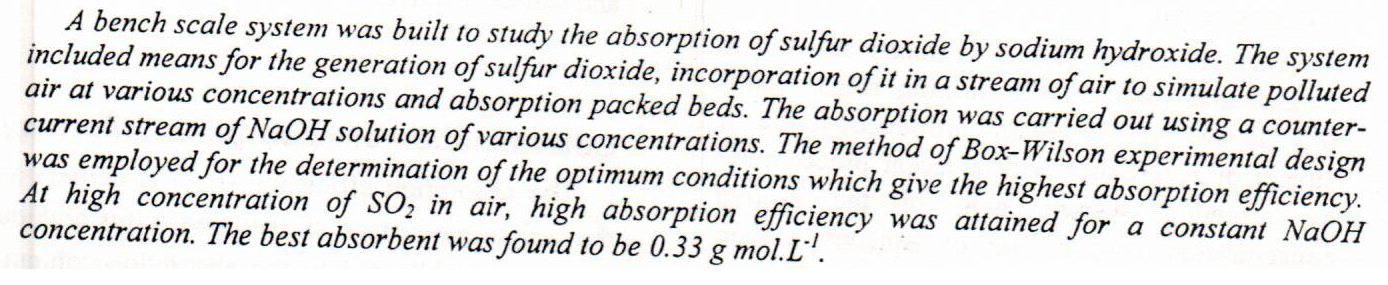

 (3)
(3)

A dispersive liquid-liquid microextraction combines with UV-V is spectrophotometry for the preconcentration and determination of Mefenamic acid in pharmaceutical preparation was developed and introduced. The proposed method is based on the formation of charge transfer complexation between mefenamic acid and chloranil as an n-electron donor and a p-acceptor, respectively to form a violet chromogen complex measured at 542 nm. The important parameters affecting the efficiency of DLLME were evaluated and optimized. Under the optimum conditions, the calibration graphs of standard and drug, were ranged 0.03-10 µg mL-1. The limits of detection, quantification and Sandell's sensitivity were calculated. Good recoveries of MAF Std. and drug at 0.05,
... Show More
(1)
 (2)
(2)

Thirty uropathogenic E. coli isolates were isolated from hospitalized and non hospitalized patients, complaining of urinary tract infections, of Al-Kadhymia Teaching Hospital and subjected to tRNA extraction. A method of tRNA extraction was modified by adding sodium dodecyl sulfate (SDS) instead of urea. Polyacrylamide gel electrophoresis and two methods of staining, ethidium bromide staining and silver staining, as well as spectrophotometric detection were used.
Efficiency of Pisum sativum plants in using tricalcium super phosphate (TSP) in presence and absence of mycorrhizal fungi was evaluated in the field experiment in College of Science / Al-Mustansiriyah University. The experiment comprised of (6) treatments prepared from the interaction of two levels of inoculation [non-inoculation with fungus F0 and inoculation with Glomus mosseae fungus (F1)]. And three levels of phosphorus: 0,20,40 Kg P/ha. The experimental size was (1x2)m. Irrigation and hand-weeding were done when needed. The following plant measurements were recorded: (Shoots dry weight, concentration of N and P% in addition to percentage of root infection with mycorrhizal fungi at flowering 50% of plants. The re
... Show More
This study included isolation of some active materials from Curcuma longa such as tannins, saponins and volatile oils with percentage of 59%, 31%, and 9% respectively. Also the study included the determination of minerals in Curcuma longa such as " Na, Ca and K" using Flame photometer. The concentrations of these minerals were (14 ppm),(10 ppm) and )76 ppm) respectively. The anti-bacterial activity study was performed for the active materials isolated from Curcuma longa against two genus of pathogenic bacteria, Escherichia Coli and Staphylococcus aurous by using agar-well diffusion method. It appeared from this study that all of the extraction have inhibitory effect on bacteria was used. The inhibition zone diameter varies with
... Show More
(2)
In order to evaluate the effect of seed size, plant growth regulators and some chemical materials on seed vigour and seedling growth of rice (Oryza sativa L.) an experiment was conducted in 2015 at Laboratories of Agriculture and Marshes College, University of Thi-Qar. Factorial experiment in CRD was used with four replications in two factors. The first factor included three seed sizes (4.6-5.1, 5.2-5.7 and 5.8-6.3 mm). The second factor was seeds soaking treatments (KNO3 6 gl-1, CaCl2 20 gl-1, salicylic acid 20 mg l-1, cytokinin 40 mg l-1, gibberllic acid 400 mg l-1, ascorbic acid 40 mg l-1 and seeds soaked in distilled water). The results showed that the largest seed size influenced significantly and gave the higher averages of germinatio
... Show MoreThis research is dealing with five sample of tomato ketchup products available in local market that were respectively as follows: Hello-Baghdad Iraq, Tiffany-Abu Dhabi, Melody-Dubai, Baidar-Saudi Arabia, and Altunsa-Turkey. Also it is dealing with four sample of sauce products available in local market that were respectively as follows: Hello-Baghdad, Iraq, Al-Badawi-Baghdad Iraq, Family-Baghdad, Iraq, and Hala-Amman Jordon. Analysis was performed on each sample three times and mean of the reading was taking. Samples were tested through terse and shorthand from lengthened steps. The spectrophotometric method used rely on theoretical and practical bases in extraction and diagnosis by UV spectrophotometer. This method in short notes, consiste
... Show More