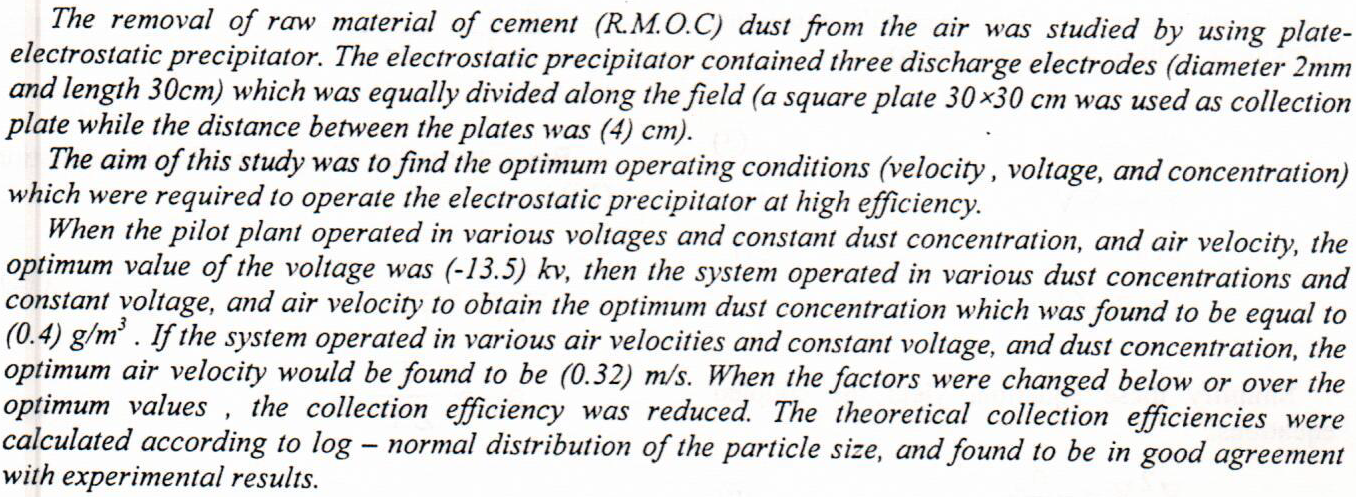
Performance of Plate-Electrostatic Precipitator for Removal of R.M.O.C. Dust

Herein, a biocomposite of crosslinked chitosan polyethylene glycol diglycidyl ether (CS-PEDGE), montmorillonite (MMT), and foodgrade algae (FGA) was successfully prepared by a hydrothermal technique. The resulting absorbent (CS-PEDGE/FGA/MMT) was assessed for its adsorption property with methyl violet 2B (MV 2B) a toxic cationic dye. The physicochemical properties of CS-EDGE/ FGA/MMT were assessed via various analytical techniques, including BET, Elemental analysis, pHpzc, and spectroscopy (FTIR, XRD, SEM-EDX). The influence of three adsorption variables, namely adsorbent dose (A: 0.02–0.1 g/100 mL), solution pH (B: 4–10), and contact time (C: 10–420 min) on the rate of MV 2B dye removal was examined using the Box-Behnken design (RSM-
... Show More (3)
(3)
 (3)
(3)


Electrochemical Grinding (ECG) process is a mechanically assisted electrochemical process for material processing. The process is able to successfully machine electrically conducting harder materials at faster rate with improved surface finish and dimensional control. This research studies the effect of applied current, electrolyte concentration, spindle speed and the gap between workpiece and tool on hardness and material removal rate during electrochemical grinding for stainless steel 316. The characteristic features of the electrochemical grinding process are explored through Taguchi-design-based experimental studies. The better hardness can be obtained at 10 A of the current, 150 g/l of the electrolyte concentration, 0.3 mm of gap an
... Show MoreThe current study investigated the stability and the extraction efficiency of emulsion liquid membrane (ELM) for Abamectin pesticide removal from aqueous solution. The stability was investigated in terms of droplet emulsion size distribution and emulsion breakage percent. The proposed ELM included a mixture of corn oil and kerosene (1:1) as a diluent, Span 80 (sorbitan monooleate) as a surfactant and hydrochloric acid (HCl) as a stripping agent without utilizing a carrier agent. Parameters such as homogenizer speed, surfactant concentration, emulsification time and internal to organic volume ratio (I/O) were evaluated. Results show that the lower droplet size of 0.9 µm and higher stable emulsion in terms of breakage percent of 1.12 % we
... Show More
(7)
(9)
(8)
The current study investigated the stability and the extraction efficiency of emulsion liquid membrane (ELM) for Abamectin pesticide removal from aqueous solution. The stability was investigated in terms of droplet emulsion size distribution and emulsion breakage percent. The proposed ELM included a mixture of corn oil and kerosene (1:1) as a diluent, Span 80 (sorbitan monooleate) as a surfactant and hydrochloric acid (HCl) as a stripping agent without utilizing a carrier agent. Parameters such as homogenizer speed, surfactant concentration, emulsification time and internal to organic volume ratio (I/O) were evaluated. Results show that the lower droplet size of 0.9 µm and higher stable emulsion in terms of breakage percent of 1.12 % were
... Show More
(7)
The increasing discharge of dye-containing wastewater has become a serious environmental problem, requiring efficient and sustainable treatment technologies. In this study, poultry litter–derived biochar (BC) was prepared via pyrolysis at 550 °C and subsequently modified with chitosan to produce a composite adsorbent (BC/CS) for the removal of Congo Red (CR) from aqueous solutions. The materials were characterized using SEM, BET, XRD, FTIR, and XPS analyses. BET results showed that chitosan modification slightly decreased the specific surface area from 8.28 to 8.18 m²/g and pore volume from 0.035 to 0.030 cm³ /g, while introducing abundant amine and hydroxyl functional groups on the surface. Maximum adsorption occurred at pH 3, w
... Show More
(2)
In this study, stabilization of expansive soils using waste materials namely; Cement Kiln Dust (CKD), and waste plastic bottles (WPB) was experimentally investigated. Using CKD and WPB are exponentially increasing day by day, due to their capability to solve both environmental and geotechnical problems successfully. Expansive soils were collected from locations with a wide range of plasticity index (PI) (15 - 27) and liquid limit (LL) (35% - 64%). Stabilizer percentages were varied from 0% to 20%, and curing durations for CKD cases were 7 and 28 days. Results showed the best percentages of CKD and WPB are 12% of each one respectively. LL, plastic limit (PL), and swelling percent (SP) loss were observed, which are 46%, 55%, and 96% respec
... Show More
(10)
(5)
Investigation of the adsorption of acid fuchsin dye (AFD) on Zeolite 5A is carried out using batch scale experiments according to statistical design. Adsorption isotherms, kinetics and thermodynamics were demonstrated. Results showed that the maximum removal efficiency was using zeolite at a temperature of 93.68751 mg/g. Experimental data was found to fit the Langmuir isotherm and pseudo second order kinetics with maximum removal of about 95%. Thermodynamic analysis showed an endothermic adsorption. Optimization was made for the most affecting operating variables and a model equation for the predicted efficiency was suggested.
Photocatalytic degradation of methylene blue was studied using CdS and ZnS as catalyst. The photocatalytic activity of the specimen was studied by exposing to UV-radiation. The result shows that the degradation efficiency of the dye for CdS micro-particles was 92% after 7 hours and for ZnS micro-particles was 88.29% for the same time interval.
(4)
The research explores through its three parts, to search for the unconscious and the collective unconscious in order to identify the per-formative stimuli and motives and their motivation to produce a performance that is consistent with the metaphysics of the myth or the epic and its different characters from other human characters. The paper also explores in its second section a sort of sacred performance energy. Together, along with motivating the mind and engaging the subconscious, comes a metaphysical text and with its characters and epic events.