Preparation, Characterization, and Properties of Barium Titanate
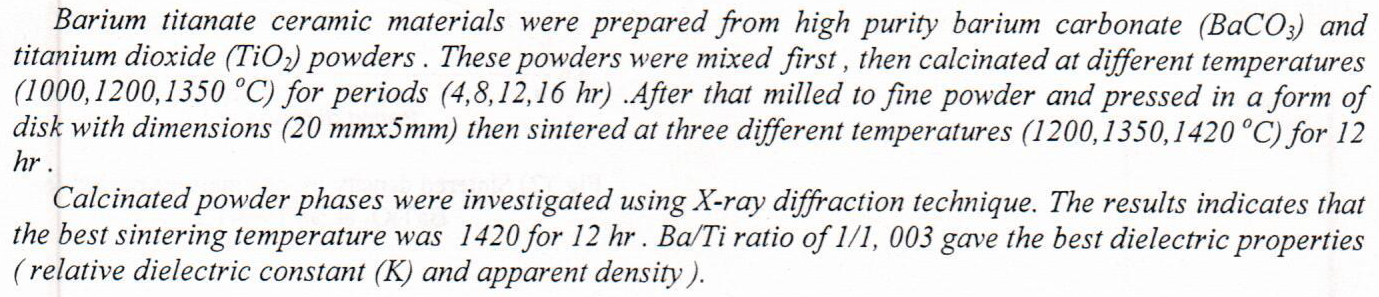

 (10)
(10)
 (7)
(7)



Meloxicam is a non-steroidal anti-inflammatory drug. It is practically insoluble in water. It is associated with gastrointestinal side effects at high doses on long term treatment. The aim of this investigation to formulate and evaluate gellified nanoemulsion of meloxicam as a topical dosage form to enhance meloxicam therapeutic activity and reduce systemic side effect.
The pseudo ternary phase diagrams were made, including the oil mixture which is composed of almond oil and peppermint oil at a ratio (1:2), variable surfactant mixture (S mix) which are tween 80 and ethanol at ratios of (1:1, 2:1, 3:1, and 4:1) and double distilled water. Slow dripping of double distilled water to the combination of the oil mixtu
... Show More
(9)
The green production of iron oxide nanoparticles (FeONPs) due to its numerous biotechnological uses has attracted a lot of attention and clean and eco-friendly approaches in the medical field.
The objectives of this study are to demonstrate the biogenic creation of FeONPs. The search for alternative antimicrobial medicines has been prompted by growing worries about multidrug resistance.
(14)
(12)
Nano crystalline copper sulphide (Cu2S) thin films pure and 3% Bi doped were deposited on glass substrate by thermal evaporation technique of thickness 400±20 nm under a vacuum of ~ 2 × 10− 5 mbar to study the influence of annealing temperatures ( as-deposited, and 573) K on structural, surface morphology and optical properties of (Cu2S and Cu2S:3%Bi). (XRD) X-ray diffraction analysis showed (Cu2S and Cu2S:3%Bi) films before and after annealing are polycrystalline and hexagonal structure. AFM measurement approves that (Cu2S and Cu2S:3%Bi) films were Nano crystalline with grain size of (105.05-158.12) nm. The optical properties exhibits good optical absorption for Cu2S:3%Bi films. Decreased of optical band gap from 2.25 to 2 eV after dop
... Show More
(4)
(3)
Three new hydrazone derivatives of Etodolac were synthesized and evaluated for their anti-inflammatory activity by using egg white induced paw edema method. All the synthesized target compounds were characterized by CHN- microanalysis, FT-IR spectroscopy, and 1HNMR analysis. The synthesis of the target (P1-P3) compounds was accomplished following multistep reaction procedures. The synthesized target compounds were found to be active in reducing paw edema thickness and their anti-inflammatory effect was comparable to that of the standard (Etodolac).
(21)
(7)
Lactococcus lactis ssp. lactis isolated from raw milk was used for titanium dioxide (TiO2) nanoparticles biosynthesis. Biosynthesized TiO2 nanoparticles were characterized using UV-vis spectroscopy, Atomic Force Microscopy (AFM) (1.97 nm), X-ray diffraction (XRD) appa-ratus, Field Emission Scanning Electron Microscopy (FE-SEM), Energy dispersive X-ray anal-ysis (EDX) spectra and Fourier Transform Infrared Spectroscopy (FTIR). Result was 408.21 cm-1 that belong to anatase Titania. L. lactis ssp. Lactis isolates had the ability to synthesize TiO2 nanoparticles, the characterization results presented that the biosynthesized nanoparti-cles were at wavelength (344-347) nm; approving the formation of anatase phase of TiO2 NPs; spherical c
... Show More
(7)
A new series of morpholine derivative were prepared by reacting the morpholine with ethyl chloro acetate in the presence triethylamine as an catalyst and benzene as a solvent gave the ethyl morpholin-4-ylacetate reaction with hydrazine hydrate and ethanol as a solvent gave the 2-(morpholin-4-yl)acetohydrazide gave series of Schiff base were prepared by reacting 2-(morpholin-4- yl)acetohydrazide with different aromatic aldehydes and ketons . The new series of (3-9 )were synthesis by reaction of Schiff base (10-14) with chloroacetyl chloride, triethyl amine as an catalyst and 1,4dioxane as a solvent .The chemical structures of the synthesis compound were identified by spectral methods their [ IR ,1H-NMR and 13C-NMR ].The synthesised compoun
... Show More
(2)
(19)
(16)
With the aim of developing potential antimicrobials, a series of new 5-fluoroisatin derivatives incorporated with different secondary amines (piperidine, morpholine, pyrrolidine, dimethylamine, and diphenylamine) for monomer, and (piperazine) in case of dimer Mannich bases, separately in presence of formaldehyde to obtain Mannich bases of 5-fluoroisatin derivatives, which then each Mannich derivatives reacts with phenylhydrazine to form Schiff bases as final products. The resulting compounds were characterized by two spectroscopic analyses; (Fourier- transform infrared) FT-IR and proton nuclear magnetic resonance spectroscopy (¹H-NMR). In addition, the in vitro antibacterial and antifungal activities were tested against some human pathogen
... Show More
This research set out to provide a faster, easier, and more efficient process for nanoparticle (NP) synthesis of aluminum oxide NPs preparation by microwave irradiation, using plant extracts separately and in the same way (tea, coffee, rosemary), which is an easy-to-use and inexpensive method. The structural properties were investigated by X-ray diffractometer analysis technique (XRD). The X-ray analysis shows the structure has a polycrystalline nature with a hexagonal phase. The optical properties were studied using ultraviolet visible (UV-Vis) spectrometer, where the energy gap was determined. The surface morphology properties of the prepared aluminum NPs were examined by atomic force microscope (AFM). The Fourier transform infra
... Show More
(5)
(6)