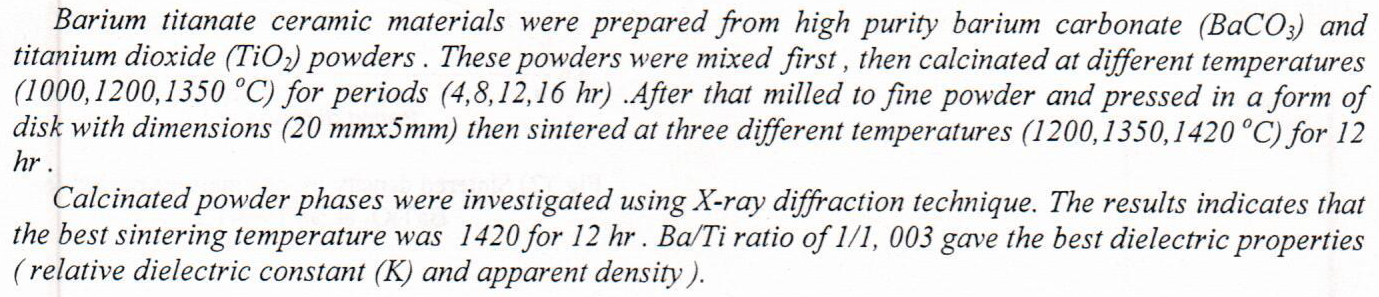
Preparation, Characterization, and Properties of Barium Titanate

The electronic properties (such as energy gap HOMO levels. LUMO levels, density of state and density of bonds in addition to spectroscopic properties like IR spectra, Raman spectra, force constant and reduced masses as a function of frequency) of coronene C24 and reduced graphene oxide C24OX , where x=1-5, were studied.. The methodology employed was Density Functional Theory (DFT) with Hybrid function B3LYP and 6-311G** basis sets. The energy gap was calculated for C24 to be 3.5 eV and for C24Ox was from 0.89 to 1.6862 eV for x=1-5 ,respectively. These energy gaps values are comparable to the measured gap of Graphene (1-2.2 eV). The spectroscopic properties were compared with experimental measurements, specificall
... Show More (2)
(2)
 (1)
(1)


Polycrystalline Cadmium Oxide (CdO) thin films were prepared
using pulsed laser deposition onto glass substrates at room
temperature with different thicknesses of (300, 350 and 400)nm,
these films were irradiated with cesium-137(Cs-137) radiation. The
thickness and irradiation effects on structural and optical properties
were studied. It is observed by XRD results that films are
polycrystalline before and after irradiation, with cubic structure and
show preferential growth along (111) and (200) directions. The
crystallite sizes increases with increasing of thickness, and decreases
with gamma radiation, which are found to be within the range
(23.84-4.52) nm and (41.44-4.974)nm before and after irradiation for
(1)
(9)
In this article, the casting method was used to prepare poly(methyl methacrylate)/hydroxyapatite (PMMA/HA) nanocomposite films incorporated with different contents (0.5, 1, and 1.5 wt%) of graphene nanoplatelets (Gnp). The chemical properties and surface morphology of the PMMA/HA blend and PMMA/HA/Gnp nanocomposite were characterized using FTIR, and SEM analysis. Besides, the thermal conductivity, dielectric and electrical properties at (1–107 Hz) of the PMMA/HA blend and PMMA/HA/Gnp composites were investigated. The structural analysis showed that the synthesized composites had a low agglomerated state, with multiple wrinkles of graphene flakes in the PMMA/HA blend. The thermal conductivity was improved by more than 35-fold its value for
... Show More
(22)
(19)

Tight reservoirs have attracted the interest of the oil industry in recent years according to its significant impact on the global oil product. Several challenges are present when producing from these reservoirs due to its low to extra low permeability and very narrow pore throat radius. Development strategy selection for these reservoirs such as horizontal well placement, hydraulic fracture design, well completion, and smart production program, wellbore stability all need accurate characterizations of geomechanical parameters for these reservoirs. Geomechanical properties, including uniaxial compressive strength (UCS), static Young’s modulus (Es), and Poisson’s ratio (υs), were measured experimentally using both static and dynamic met
... Show MoreBackground Microorganisms and fungal growth especially Candida albicans, on soft denture lining material are the most common problem which can lead to chronic mucosal inflammation. The aim of this study was to evaluate the effect of zirconium nanoparticles into acrylic-based heat cured soft denture lining material against Candida albicans, and the amount of zirconium ion release of soft liner/ZrNPs composite. Furthermore, evaluate shear bond strength after ZrNPs addition to soft liner. Materials and methods: Zirconium nanoparticles were added into acrylic-based soft denture liner in various percentages (1%, and 1.5% by weight). Two hundred and fifty specimens were arranged and isolated into four groups as per the test to be done The antifu
... Show More
(16)
Friction stir welding (FSW) process is an emerging solid state joining process in which the material that is being welded does not melt. This process uses a nonconsumable tool to generate frictional heat in the abutting surfaces. The welding parameters such as tool rotational speed, welding speed, axial force, etc., and tool pin profile play a major role in deciding the weld quality. In this investigation an attempt
has been made to understand the effect of tool pin profile and rotation diameter on microstructure and mechanical properties in aluminum alloy (2218-T72). Five different tool pin profiles (straight cylindrical, threaded cylindrical, triangular, square, and threaded cylindrical with flat), with three different rotation
d
(12)
(11)
Transition metal complexes of Co(II) and Ni(II) with azo dye 3,5-dimethyl-2-(4-nitrophenylazo)-phenol derived from 4-nitoaniline and3,5-dimethylphenol were synthesized. Characterization of these compounds has been done on the basis of elemental analysis,electronic data, FT-IR,UV-Vis and 1 HNMR, as well as magnetic susceptibility and conductivity measurements. The nature of thecomplexes formed were studies following the mole ratio and continuous variation methods, Beer ' s law obeyed over a concentrationrange (1x10 -4 - 3x10 -4 M). High molar absorbtivity of the complex solutions were observed. From the analytical data, thestoichiomerty of the complexes has been found to be 1:2 (Metal:ligand). On the basis of physicochemical data tetrahedral
... Show More