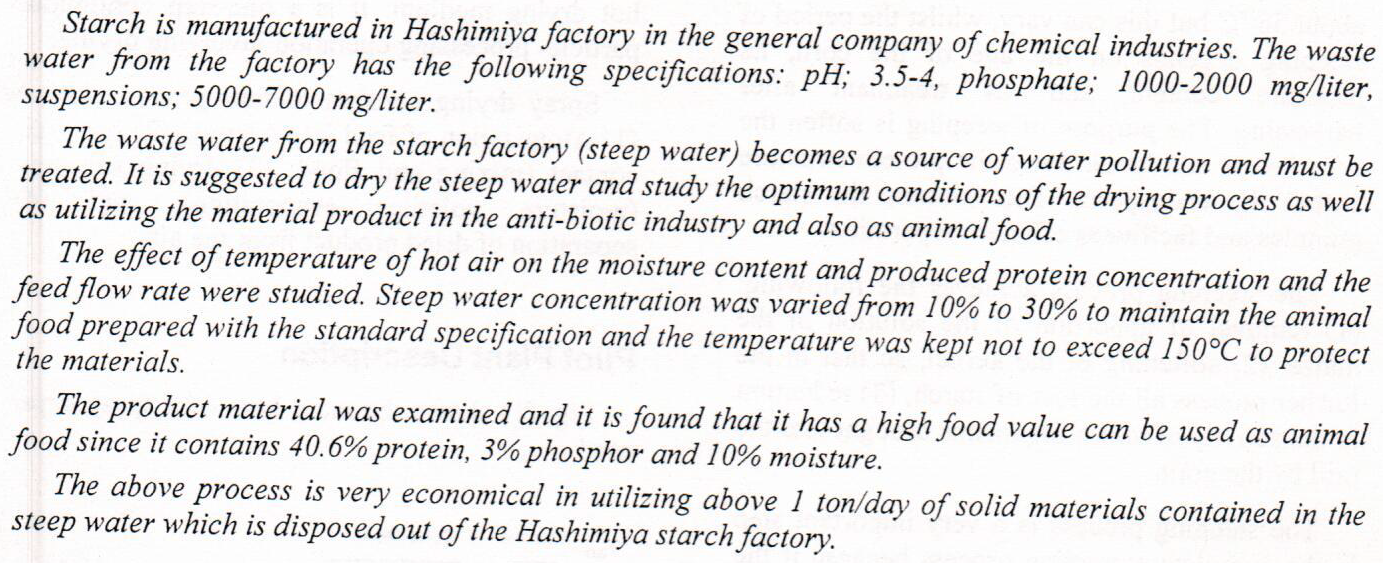
Effects of Drying Conditions on the Properties of Dried Particles of Powdered steep Liquor

The liver protective effects of pentoxifylline were studied through pre-treatment of rats with various intraperitoneal (IP) doses (25, 50 and 100mg/kg/day) 14 days before induction of liver toxicity by carbon tetrachloride (CCl4). The parameters of oxidative stress, malondialdehyde (MDA) and reduced glutathione (GSH) were measured in liver homogenate in addition to histopathological examinations. Analysis of data revealed significant amelioration of oxidative stress in groups of animals pre-treated with different doses of pentoxifylline (PTX) compared to group of animals intoxicated by CCl4 as evidenced by lowering MDA contents and elevation of GSH levels in liver tissue homogenate but the levels still signifi
... Show More (5)
(5)

 (38)
(38)
(38)
(38)


The study aimed to detect the VrPIP2;7 gene using PCR approach, as well as to know the effect of the treatment with four increased melatonin concentrations of 50, 100, 150 and 200 ppm in addition to control treatment were 0 ppm on the gene expression of plasma membrane intrinsic proteins (PIP) genes in Vigna radiata L. plant exhibition for five periods of drought which is irrigation every 24 hours, 48 hours, 5 days, 10 days and every 15 days. The electrophoresis of agarose gel at a concentration of 2% showed one band when detecting the VrPIP2;7 gene with a sizeable 732 bp and using the 100 bp volume index. This gene was selected for sequencing study based on its importance as well as on the results of its gene expression. The sequencing of
... Show MoreBackground This study establishes a mathematically consistent and computational framework for the simultaneous identification of two time-dependent coefficients in a one-dimensional second-order parabolic partial differential equation. The considered problem is governed by nonlocal initial, boundary, and integral overdetermination conditions. Methods The direct problem is solved using the Crank-Nicolson finite difference method (FDM), which ensures unconditional stability and second-order accuracy in both spatial and temporal discretizations. The corresponding inverse problem is reformulated as a nonlinear regularized least-squares optimization problem and efficiently solved used the MATLAB subroutine
... Show More
In this article the conventional "solid-state reaction" method was used to synthesize perovskite Li0.4Cd0.6Ba2Ca2Cu3O10+δ. Four main types of compounds were obtained by physically replacing calcium oxide with cadmium in proportions 0, 0.03, 0.06 and 0.09, the pure Li0.4Cd0.6Ba2Ca2Cu3O10+δ phase, and the phases Li0.4Cd0.6Ba2Ca1.97Cd0.03Cu3O10+δ
... Show More
(3)
(1)
The effect of approaching nozzle jet from the deposition surface
on structural, optical and morphology properties of copper oxide thin
films was studied. The film was prepared by homemade fully
computerized CNC spray pyrolysis deposition technique at
preparations speed (3, 4, 5, and 6 mm/sec). The repeated line mode
was used at deposition temperature equal 450 °C whereas the
spraying time was in the range of (15-30 min) according to the
deposition speed. The film exhibit polycrystalline structure with
preferred orientation along (-111), (022) and (011), (002) at a 2θ
value of (35.63o) and (38.8o) respectively. Optical band gaps were
recorded at these speed shows variance in value from (1.53-2.08 eV).
Fi
(1)
Al-Si alloys which are widely used in engineering applications due to their outstanding properties can be modified for more enhancements in their properties. Current work investigated the ability of these alloys to be modified by casting them through the addition of nanoparticles. So, Multi-wall carbon nanotubes (CNT) and titanium carbide ceramic particles (TIC) with size of (20 nm) were added with different amounts started from (0.5 up to 3%) weight to cast alloy A356 that was considered to be the base metal matrix, then stirred with different speeds of (270, 800, 1500, 2150) rpm at 520 °C for one minute. The results showed change in microstructure’ shape of the casted alloys from the dendritic to spherical gra
... Show More
Oil well drilling fluid rheology, lubricity, swelling, and fluid loss control are all critical factors to take into account before beginning the hole's construction. Drilling fluids can be made smoother, more cost-effective, and more efficient by investigating and evaluating the effects of various nanoparticles including aluminum oxide (Al2O3) and iron oxide (Fe2O3) on their performance. A drilling fluid's performance can be assessed by comparing its baseline characteristics to those of nanoparticle (NPs) enhanced fluids. It was found that the drilling mud contained NPs in concentrations of 0,0.25, 0. 5, 0.75 and 1 g. According to the results, when drilling fluid was used without NPs, the coeff
... Show More
(3)
Recently, many materials have shown that they can be used as alternatives to chemicals materials in order to be used to improve the properties of drilling fluids. Some of these materials are banana peels and corn cobs which both are considered environmentally- friendly materials. The results of the X-ray diffraction examination have proved that the main components of these materials are cellulose and hemicellulose, which contribute greatly to the increasing of the effectiveness of these two materials. Due to their distinct composition, these two materials have improved the rheological properties (plastic viscosity and yield point) and reduced the filtration of the drilling fluids to a large extent. The addition rates used for each o
... Show More
(7)