Preparation, Characterization, and Properties of Barium Titanate
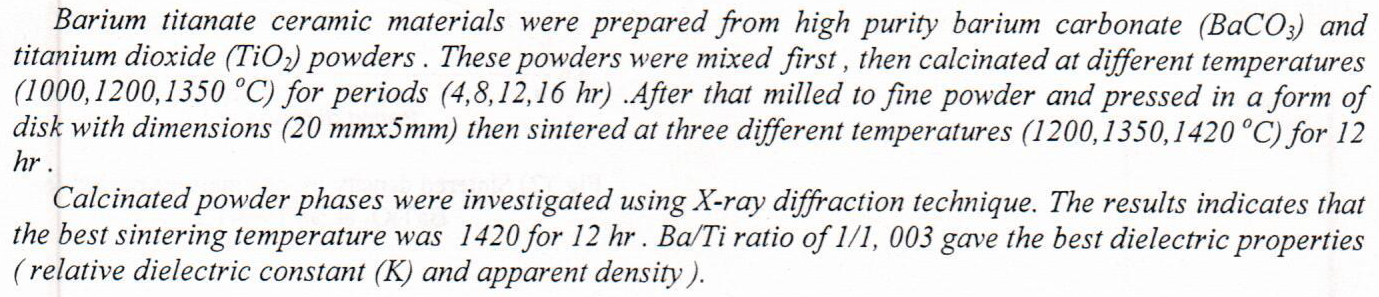

Pure and doped barium titanate with Mg2+ ion at two molar ratios x= (5%, 10%) mol. has been synthesized by solid state reaction technique. The powders sintered at two temperatures (1000 °C and 1400 °C). An XRD technique was used in order to study the crystal structure of pure and doped barium titanate, which confirmed the formation of the tetragonal phase of BaTiO3, and then calculate the lattice parameters of pure and doped barium titanate, the addition of magnesium ion Mg2+ can lead to decreases lattice parameters.

Pure and doped barium titanate with Mg2+ ion at two molar ratios x= (5%, 10%) mol. has been synthesized by solid state reaction technique. The powders sintered at two temperatures (1000 °C and 1400 °C). An XRD technique was used in order to study the crystal structure of pure and doped barium titanate, which confirmed the formation of the tetragonal phase of BaTiO3, and then calculate the lattice parameters of pure and doped barium titanate, the addition of magnesium ion Mg2+ can lead to decreases lattice parameters.
Using an environmentally friendly chemical process, a novel nanocomposite consisting of reduced graphene oxide (rGO) and silver(I) oxide (Ag2O) nanoparticles was successfully synthesized in this work, and its optical properties along with photoelectric performance were investigated. Ag2O is a narrow-bandgap p-type semiconductor with strong visible light response but exhibits poor carrier separation and structural instability during exposure to radiation. In order to overcome shortcomings encountered with Ag2O, rGO was used as a conductive support to produce rGO@Ag2O nanocomposites with improved electronic interactions. Various characterization tests, including energy-dispersive X-ray spectroscopy (EDXS), field emission scanning electron mic
... Show More
This work investigates the properties of polyvinyl alcohol (PVA) nanocomposite films with varying multi-walled carbon nanotube (MWCNT) content, ranging from 2 to 8 wt.%. The films were prepared using a solution casting method and characterized using UV-visible spectroscopy, optical microscopy, X-ray diffraction, and tensile tests. The prepared PVA/MWCNT nanocomposite films exhibited optical band gap values ranging from 3.5 eV to 5.3 eV. XRD analysis confirmed the semi-crystalline nature of these nanocomposites. Mechanical properties, including hardness, yield strength, ultimate tensile strength, and Young's modulus, were enhanced by increasing MWCNT content by up to 8%. Contact angle measurements showed an increase in hydrophobicity with in
... Show More (8)
(8)
 (7)
(8)
(7)
(7)
(8)
(7)

Here, we synthesized three new blended ligand complexes of chromium (III), iron (III), and lanthanum (III) ions with a Schiff base made from the condensation of [o-aminophenol and 2-hydroxyacetophenone in the presence of concentrated sulphoric acid (HL1)] as a primary ligand and o-nitroaniline (L2) as a secondary. The Schiff base and its dual ligand chelate were characterized using several spectroscopic studies, IR, 1HNMR, electronic and mass spectra, in addition to elemental analyses, molar conductivity measurements, and magnetic moments. The spectroscopic and analytical outcomes confirmed the formation of the chelates in a 1:1:1(L1: M: L2) ratio. Similarly, an octahedral structure became counseled for all chelates.
(30)
(27)
Iraqi kaolin was used for the preparation and characterization of NaY zeolite for biodiesel production via esterification reaction. Oleic acid was used usually as a typical simulated feedstock of high acid number for the esterification reaction.
The chemical composition for the prepared Nay zeolite is as following: (Ca2.6Na1.K0.1)(Al6.3Si17.7)O48.16H2O, the silica to alumina ratio in the prepared catalyst was found equal to 2.6 and Na2O content was 12.26 wt. %, with relative crystallinity equal to 147.4 % obtained by the X-ray diffraction. The surface area result shows that the prepared catalyst has 330 m2
... Show MoreIn this research four steps of the new derivatives of Naproxen drug have been made which are known as a high medicinal effectiveness; the first step involved converting Naproxen into the corresponding ester (A) by reaction Naproxen with methanol absolute in presence H2SO4. While the second step involved treatment methyl Naproxen ester (A) with hydrazine hydrate 80% in presence of ethanol .The third reaction requires synthesis of Schiff bases (C1-C10) by condensation. of Naproxen hydrazide (B) with many substituted aromatic aldehydes . Finally, the fourth step synthesized new tetrazole derivatives ( D1- D10) by the reaction of the prepared Schiff bases (in the third step) with Sodium azide in THF as a solvent .The prepared compounds wer
... Show More
(3)
In this work, silver (Ag) self-metallization on a polyimide (PI) film was prepared through autocatalytic plating. PI films were prepared through the solution casting method, followed by etching with potassium hydroxide (KOH) solution, sensitization with tin chloride (SnCl2), and the use of palladium chloride (PdCl2) to activate the surface of PI. Energy-dispersive X-ray analysis (EDX) showed the highest peak in the (Ag) region and confirmed the presence of AgNPs. The diffraction peaks at 2θ = 38.2°, 44.5°, 64.6°, and 78.2° represented the 111, 200, 220, and 311 planes of Ag, respectively. The FT–IR an
... Show More
(7)
(2)