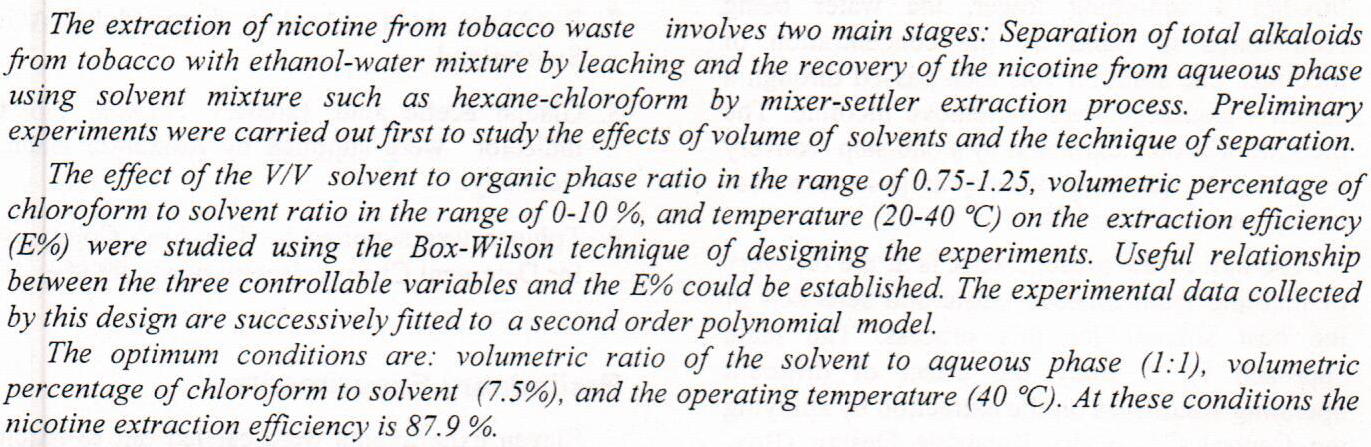
The Nicotine Extraction from Tobacco Wastes

Metal complexes of Mn(II), Co(II), Ni(II), Cu(II), Cd(II), Zn(II), Hg(II), Pd(II), and Pt(II) with Schiff base ligand (LH) derived from 2,5-dichloroaniline and 2-hydroxy-5-metheylbenzalaldehyde were synthesized and characterized using a variety of spectrophotometric techniques The findings of the spectroscopic analysis indicated that (LH) behaved as a binary coordinating agent to the metal ion by the N and O atoms, and the geometry shape of the complexes was octahedral, with the exception of the Pd and Pt complexes, which had a square planar geometry. Using the DPPH radical scavenging method, we investigated the antimicrobial activity of the compound against Staphylococcus aureus and Escherichia coli, as well as the antifungal activity of t
... Show MoreThe mixed ligand complexes of Schiff base ligand (Z)-2-(((4-bromo-2-methylphenyl) imino) methyl)-4-methylphenol (L) with some metals ion (II); Mn(1), Co(2), Ni(3), Cu(4), Zn(5) Cd(6) and Hg(7) and 1,10-Phenanthroline (phen) were Synthesis and characterized by the mass and 1HNMR spectrometry (ligand Schiff base), the FTIR, UV-visible and the flame atomic absorption (A.A) spectrum, the C.H.N analysis and the chlorine content, in addition to measuring the magnetic sensitivity of the complexes. All the complexes had octahedral geometry. The bioactivity activity for compounds against; Rhizopodium, Staphylococcus aureus and Escherichia coli, the compounds showed different efficacy towards these microorganisms
New schiff bases series (VIII) a-e and 1,3-thiazolidin-4-one derivatives (IX) a-e containing the 1,2,4-triazole and 1,3,4-thiazazole rings were synthesized and screening their biological activities. These compounds were identified via Fourier transform infrared (FT-IR) spectra, some via Proton nuclear magnetic resonance (1H-NMR) and mass spectra. The biological results indicated that all of these compounds did not reveal antibacterial effectiveness against (Escherichia coli and Klebsiella species) (G-). Some of these compounds showed moderate antibacterial activity against (Staphylococcus aureus, and Staphylococcus epidermidis) (G+), and all compounds exhibited moderate activity against Candida albicans.
 (1)

In this study, iron oxide nanoparticles (α-Fe₂O₃ NPs) were prepared using a readily available chili pepper plant extract from local markets. This study aims to evaluate the magnetic properties of α-Fe₂O₃ prepared in green chemistry from Capsicum plant extract. After several simple preparatory steps, such as washing and cutting, they were treated with an inorganic complex (potassium hexacyanoferrate) (K3[Fe(CN)₆]). In the first analytical step, the in vitro detection of the plant extract solution after reaction with the potassium hexacyanoferrate (III) complex revealed characteristic adsorption bands of the cyanide group, which disappeared upon complexation. The iron oxide NPs were characterized using various methods, including X
... Show MoreThis study was conducted in the poultry field of the Department of Animal Production - Faculty of Agriculture - University of Baghdad (Abu Ghraib) for the period from 28/9/2017 to 9/11/2017 for a period of six weeks (42 days), was used in the experiment 300 chick of broiler (Ross 308) one day old. The aim of this study was to effect of adding supplementing different levels of bee pollen (0, 250, 500, 750 and 1000) gm/100kg on Productive Performance. The chicks were randomly distributed in to five treatments, T1 control (without any addition), (T2, T3, T4 and T5) adding bee pollen in the diet 250, 500, 750 and 1000 gm/100kg respectively. The results showed that bee pollen in the diet level 1000 gm/100 kg led to significant increase in the we
... Show More
(6)
This article reviews the technical applicability of nanofiltration membrane process for the removal of nickel, lead, and copper ions from industrial wastewater.
Synthetic industrial wastewater samples containing Ni(II), Pb(II), and Cu(II) ions at various concentrations (50, 100, 150 and 200 ppm), under different pressures (1, 2, 3 and 4 bar), temperatures (10, 20, 30 and 40 oC), pH (2, 3, 4, 5 and 5.5), and flow rates (1, 2, 3 and 4 L/hr), were prepared and subjected treated by NF systems in the laboratory. Suitable NF membrane was chosen after testing a number of NF membranes (University of Technology-Baghdad), in terms of production and removal. NF system was capable of removing more than (85%, 78%, and 66% for Ni(II
... Show MoreNi and Cd complexes of new Schiff base derived from 5-Amino-2-phenyl-2,4-dihydro-pyrazol-3-one with 4-chlorobenzalaldehyde (A) , 2-Hydroxy-benzalaldehyde (B) and 4-Hydroxy-benzaldehyde (C) have been prepared and characterized by elemental analysis , molar conductivity measurements , FTIR , UV- vis , 1HNMR, mass spectrometer and magnetic susceptibility. Analytical data revealed that six complexes were a distorted tetrahedral geometry and exhibited (1:1) metal :ligand ratio. The biological activity for the three ligands and its complexes were studied
Candida Berkh. (1923) occurs naturally in the body. But it becomes opportunistic fungi, meaning that it infects humans when there is any weakening of the immune system, such as exposure to chemotherapy, diabetes, or organ transplantation. Most species of Candida grow at a temperature between 20-40 °C and have a pH of 3-8. Human pathogens of Candida species include C. albicans, C. glabrata, C. lusitaniae, C. parapsilosis, C. tropicalis and C. utili. C. albicans has many virulence factors that facilitate injury process. Virulence factors are considered as a measure of pathogenicity, and it is in the form of fungal toxins, enzymes, or cell structures that facilitate infection, as well as pathogen resistance in different conditions. This study
... Show MoreAeromonas salmonicida is a fish pathogen and recognized to cause a variety of diseases in humans. There are a few information about A.salmonicida in Iraq and there is no any previous molecular study on it. During the period of December 2017 to May 2018; Sixteen isolates of the A. salmonicida were isolated and identified from 300 common carp (Cyprinus carpio) fishes stomach in aquarium of Erbil city/ Iraq by using manual, automated Vitek 2 compact system, and confirmed by PCR using gene TonB-dependent siderophore (364bp). Antimicrobial susceptibility was determined by disk diffusion method and the results found that all isolates 100% susceptible to imipenem, 100% resistant to nalidixic acid and variable resistan
... Show More

