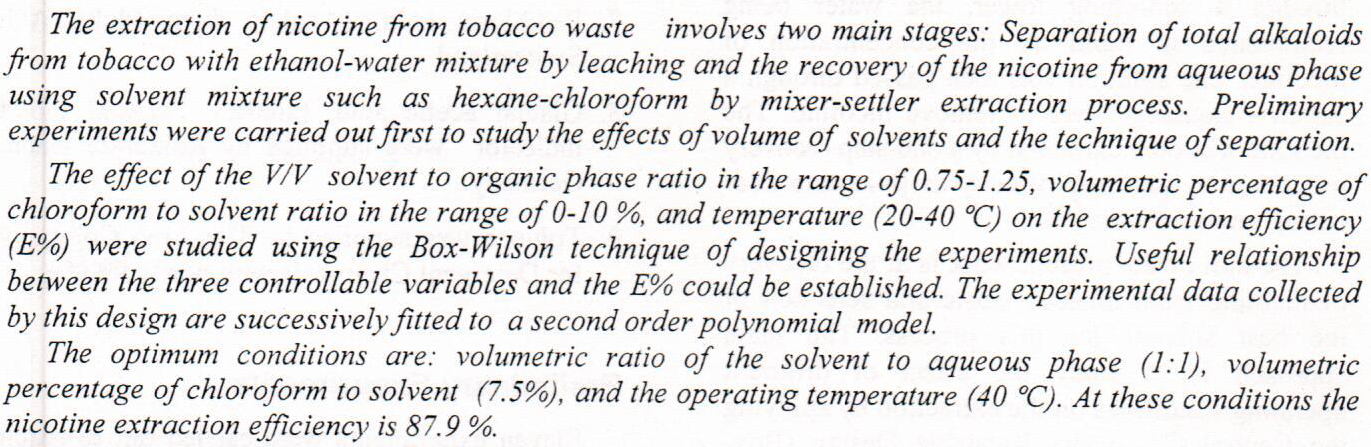
The Nicotine Extraction from Tobacco Wastes

 (11)
(11)
 (11)
(11)

 (3)
(3)

The plant occupied the largest area in the biosynthesis of silver nanoparticles, especially the medicinal plants, and it has shown great potential in biotechnology applications. In this study, green synthesis of silver nanoparticles from Moringa oleifera leaves extract and its antifungal and antitumor activities were investigated. The formation of silver nanoparticles was observed after 1 hour of preparation color changing. The ultraviolet and visible spectrum, Fourier transform infrared spectroscopy, X-ray diffraction, scanning electron microscopy, and transmission electron microscopy techniques were used to characterize synthesis particles. Ultraviolet and visible spectroscopy showed a silver surface plasmon resonance band at 434
... Show More
(97)
(83)
(14)
(9)
Purpose: The purpose of the study is to compare and evaluate Earnings Management in Tunisia and Iraq. Theoretical framework: Earnings Management is an important topic that has been studied by a significant number of researchers, as well as those who are interested in the accounting profession. Earnings Management has gotten a lot of attention from academics, professionals, and other interested parties in recent years (e.g. Kliestik et al., 2020; Rahman et al., 2021; Gamra &Ellouze, 2021) Design/methodology/approach: The sample includes ten banks listed on the Bourse of Tunisia and Iraq Stock Exchanges for the year 2017. We have used a model of Kothari et al., (2005) as a tool to measure Earnings Management in both mark
... Show More
(23)
(4)
(1)
(3)
(7)
(1)
A comparative study was done on the adsorption of methyl orange dye (MO) using non-activated and activated corn leaves with hydrochloric acid as an adsorbent material. Scanning electron microscopy (SEM) and Fourier Transform Infrared spectroscopy (FTIR) were utilized to specify the properties of adsorbent material. The effect of several variables (pH, initial dye concentration, temperature, amount of adsorbent and contact time) on the removal efficiency was studied and the results indicated that the adsorption efficiency increases with the increase in the concentration of dye, adsorbent dosage and contact time, while inversely proportional to the increase in pH and temperature for both the treated and untreated corn leav
... Show More
(27)
A comparative study was done on the adsorption of methyl orange dye (MO) using non-activated and activated corn leaves with hydrochloric acid as an adsorbent material. Scanning electron microscopy (SEM) and Fourier Transform Infrared spectroscopy (FTIR) were utilized to specify the properties of adsorbent material. The effect of several variables (pH, initial dye concentration, temperature, amount of adsorbent and contact time) on the removal efficiency was studied and the results indicated that the adsorption efficiency increases with the increase in the concentration of dye, adsorbent dosage and contact time, while inversely proportional to the increase in pH and temperature for both the treated and untreated corn leaves. The equi
... Show More
(27)
Nanotechnology is a continually expanding field for its uses and applications in multiple areas i.e. medicine, science, and engineering. Biosynthesis is straightforward, less-toxicity, and cost-effective technology. TiO2 NPs biosynthesis has attained consideration in recent decades. In this study, probiotic bacteria were isolated from cow’s raw milk samples, and then were identified by using the Vitek2 system; as Leuconostoc spp. included Leuconostoc mesenteroides subsp. mesenteroides (Leu.1), Leuconostoc mesenteroides subsp. cremoris (Leu.4), and Leuconostoc pseudomesenteroides (Leu.14). All Leuconostoc spp. isolates showed an ability for TiO2 NPs bio-production, after being incubated at anaerobic conditions (30 o C/ 24 h) in DeM
... Show More
(8)
(2)