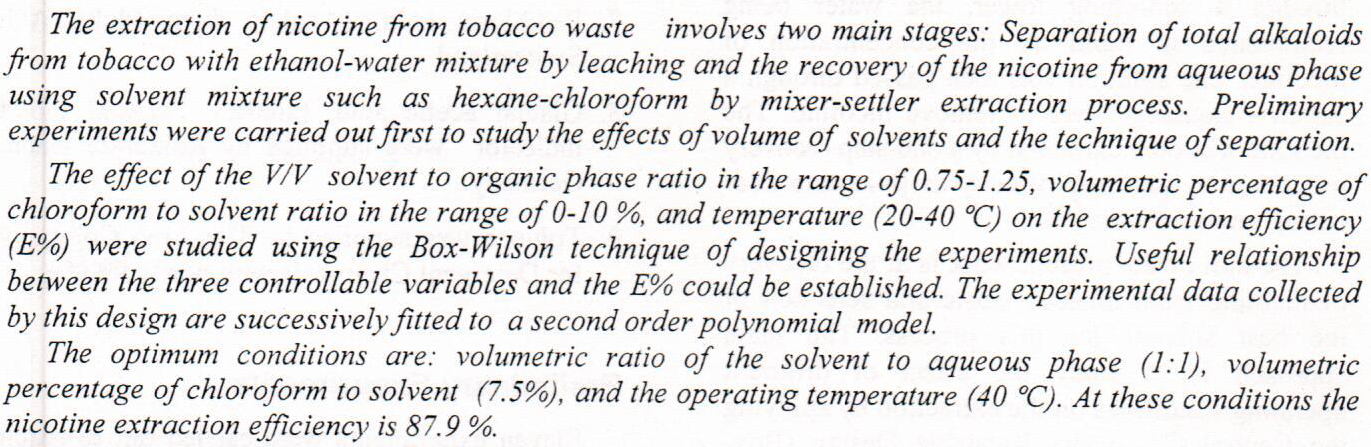
The Nicotine Extraction from Tobacco Wastes

The antioxidant and antibacterial activities of ethanolic extract and phenolic compounds extract of Lemon balm (Melissa officinalis) and Oregano (Oreganum vulgare) plants were studied; the phenolic content and the relationship between these compounds and the above activities were also investigated. The results showed that the Lemon balm had the highest phenolic content (56.5% mg g) and the phenolic content of Oregano was twice lower than Lemon balm. Lemon balm has the highest antioxidant activity which causes lipid peroxidation inhibition activity of linoleic acid (90.5%), this activity was more than ?-tocopherole antioxidant activity (79.3 %). It was found that the main source of antioxidant activity o
... Show More (1)
(1)

This work dealt with separation of naphthenic hydrocarbons from non-naphthenic hydrocarbons and in particular concerns an improved process for increasing the naphthenes concentration in naphtha, The separation was examined using adsorption by Y and B zeolite in a fixed bed process. The concentration of naphthenes in the influent and effluent streams was determined using PONA classification. The effect of different operating variables such as feed flow rate (2- 4 L/hr); bed length (50 - 80 cm) on the adsorption capacity of Y and zeolite was studied. Increasing the bed length lead to increase the naphthenes concentration, and increasing the flow rate lead to decrease in the concentration of naphthenes, It was found that the decrease
... Show More
(1)
The aim of study To purify GPCR from a local strain of S. cerevisiae using Ion exchange and gel filtration chromatography techniques , by packing materials for columns which will be chosen of low cost comparing to the already used in published researches, which depend on the costly affinity chromatography and other expensive methods of purification. Local strain of S. cerevisiae chosen for extraction and purification of G-protein coupled receptor (GPCR) .The strains were obtained from biology department in Al- Mosul University, Iraq. The isolated colony was activated on Yeast Extract Pepton Dextrose Broth (YEPDB) and incubated at 30 C˚ for 24 h .Loop fully of the yeast culture was transferred to (10ml) of yeast extract peptone glucose
... Show MoreBackground: Bacteriocin is a peptidic toxin has many advantages to bacteria in their ecological niche and has strong antibacterial activity. Objective: The aim of this study was to evaluation of bacteriocin using Streptococcus sanguinis isolated from human dental caries.
Subjects and Methods: Thirty five streptococcus isolates were diagnosed and tested for their production of bacteriocin, and then the optimal conditions for production of bacteriocin were determined. After that, the purification of bacteriocin was made partially by ammonium sulfate at 95% saturation levels, followed by and gel filtration chromatography
... Show More

 (1)
(1)
(33)
(26)
(1)
(1)
(33)
(26)
 (11)
(11)
(3)
(11)
(11)
(3)
The plant occupied the largest area in the biosynthesis of silver nanoparticles, especially the medicinal plants, and it has shown great potential in biotechnology applications. In this study, green synthesis of silver nanoparticles from Moringa oleifera leaves extract and its antifungal and antitumor activities were investigated. The formation of silver nanoparticles was observed after 1 hour of preparation color changing. The ultraviolet and visible spectrum, Fourier transform infrared spectroscopy, X-ray diffraction, scanning electron microscopy, and transmission electron microscopy techniques were used to characterize synthesis particles. Ultraviolet and visible spectroscopy showed a silver surface plasmon resonance band at 434
... Show More
(97)
(83)