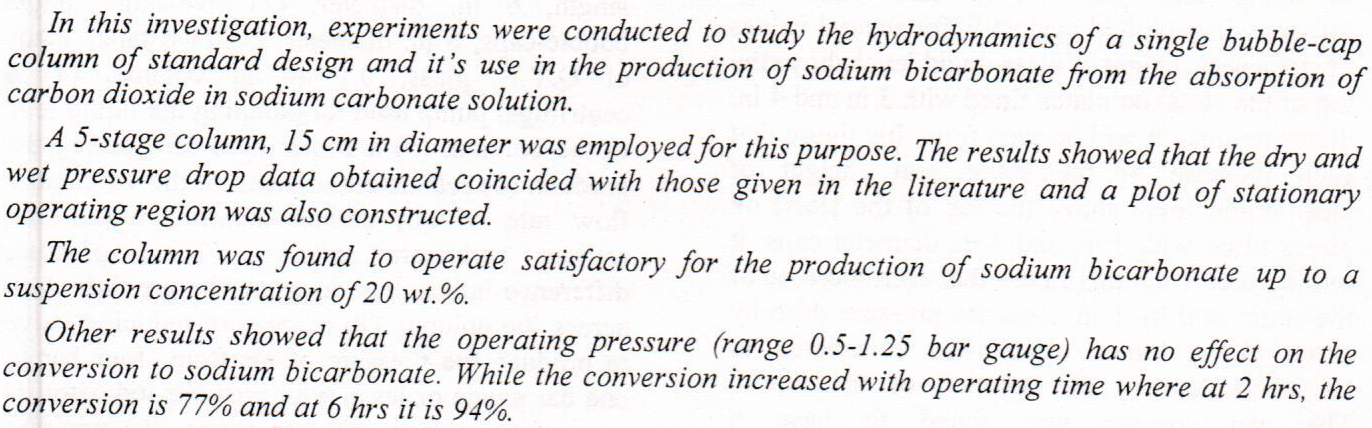
A Study of Absorption Column with Single Bubble Cap Tray in the Production of Sodium Bicarbonate

This article reviews the technical applicability of nanofiltration membrane process for the removal of nickel, lead, and copper ions from industrial wastewater.
Synthetic industrial wastewater samples containing Ni(II), Pb(II), and Cu(II) ions at various concentrations (50, 100, 150 and 200 ppm), under different pressures (1, 2, 3 and 4 bar), temperatures (10, 20, 30 and 40 oC), pH (2, 3, 4, 5 and 5.5), and flow rates (1, 2, 3 and 4 L/hr), were prepared and subjected treated by NF systems in the laboratory. Suitable NF membrane was chosen after testing a number of NF membranes (University of Technology-Baghdad), in terms of production and removal. NF system was capable of removing more than (85%, 78%, and 66% for Ni(II
... Show MoreIn this paper, a new third kind Chebyshev wavelets operational matrix of derivative is presented, then the operational matrix of derivative is applied for solving optimal control problems using, third kind Chebyshev wavelets expansions. The proposed method consists of reducing the linear system of optimal control problem into a system of algebraic equations, by expanding the state variables, as a series in terms of third kind Chebyshev wavelets with unknown coefficients. Example to illustrate the effectiveness of the method has been presented.

Optical properties of chromium oxide (Cr2O3) thin films which were prepared by pulse laser deposition method, onto glass substrates. Different laser energy (500-900) mJ were used to obtain Cr2O3 thin films with thickness ranging from 177.3 to 372.4 nm were measured using Tolansky method. Then films were annealed at temperature equal to 300 °C. Absorption spectra were used to determine the absorption coefficient of the films, and the effects of the annealing temperature on the absorption coefficient were investigated. The absorption edge shifted to red range of wavelength, and the optical constants of Cr2O3 films increases as the annealing temperature increased to 300 °C. X-ray diffraction (XRD) study reveals that Cr2O3 thin films are a
... Show More (1)
(1)
 (3)
(2)
(3)
(2)

Background The application of nanotechnology to biomedical surfaces is explained by the ability of cells to interact with nanometric features. The aim of this study was to consider the role of nanoscale topographic modification of CPTi dental implant using chemical etching method for the purpose of improving osseointegration. Materials and methods: Commercial pure titanium rod was machined into 20 dental implants. Each implant was machined in diameter about 3mm, length of 8mm (5mm was threaded part and 3mm was flat part). Implants were prepared and divided into 2 groups according to the types of surface modification method used: 1st group (10 implant) remained without nano surface modification (control), 2nd group include (10 implant) etche
... Show MoreThe Schiff base (E)-2-(((2-(1H-benzo[d]imidazol-2-yl) phenyl) imino) methyl)-4-methylphenol (Lb) ligand with some metals(II) ion such as; Co, Cu, Cd, and Hg, were synthesis and characterized by the mass and 1 HNMR spectrometry for ligand Schiff base, the fourier-transform infrared spectroscop (FTIR), UV- visible and the flame atomic absorption (AA) spectrum, the CHN analysis, and the chlorine content, in addition to measuring the magnetic sensitivity of the complexes. All the complexes had octahedral geometry. The bioactivity activity for compounds against; Rhizopodium, Staphylococcus aureus, and Escherichia coli showed different efficacy towards these microorganisms
The current study included the separation of three alkaloid compounds from Anastatica Hierochuntica and studied the effect of the these compounds on cancerous cells , specifically liver cancer it was found that compound number one is the most influential or inhibiting at 50 percent followed by compound number three when using concentration of 400 μg/mL.
The turning process has various factors, which affecting machinability and should be investigated. These are surface roughness, tool life, power consumption, cutting temperature, machining force components, tool wear, and chip thickness ratio. These factors made the process nonlinear and complicated. This work aims to build neural network models to correlate the cutting parameters, namely cutting speed, depth of cut and feed rate, to the machining force and chip thickness ratio. The turning process was performed on high strength aluminum alloy 7075-T6. Three radial basis neural networks are constructed for cutting force, passive force, and feed force. In addition, a radial basis network is constructed to model the chip thickness ratio. T
... Show More
(3)
The ionospheric characteristics exhibit significant variations with the solar cycle, geomagnetic conditions, seasons, latitudes and even local time. Representation of this research focused on global distribution of electron (Te) and ion temperatures (Ti) during great and severe geomagnetic storms (GMS), their daily and seasonally variation for years (2001-2013), variations of electron and ion temperature during GMS with plasma velocity and geographic latitudes. Finally comparison between observed and predicted Te and Ti get from IRI model during the two kinds of storm selected. Data from satellite Defense Meteorological Satellite Program (DMSP) 850 km altitude are taken for Te, Ti and plasma velocity for different latitudes during great
... Show More