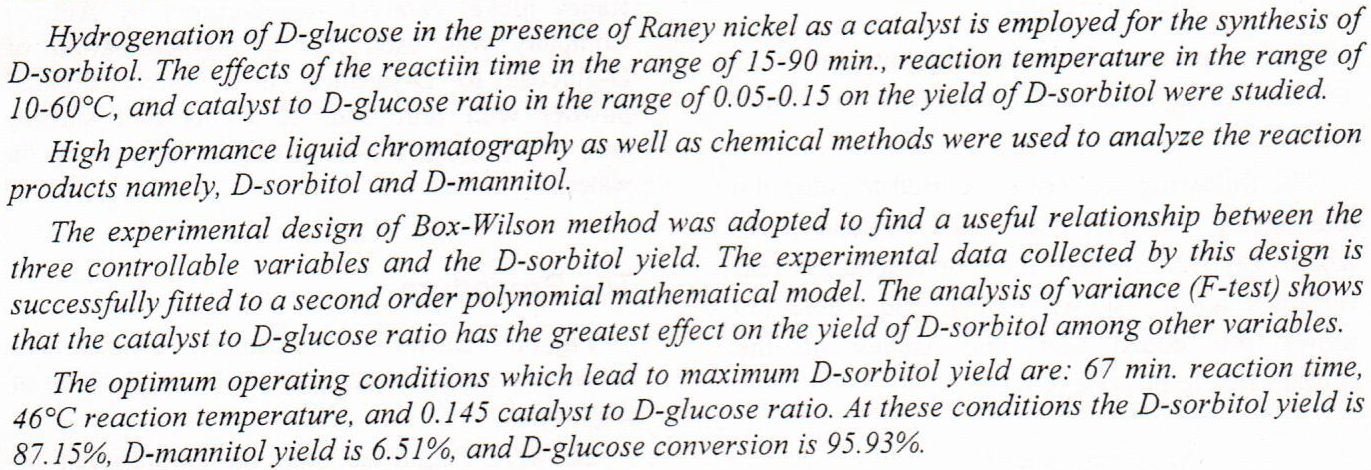
D-Sorbitol Production by Catalytic Hydrogenation of D-Glucose

The development of economic and environmentally friendly extractants to recover cobalt metal is required due to the increasing demand for this metal. In this study, solvent extraction of Co(II) from aqueous solution using a mixture of N,N0-carbonyl difatty amides (CDFAs) synthesised from palm oil as the extractant was carried out. The effects of various parameters such as acid, contact time, extractant concentration, metal ion concentration and stripping agent and the separation of Co(II) from other metal ions such as Fe(II), Ni(II), Zn(III) and Cd(II) were investigated. It was found that the extraction of Co(II) into the organic phase involved the formation of 1:1 complexes. Co(II) was successfully separated from commonly associated metal
... Show More (27)
(27)
 (14)
(14)


 (13)
(13)
Research aims to develop a novel technique for segmental beam fabrication using plain concrete blocks and externally bonded Carbon Fiber Reinforced Polymers Laminates (CFRP) as a main flexural reinforcement. Six beams designed an experimentally tested under two-point loadings. Several parameters included in the fabrication of segmental beam studied such as; bonding length of carbon fiber reinforced polymers, the surface-to-surface condition of concrete segments, interface condition of the bonding surface, and thickness of epoxy resin layers. Test results of the segmental beams specimens compared with that gained from testing reinforced concrete beam have similar dimensions for validations. The results show the effectiven
... Show More
(5)
zine level in serum was mesured from patients suffering ftom cancer and healthy indiciduals hindred from each individuals were classified into three according to thier age the groups were
Poly urea formaldehyde –Bentonite (PUF-Bentonite) composite was tested as new adsorbent
for removal of mefenamic acid (MA) from simulated wastewater in batch adsorption
procedure. Developed a method for preparing poly urea formaldehyde gel in basic media by
using condensation polymerization. Adsorption experiments were carried out as a function of
water pH, temperature, contact time, adsorbent dose and initial MA concentration .Effect of
sharing surface with other analgesic pharmaceuticals at different pH also studied. The
adsorption of MA was found to be strongly dependent to pH. The Freundlich isotherm model
showed a good fit to the equilibrium adsorption data. From Dubinin–Radushkevich model the
mean free
Liquid-liquid membrane extraction technique, pertraction, using three types of solvents (methyl isobutyl ketone, n-butyl acetate, and n-amyl acetate) was used for recovery of penicillin V from simulated fermentation broth under various operating conditions of pH value (4-6) for feed and (6-8) for receiver phase, time (0-40 min), and agitation speed (300-500 rpm) in a batch laboratory unit system. The optimum conditions for extraction were at pH of 4 for feed, and 8 for receiver phase, rotation speed of 500 rpm, time of 40 min, and solvent of MIBK as membrane, where more than 98% of penicillin was extracted.
Leaching process applied for the extraction of bio active compounds from dried roots of (Elecampane) Inula helenium. Ethanol, hexane and distillated water were used as solvents. Roots were soaked with ethanol (5% w/v) with various concentration of ethanol (30 to 98%) at one day to know effect concentration of the solvent with concentration of bio active compound in Inula helenium. The same procedure was done using hexane as solvent. Also distilled water was used as solvent for extraction 5%(w/v) where plant material was soaked in water at different temperatures (25, 40, 65, 80, and 90) C. In all solvents undertaken, the effect of time duration on active ingredient (Thymol, Isoalatolactone, Alatolactone, 10-isobutyryl-oxy 8-9-epoxy thymol is
... Show More
(3)
Molecular barcoding was widely recognized as a powerful tool for the identification of organisms during the past decade; the aim of this study is to use the molecular approach to identify the diatoms by using the environmental DNA. The diatom specimens were taken from Tigris River. The environmental DNA(e DNA) extraction and analysis of sequences using the Next Generation Sequencing (NGS) method showed the highest percentage of epipelic diatom genera including Achnanthidium minutissimum (Kützing) Czarnecki, 1994 (21.1%), Cocconeis placentula Ehrenberg, 1838 (21.3%) and Nitzschia palea (Kützing) W. Smith, 1856 (16.3%).
Five species of diatoms: Achnanthidiu
... Show More
(4)
(2)
(2)
In this study, a double frequency Q-switching Nd:YAG laser beam (1064 nm and λ= 532 nm, repetition rate 6 Hz and the pulse duration 10ns) have been used, to deposit TiO2 pure and nanocomposites thin films with noble metal (Ag) at various concentration ratios of (0, 10, 20, 30, 40 and 50 wt.%) on glass and p-Si wafer (111) substrates using Pulse Laser Deposition (PLD) technique. Many growth parameters have been considered to specify the optimum condition, namely substrate temperature (300˚C), oxygen pressure (2.8×10⁻⁴ mbar), laser energy (700) mJ and the number of laser shots was 400 pulses with thickness of about 170 nm. The surface morphology of the thin films has been studied by using atomic force microscopes (AFM). The Root Mean Sq
... Show More
(2)