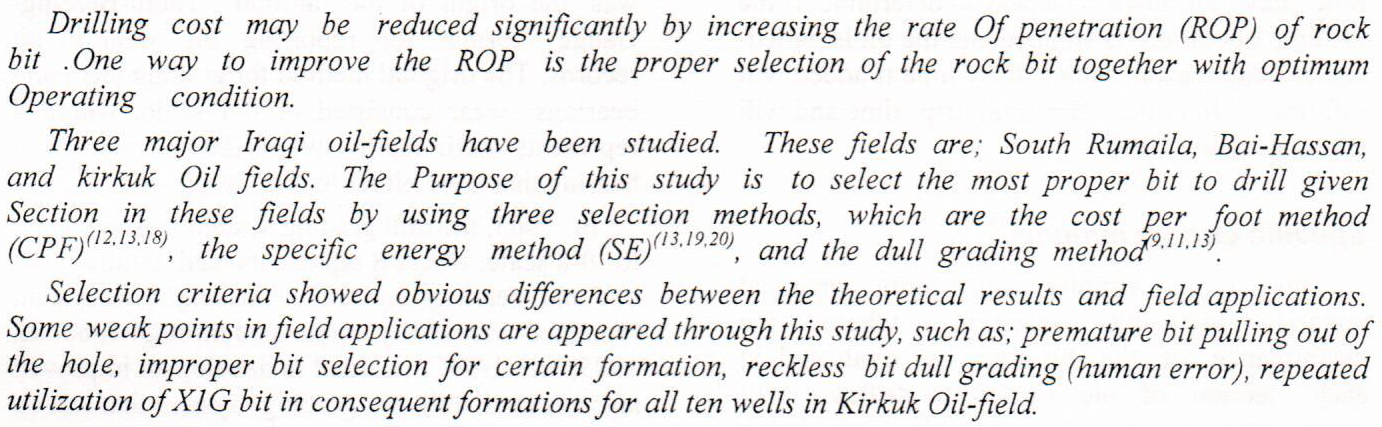
Analyzing and Optimizing Bits Performance in Three Iraqi Oil-Fields

This research presents a comparison of performance between recycled single stage and double stage hydrocyclones in separating water from water/kerosene emulsion. The comparison included several factors such as: inlet flow rate (3,5,7,9, and 11 L/min), water feed concentration (5% and 15% by volume), and split ratio (0.1 and 0.9). The comparison extended to include the recycle operation; once and twice recycles. The results showed that increasing flow rate as well as the split ratio enhancing the separation efficiency for the two modes of operation. On the contrary, reducing the feed concentration gave high efficiencies for the modes. The operation with two cycles was more efficient than one cycle. The maximum obtained effici
... Show More (1)
(1)

 (3)
(3)
 (3)
(3)
A review of the literature on intellectual capital development was conducted using systemic criteria for the inclusion of relevant studies. The concepts behind the ideas explored in the present study were discussed in respect to the subject matter. Examining the past state of the art in the intellectual capital sector for achieving high levels of innovation performance provided a multidimensional picture of intellectual capital, innovation performance, and dynamic capabilities. The present review was designed to illustrate the correlation between intellectual capital and innovation performance, as well as the role of dynamic capabilities in moderating the relationship between these constructs. Accordingly, we presented an extensive
... Show More
(38)
(25)
A three-stage learning algorithm for deep multilayer perceptron (DMLP) with effective weight initialisation based on sparse auto-encoder is proposed in this paper, which aims to overcome difficulties in training deep neural networks with limited training data in high-dimensional feature space. At the first stage, unsupervised learning is adopted using sparse auto-encoder to obtain the initial weights of the feature extraction layers of the DMLP. At the second stage, error back-propagation is used to train the DMLP by fixing the weights obtained at the first stage for its feature extraction layers. At the third stage, all the weights of the DMLP obtained at the second stage are refined by error back-propagation. Network structures an
... Show More
(1)
Background: This study aimed to compare the surface microhardness (MH) and mineral content of white spot lesions(WSLs) after using bioactive glass (BAG)casein phosphopep-tides-amorphous calcium phosphate(CPP-ACP),and nanohydroxyapatite(Nano-HAP) under pHcycling. Material and method:18 sound maxillary first premolar were used for the study.10 were selected for the vickers microhardness test, For Energy-dispersive X-ray spectroscopy analysis (EDX), the remaining 8 premolar teeth were used, 40 sections of enamel blocks (Four from each tooth) were produced from the middle part of the buccal and palatal surfaces of teeth for MH test while 48 sections of enamel blocks (Six from each tooth) were produced for EDX analysis. Enamel slabs were
... Show More
(11)
(7)
The study included selection six species of the fungi related to Pleurotus genus were evaluated for their ability to production of Pleurotin, one of them, Pleurotus ostreatus (P.11) was isolated and identified in the present study. Pleurotin was extracted with screening by Thin Layer Chromatography (TLC) and quantification High Performance Liquid Chromatography (HPLC). Cytotoxicity of Pleurotin extracted from P. ostreatus (P.11) grown in different sugar sources (galactose, mannitol, sucrose, dextrose and lactose) liquid media was test against three selected cancer cell lines, CaSki, MCF-7 and A549 addition to Human Non Cancer Fibroblast Cell Line (MRC-5). Pleurotin of P. ostreatus (P.11) grown in galactose induced the significant highest
... Show MoreThis study investigates the possibility of removing ciprofloxacin (CIP) using three types of adsorbent based on green-prepared iron nanoparticles (Fe.NPs), copper nanoparticles (Cu. NPS), and silver nanoparticles (Ag. NPS) from synthesized aqueous solution. They were characterized using different analysis methods. According to the characterization findings, each prepared NPs has the shape of a sphere and with ranges in sizes from of 85, 47, and 32 nanometers and a surface area of 2.1913, 1.6562, and 1.2387 m2/g for Fe.NPs, Cu.NPs and Ag.NPs, respectively. The effects of various parameters such as pH, initial CIP concentration, temperature, NPs dosage, and time on CIP removal were investigated through batch experiments. The res
... Show More
(3)
(3)
Background: This study aimed to compare the surface microhardness (MH) and mineral content of white spot lesions(WSLs) after using bioactive glass (BAG)casein phosphopep-tides-amorphous calcium phosphate(CPP-ACP),and nanohydroxyapatite(Nano-HAP) under pHcycling. Material and method:18 sound maxillary first premolar were used for the study.10 were selected for the vickers microhardness test, For Energy-dispersive X-ray spectroscopy analysis (EDX), the remaining 8 premolar teeth were used, 40 sections of enamel blocks (Four from each tooth) were produced from the middle part of the buccal and palatal surfaces of teeth for MH test while 48 sections of enamel blocks (Six from each tooth) were produced for EDX analysis. Enamel slabs were divi
... Show More
(11)
(7)