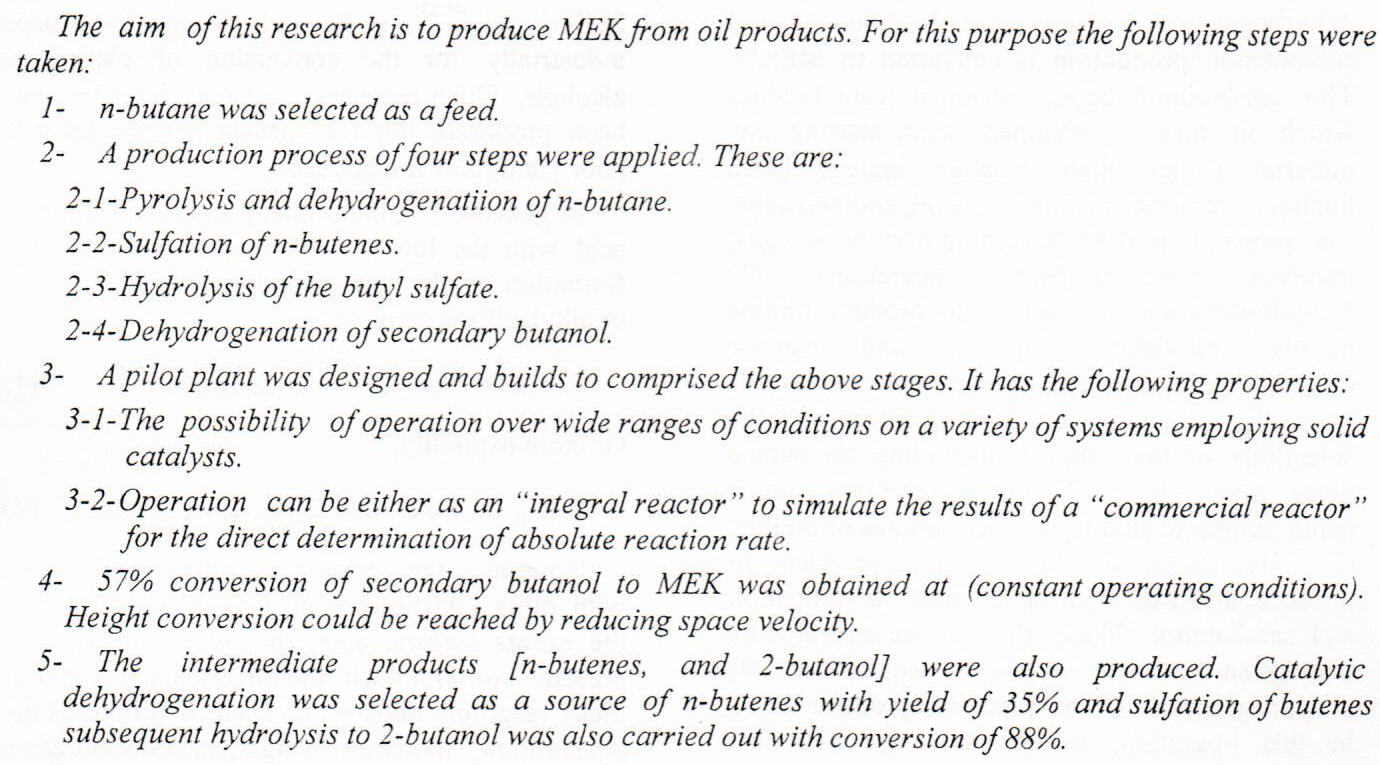
Production of Methyl Ethyl Ketone from N-Butane

Staphylococcus Sp.is the most common type of bacteria found in contamination place, we design this
study to compare the contamination accident between two hospitals in Baghdad.One of them isthe Burns
Specialist Hospital in the Medical CityinRusafa and another one is Al-Karama Hospital in Karkh. The
samples were collected fromOperativeWard No1 (OW1), Operative Ward No2 (OW2), Consulting Pharmacy
(CP), Emergency Room (ER), Reception Room (RR), Women's Ward (WW) and Men's Ward (MW).The
samples were taken from inside each clinical unit, surfaces, food, and air. The results showed that the
number of samples containing Staphylococcus sp. bacteria is 81, including 45 belonging to Al-Karama Burns
Ward Ho
 (7)
(7)
 (2)
(2)


From different hospitals in Baghdad city, 25 clinical isolates of Proteus spp. were collected from different clinical samples, all isolates were identified as Proteus mirabilis by using bacteriological and biochemical assays in addition to Vitek-2 identification system. 15 (60%) isolates were identifying as Proteus mirabilis. The susceptibility of P. mirabilis isolates towards cefotaxime and ceftazidime was (66.6 %), (20%) consecutively; while extended spectrum β-lactamases producing P. mirabilis percentage was (30.7 %). Because blaVEB-1 was documented as an important indicator for increasing risk of extended spectrum beta ßlactamases producing P. mirabilis isolates that began to spread from many geographic area to Far east which inc
... Show MoreA new series of Sulfamethoxazole derivatives was prepared and examined for antifibrinolytic and antimicrobial activities. Sulfamethoxazole derivatives bear heterocyclic moieties such as 1,3,4-thiadiazine {3}, pyrazolidine-3,5-diol {4} 6-hydroxy-1,3,4-thiadiazinane-2-thione {5} and [(3-methyl-5-oxo-4,5-dihydro-1H-pyrazol-4-yl)diazenyl] {8}. Their structures were elucidated by spectral methods (FT-IR, H1-NMR). Physical properties are also determined for all compound derivatives. Recently prepared compounds were tested for their antimicrobial activity in the laboratory. Each screened compound showed good tendency to moderate antimicrobial activity.
(29)
(8)
 (1)
(1)
The artificial silk (Rayon) was produced from the fronds of date palms which was taken from date palm trees (type Al-Zahdi) from the Iraqi gardens. Two main parts of the frond, namely leaves and stalks were used in this study to produce rayon. The palm fronds were converted into a powder of 90-180 micrometers. Major steps were used to produce rayon; delignification, bleaching and finally dissolution. Modified organosolv method which uses organic solvent method was applied to remove high lignin content. Three variables were studied in the delignification process: temperature, the ratio of ethanol to water and digestion time. The results showed that the best percent of lignin removal was (97%) which occured at; digestion time (80 minutes), te
... Show MoreThe 4-(?-bromo acetyl)-4?-toluene sulfonanilide (2) was used as key intermediate to synthesize new heterocyclic compounds. This bromo compound was synthesized via sulfonation of amino group of p-amino acetophenone using Hinsburg method with 4-toluene sulfonyl chloride to form 4-acetyl-4?-toluene sulfonanilide (1) which is used as a starting material in this work. This compound was brominated to yield compound (2) which is used as a precursor to synthesize new five and seven membered heterocyclic compounds such as substituted 1,3-oxazoles (3,4), 1,3-thiazole derivatives (5-7), thiourea compounds (8a,b), 1,3-Thiazoline-2-thione compounds (9a-f) and 1,2,5-triazepine compounds (11a-d). The synthesized compounds were identified depending u
... Show More
The six tablets presented here were returned to Iraq by the Jordanian authorities in 2008 and are now housed in the Iraq Museum.1 They date from the Third Dynasty of Ur (2112–2004 B.C.), from AS 9 to IS 2. The tablets record expenditures (zi-ga) of gold and various food items such as bread, fish, soup, beer, and meat. These food supplies were provided primarily as rations for royal messengers (lu2-kiĝ2-gi4-a lugal) on their journeys from cities such as Dēr, Adamdun, and Simaškum to the king’s residence. In addition, rations were provided for men coming from several cities, including Maza, Harši, and Kimaš. This study confirms that the tablets came from Irisaĝrig.
The current research was conducted to report the synthesis of alumina powder from Iraqi kaolin. The kaolin was transformed to metakaolin by calcinations at temperature 800 °C for three hours. Then the calcined kaolin was treated with (1.5 M) from H2SO4 for 6 hours to form Al2(SO4)3.12H2O solution. The precipitate was dried at 80oC for 10 hours and calcinations at different temperatures for two hours. The samples which result was characterized by X–Ray diffraction (XRD) and X–Ray fluorescence (XRF). The results indicate to the crystalline hydrate aluminum sulfate for the sample that be as – synthesis and when calcinations at 600 oC transformed into aluminum sulfate phase. The phases of alumina which we obtain consisted of a gamma a
... Show More
(2)

