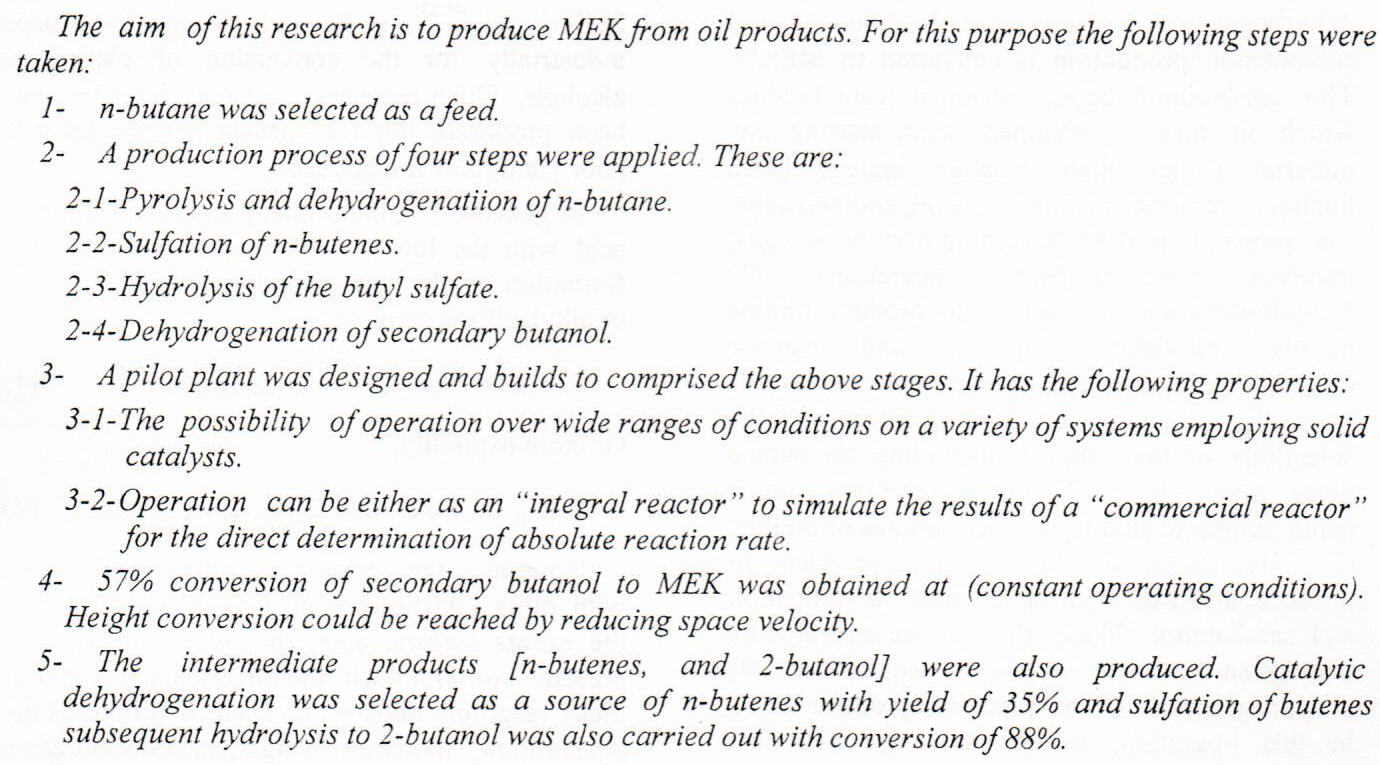
Production of Methyl Ethyl Ketone from N-Butane


 (3)
(3)
 (1)
(1)


The current study shows the cytotoxicity effect of the Crassula ovata n-hexane extract on esophagus can¬cer. C. ovata is a perennial succulent plant belonging to the Crassulaceae family. In Africa, the leaves were used medicinally to cure epilepsy and diarrhoea by boiling them in milk. The hexane fraction, which is obtained through the maceration method, demonstrates the presence of many compounds that have an anticancer effect, which are ob¬tained by gas chromatography - mass spectroscopy. The phytosterol compound was isolated by a preparative thin layer chromato¬graph and was identified by liquid chromatography - mass spectroscopy. The hexane fraction was found to possess a strong anticancer effect against esophagus cancer. The
... Show More
(1)
The New Schiff base ligand 4,4'-[(1,1'-Biphenyl)-4,4'-diyl,bis-(azo)-bis-[2-Salicylidene thiosemicarbazide](HL)(BASTSC)and its complexes with Co(II), Ni(II), and Cu(II) were prepared and characterized by elemental analysis, electronic, FTIR, magnetic susceptibility measurements. The analytical and spectral data showed, the stiochiometry of the complexes to be 1:1 (metal: ligand). FTIR spectral data showed that the ligand behaves as dibasic hexadentate molecule with (N, S, O) donor sequence towards metal ions. The octahedral geometry for Co(II), Ni(II), and Cu(II) complexes and non electrolyte behavior was suggested according to the analysis data.
Three N-(hydroxylphenyl) dimethylmaleimides were directly prepared in good yields (81-86)% from the reaction of dimethylmaleic anhydride with amino phenols. The prepared imides were esterified to the corresponding benzoates, methacrylates and cinnamates via their reaction with different acid chlorides in the presence of triethylamine. The prepared esters were tested as plasticizers for PVC via preparing of thirty six samples of PVC with the prepared esters in certain weight ratio followed by recording their softening points. Comparison the results with the universal plasticizers for PVC (DOP) and (DBP) indicated that the prepared esters in general have high plasticizing efficiency.
(8)
(7)
(8)
(7)
The compound 2,2'-(((1H-benzo(d)imidazol-2-yl)methyl)azanediyl)bis(ethan-1-ol) was reacted with benzyl bromide to afford compound (1) which used as row material to prepare a series of compounds through condensation reaction, the starting compound were reacted with tosyl chloride to protect the OH group to afford compound 2, then reacted benzyl bromide to produce compound (2), then the compound (2) treated with three compounds ( 2-mercaptobenzthiazole, 2-mercaptobenimidazol and 2-chloromethyl benzimidazole) to form compounds 3a,b, 4a,b and 5a,b respectively. In the another step the click reaction of compound 2,2'-(((1H-benzo(d)imidazol-2-yl)methyl)azanediyl)bis(ethan-1-ol) with Propargyl bromide produce compound 6 which reacted
... Show More
(3)
New complexes of the type [ML2(H2O)2] ,[FeL2(H2O)Cl] and [VOL2] were M=Co(II),Ni(II) and Cu(II) ,L=4-(2-methyl-4-oxoquinazoline-3(4H)-yl) benzoic acid were synthesized and characterized by element analysis, magnetic susceptibility ,molar conductance ,FT-IR and UV-visible. The studies indicate that the L acts as doubly monodentate bridge for metal ions and form mononuclear complexes. The complexes are found to be octahedral except V(IV) complex is square pyrimde shape . The structural geometries of compounds were also suggested in gas phase by theoretical treatments, using Hyper chem-6 program for the molecular mechanics and semi-empirical calculations, addition heat of formation(?Hf ?) and binding energy (?Eb)for the free ligan
... Show More
Refuse derived fuel (RDF) is considered one of the most important types of low cost thermal energy which can be tapped in the industry, especially the cement industry in particular being the need of high thermal energy during the production processes, and in this paper we have implemented the use of a derivative of the fuel RDF as a substitute for gasoline , to reduce production costs and thereby achieve production efficiency, and the methodology used in this research statistical analysis as well as the use of the cost of kaizen target for the purpose of reducing costs and achieve production efficiency, and this has reduced the cost total cement production by which led to reduce total costs of cement production by 8.4% and an incre
... Show More