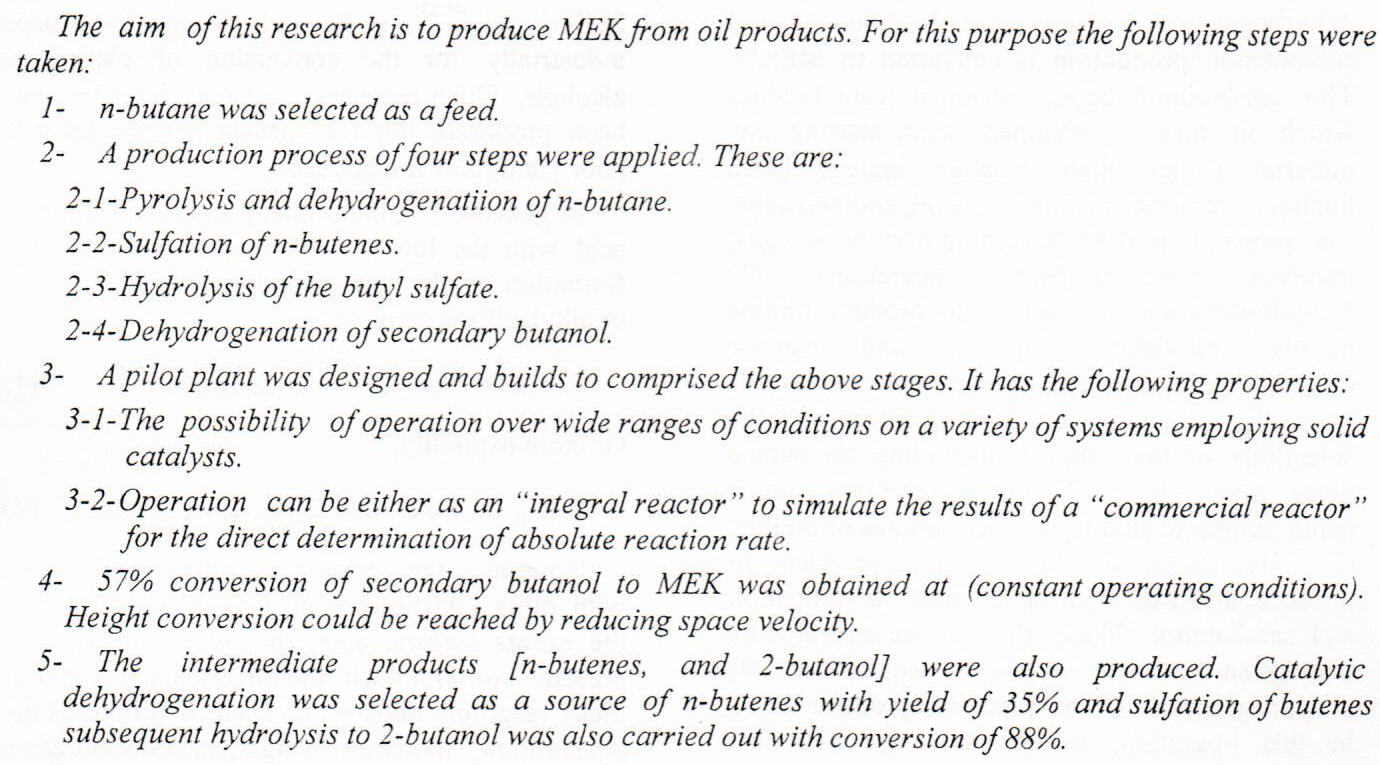
Production of Methyl Ethyl Ketone from N-Butane

Early detection of eye diseases can forestall visual deficiency and vision loss. There are several types of human eye diseases, for example, diabetic retinopathy, glaucoma, arteriosclerosis, and hypertension. Diabetic retinopathy (DR) which is brought about by diabetes causes the retinal vessels harmed and blood leakage in the retina. Retinal blood vessels have a huge job in the detection and treatment of different retinal diseases. Thus, retinal vasculature extraction is significant to help experts for the finding and treatment of systematic diseases. Accordingly, early detection and consequent treatment are fundamental for influenced patients to protect their vision. The aim of this paper is to detect blood vessels from
... Show More (1)
(1)

In this study, a new class of polymeric nanocomposites was synthesized and characterized. One mole of dimethyl adipate and two moles of thiosemicarbazide in ethanol first reacted to form the compound [C1]. Compound [C1] then reacted with sodium hydroxide to produce compounds [C2]. Hydrazine hydrate reacted with compound [C2] to generate compound [C3]. Compound [C4] was synthesized from compound [C3] and maleic anhydride. A polymer [C5] is formed by the reaction of the compound [C4] with ammonium persulfate as an initiator. This polymer was then combined with nano: ZnNPs, AgNPs, SiNPs, or IONPs using a hotplate stirrer for 3 hours to produce nanocomposites [C6-C9]. FTIR, 1H-NMR, and Field Emission Scanning Electron Microscope (FESEM) were
... Show More
Copper oxide (CuO) nanoparticles were synthesized through the thermal decomposition of a copper(II) Schiff-base complex. The complex was formed by reacting cupric acetate with a Schiff base in a 2:1 metal-to-ligand ratio. The Schiff base itself was synthesized via the condensation of benzidine and 2-hydroxybenzaldehyde in the presence of glacial acetic acid. This newly synthesized symmetric Schiff base served as the ligand for the Cu(II) metal ion complex. The ligand and its complex were characterized using several spectroscopic methods, including FTIR, UV-vis, 1H-NMR, 13C-NMR, CHNS, and AAS, along with TGA, molar conductivity and magnetic susceptibility measurements. The CuO nanoparticles were produced by thermally decomposing the
... Show More (3)
(2)
(3)
(2)
 (34)
(34)
Despite the significant increase in women in academic medicine over the last 50 years, women are still under-represented in leadership positions in academia. However, there is a lack of data on the diversity of editorial boards in Middle Eastern medical journals. So, we aim to portray the diversity of editorial boards of Iraqi medical journals by conducting a cross-sectional analysis of the editorial boards’ members of all Iraqi medical journals. Gender, affiliation and specialty were extracted from the journals’ websites and/or from the professional profiles of the editorial board members. Twenty-five journals and 446 editorial board members were analysed. More than half of editorial board members specialized in basic scienc
... Show More
(4)
(4)
(34)
(26)
Metal and metal oxide NPs have shown to be perfectly synthesized by using plant extracts with high efficiency, low cost and low toxicity. Our goal was to synthesize ZnO NPs by using an extract of pomegranate seeds and investigate the anticorrosion, antimicrobial and antioxidant properties of the synthesized ZnO NPs. The results have shown that the use of pomegranate in the green synthesis of ZnO NPs gave a good yield, with a low cost and non-toxic approach. The electrophoretic deposition (EPD) was used to coat stainless steel (S.S) by synthesized ZnO NPs in an alcoholic solution at room temperature producing a good coating against corrosion. The corrosion properties were investigated in a saline solution and a temperature range of (293–32
... Show More
(7)
(3)
Copper oxide (CuO) nanoparticles were synthesized through the thermal decomposition of a copper(II) Schiff-base complex. The complex was formed by reacting cupric acetate with a Schiff base in a 2:1 metal-to-ligand ratio. The Schiff base itself was synthesized via the condensation of benzidine and 2-hydroxybenzaldehyde in the presence of glacial acetic acid. This newly synthesized symmetric Schiff base served as the ligand for the Cu(II) metal ion complex. The ligand and its complex were characterized using several spectroscopic methods, including FTIR, UV-vis, 1H-NMR, 13C-NMR, CHNS, and AAS, along with TGA, molar conductivity and magnetic susceptibility measurements. The CuO nanoparticles were produced by thermally decomposing the
... Show More
(3)
(2)
(15)