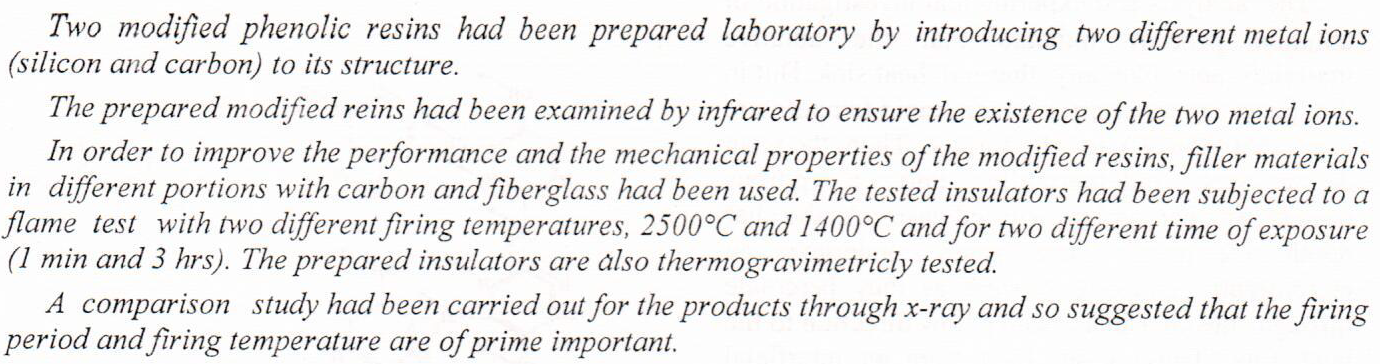
Isolation Behavior of Metal Modified Novolac Resin

The studies on unbonded post-tensioned concrete members strengthened with Carbon Fiber Reinforced Polymers (CFRPs) are limited and the effect of strengthening on the strain of unbonded pre-stressed steel is not well characterized. Estimating the flexural capacity of unbound post-tensioned members using the design methodology specified in the design guidelines for FRP strengthening techniques of bonded post-tensioned members does not provide a reliable evaluation. This study investigates the behavior of unbonded post-tensioned concrete members with partial strand damage (14.3% and 28.6% damage) and strengthened with CFRP laminates using a near-surface mounted technique with and without U-wrap anchorages. The experimental results show
... Show More (14)
(14)

The child realize that the meals time provide golden opportunities to get the attention the child needs. However, many difficulties that may appear about eating food can be avoided, if the family used the right way in dealing with this problem. The study aims, in this case, at searching for the reasons that lies behind the child's obstinacy in eating his food and the attempt to study some variables that is related to the research topic.
The results are summed up as follows:
This research aimed to examine the correlation and influence of leader-member exchange in the organizational citizenship behavior in the existence of organizational trust as mediator variable among workers in ministry of migration and displaced, has been collecting data and information relating to research by designing questionnaire was distributed to the stratified random sample included (56) member of the workers in the ministry mentioned, and through the use of several statistical method were the main findings of research was the existence of a correlation relationship and influence between leader- member exchange and organizational trust, while the results confirmed no correlation and influen
... Show More
Abstract
The research aims to identify the mediator role of workplace spirituality in the relationship between psychological capital and entrepreneurial behavior: field research to a sample opinions from employees at the center of the Iraqi ministry of Oil . The importance of the current research emerged from paucity of studies that have attempted to identify and know the nature of the relationship between the variables as well as trying to find the current address and realistic problem directly affects the performance of employees in the Iraqi oil sector.
In order to achieve the goal of research the use of the analytical method (quantitative)
... Show More
(1)
A theoretical and protection study was conducted of the corrosion behavior of carbon steel surface with different concentrations of the derivative (Quinolin-2-one), namely 7-Ethyl-4-methyl-1-[(4-nitro-benzylidene)-amino]-1H-quinolin-2-one (EMNQ2O). Theoretically, Density Functional Theory (DFT) of B3LYP/ 6-311++G/ 2d, 2p level was carried out to calculate the geometrical structure, physical properties and chemical inhibition chemical parameters, with the local reactivity in order to predict both the reactive centers and to know the possible sites of nucleophilic and electrophilic attacks, in vacuum and two solvents (DMSO and H2O), all at the equilibrium geometry. Experimentally, the inhibition efficiencies (%IE) in (3.5% NaCl)
... Show More (17)
(6)
(17)
(6)


A new series of Fe (III) , Co (II) , Ni (II) and Cu (II) complexes of the Schiff base, 5 (2-hydroxy benzylidine) -2-thio ether -1, 3, 4-thiadiazole were prepared and characterized .The imine behaves as a bidentate. The nature of bonding and the stereochemistry of the complexes were deduced from metal analyses, infrared, electronic spectra,magnetic susceptibility and conductivity measurements, an octahedral geometry was suggested for all complexes except the copper complex has a square planar geometry .preliminary in vitro tests for antimicrobial activity show that all the prepared compounds except iron complex display good activity to gram positive Staphelococcus aures and gram negative Escherchia coli.
Six mixed ligand complexes were prepared from malonic acid (MA), nicotinic acid (NA), and 2-aminopyridine (AP) in a (1:1:1:1) molar ratio (M: MA: NA: AP.), using aqueous ethanol as a reaction medium. The prepared compounds were analyzed by flame atomic absorption, (C.H.N.) analysis, and FTIR, UV-Vis, and mass spectroscopy, as well as conductivity measurement and magnetic susceptibility studies. Based on the combined analytical data, the prepared complexes were proposed to adopt an octahedral geometry. A urinary tract infection (UTI) is a bacterial infection that affects any part of the urinary tract. The emergence of antibiotic-resistant bacteria and fungi has led to poor patient outcomes and limited treatment options, prompting int
... Show More
(32)
(30)
Abstract: Mixed ligand Mn(II), Co(II), Ni(II), Cu (II), Zn(II), and Cd(II) complexes with (TMAP) Schiff base ligand and (8HQ) have been composition and analyzed. Diagnosis by, melting point, solubility, Electronic, mass and IR-spectroscopic studies, conductivity elemental, thermoanalytical analysis displayed the forming of mononuclear complexes. Spectral studies results suggest an octahedral system or the metal (II) mixed complexes. The detainments of molar conductance of the mixed complexes in DMF coincide to electrolytic nature of the mixed complexes, consequently, these complexes could be subedited as [M(TMAP)(8Q)(H2O)]nX.yH2O (M=Co(II) and Cu(II) complexes(where n = 1, y = 0 ); [M(TMAP)(8Q)(H2O)]nX.yH2O (M = (where n = 1, y = 1 for Ni(
... Show More